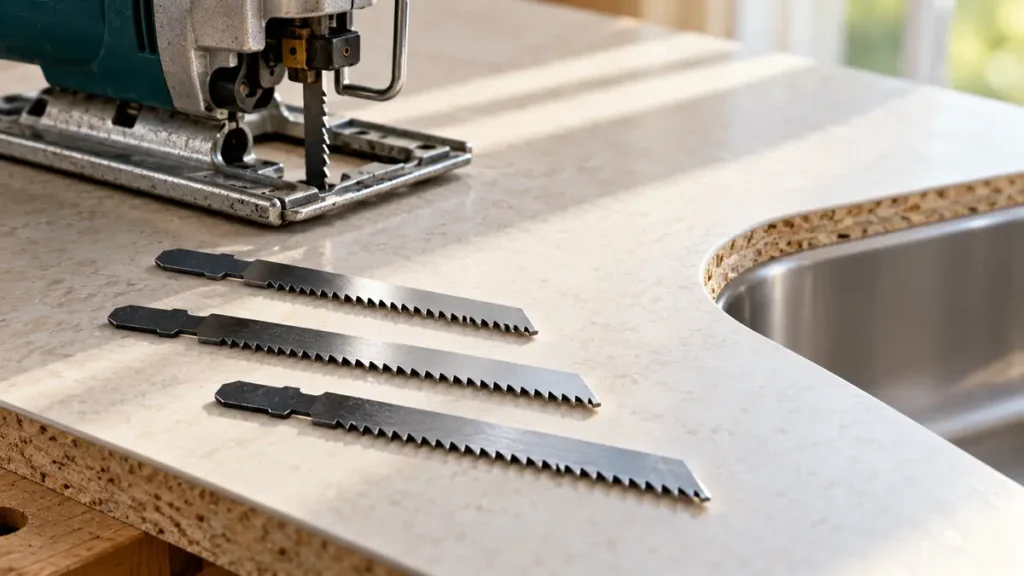
Laminate countertops can look deceptively easy to cut. The surface is thin, hard, and prone to chipping, while the substrate underneath may behave more like wood. A general-purpose wood blade can get through the panel, yet leave a ragged edge, lift the decorative layer, or wander as the cut continues. The best jigsaw blade for laminate countertop work needs a tooth pattern and cutting direction suited to laminate, plus a shank that matches your jigsaw.
Blade choice becomes especially important around sink cutouts, short backsplash returns, and other areas where a rough edge is difficult to hide. Fine teeth generally favor cleaner cuts, while down-cut or reverse-tooth designs can help keep the visible top surface neater. Carbide blades are aimed at abrasive laminate and offer a longer-wearing option, while bi-metal and high-speed-steel blades can make sense for routine projects where you need several replacements. T-shank compatibility is common among newer jigsaws, but older tools may require U-shank blades.
This comparison focuses on documented laminate applications, tooth counts, cutting direction, blade construction, pack variety, and shank style. Some selections are specialized countertop-style laminate blades, while others are useful sets for shoppers who also cut wood or need a curved sink opening. The Bosch T128BHM3 earns the strongest overall position because its carbide construction, 14 TPI design, thin kerf, and laminate-specific purpose create a particularly close match for demanding laminate work.
Quick Answer
Best Overall: BOSCH T128BHM3 is the most focused choice for laminate because it combines carbide teeth, a 14 TPI pattern, a thin kerf, and a design intended for high-pressure laminates.
Best for Down-Cutting: DEWALT DW3762H uses a reverse-cut, 10 TPI configuration intended to keep the visible surface under the workpiece cleaner during laminate cuts.
Best for Curved Cuts: BOSCH T101AOF uses 20 TPI bi-metal blades intended for scroll and curved laminate cuts, making it a practical option for sink openings and rounded details.
Best Mixed-Material Set: Bosch T11C adds laminate, wood, and metal blade types while including a carbide laminate blade and a storage case.
Best Jigsaw Blade for Laminate Countertop Comparison Table
| Product | Best For | Construction | Tooth Design |
|---|---|---|---|
| BOSCH T128BHM3 | Overall laminate work | Carbide | 14 TPI, thin kerf |
| DEWALT DW3762H | Clean top-surface cuts | High-speed steel | 10 TPI, reverse cut |
| BOSCH T503 | Laminate and hardwood projects | Bi-metal | Laminate and hardwood blades |
| DEWALT DW3712H | U-shank jigsaws | High-carbon steel | 10 TPI, down-cut |
| Diablo DJT505 | Mixed laminate cuts | Bi-metal | 14 and 20 TPI |
| Bosch T11C | Laminate and mixed materials | Mixed, including carbide | Multiple blade types |
| Diablo DJT128BHM | Single-blade carbide use | Carbide | 14 TPI, bi-directional |
| BOSCH T101AOF | Curves and scroll cuts | Bi-metal | 20 TPI |
| Bosch TPW005 | Laminate and general woodwork | Mixed blade set | Includes laminate and reverse-pitch blades |
The detailed reviews below explain where each blade fits, which jigsaws it suits, and what trade-offs matter for laminate countertop work.
1. BOSCH T128BHM3 3 Pc. 3.62 In. 14 TPI Carbide Teeth T-Shank Jig Saw Blades for Laminates — Best Overall

Laminate countertop work rewards a blade that is purpose-built for the hard decorative surface rather than a generic wood cutter. The Bosch T128BHM3 is the closest match in this group because its listing identifies it specifically for laminates and high-pressure laminates. Its carbide teeth are intended for longer service than standard bi-metal construction, while the 14 TPI pattern favors a fine, controlled cut rather than an aggressive rough cut.
The thin kerf is useful around sink openings and appliance cutouts, where a narrow cut can reduce material removal and help limit heat buildup. Its bi-directional tooth design is described as producing a clean cut on both sides of the workpiece, a helpful trait when the countertop must be handled carefully after cutting. This is a T-shank blade, so the jigsaw must accept that interface. A homeowner making one sink opening may have more blade life than needed, while a remodeler cutting several laminate panels has a stronger reason to choose carbide.
Pros
- Carbide construction is intended for abrasive laminate materials.
- 14 TPI tooth pattern favors a fine laminate cut.
- Thin kerf can reduce material removal and heat buildup.
- Bi-directional teeth are intended to improve finish quality on both sides.
- T-shank design suits jigsaws with a compatible T-shank holder.
Cons
- Limited to T-shank jigsaws rather than U-shank-only tools.
- Specialized carbide construction may be more blade than a one-off project requires.
This is the strongest selection for buyers who want one focused laminate blade type for a countertop, worktop, or similar high-pressure laminate cut. It is especially compelling where edge quality and wear resistance matter more than having a broad assortment. Buyers planning tight curves should still check the blade shape and turning requirements, since a laminate-focused straight-cut blade is not automatically a scrolling blade.
To buy this product, click here.
2. DEWALT DW3762H 4-Inch 10 TPI Laminate Down Cutting HSC T-Shank Jig Saw Blade — Best for Down-Cutting

A down-cut blade approaches the workpiece from a different angle than a conventional upward-cutting blade. The DEWALT DW3762H is a useful choice for a laminate countertop layout where the visible finished surface faces upward and the cut is made from below, or where the work setup benefits from teeth pushing toward the surface. The listing identifies it as a reverse-cut laminate blade with a 10 TPI pattern and high-speed-steel construction.
Its reinforced teeth and side chip path are aimed at durability and debris removal. The 4-inch blade length provides a practical format for countertop work, although the usable cutting depth depends on the material and the jigsaw setup. This product comes as a five-blade pack, which suits a project where a blade may be consumed by abrasive laminate or where a spare should remain in the toolbox. The T-shank interface is a key checkpoint before ordering.
Pros
- Reverse-cut design is intended for laminate down-cutting.
- 10 TPI pattern offers a balance between tooth density and chip clearance.
- Reinforced high-speed-steel teeth are intended for longer service.
- Side chip path helps move debris away from the cutting area.
- Five-blade pack provides useful replacements for project work.
Cons
- 10 TPI is less fine than the 14 and 20 TPI options in this roundup.
- Requires a compatible T-shank jigsaw and the correct workpiece orientation.
Choose this blade if the top face of a laminate countertop is your visual priority and a down-cut configuration fits your cutting method. It is less specialized than the Bosch carbide option, yet the five-pack can be practical for repeated installations. Keep the blade direction in mind before cutting, since down-cut teeth affect chip movement and how the jigsaw presses against the material.
To buy this product, click here.
3. BOSCH T503 3-Piece Hardwood and Laminate Flooring T-Shank Jig Saw Blade Set — Best for Laminate and Hardwood

The Bosch T503 takes a broader approach than a single-purpose laminate blade. Its three-piece set includes two T101BF clean-for-hardwood blades and one T101AOF blade identified for laminate. That mix can make sense during a kitchen renovation where the same jigsaw moves from laminate countertop material to hardwood trim or flooring nearby. Bi-metal construction gives the set a durable foundation for general project use.
The blade assortment is also documented for straight and curved cuts in hardwood and laminated flooring. That does not make every blade equally suitable for a countertop sink opening, but it gives the buyer more flexibility than a pack of identical straight-cut blades. Since the set uses T-shanks, it fits only jigsaws that accept that interface. Its laminate blade is the reason it qualifies here, while the hardwood blades add useful reach for surrounding woodworking tasks.
Pros
- Includes a blade specifically identified for laminate.
- Two additional blades support hardwood work.
- Bi-metal construction offers a practical general-purpose format.
- Blade types are intended for straight and curved cuts.
- T-shank design suits many modern jigsaws with that holder.
Cons
- Only one of the three blades is specifically identified for laminate.
- The set does not provide the carbide construction of the top-ranked options.
This set is a sensible pick for a homeowner who expects the countertop project to spill into flooring, cabinet trim, or hardwood work. A dedicated laminate blade may be preferable for repeated countertop installations, but the T503 avoids leaving two unused specialty blades in a drawer after one small job. Match each blade to its stated application rather than treating the set as interchangeable.
To buy this product, click here.
4. DEWALT DW3712H 4-Inch 10 TPI Laminate Down-Cutting U-Shank Jig Saw Blades — Best for U-Shank Jigsaws

Blade interface can eliminate an otherwise suitable product before cutting begins. The DEWALT DW3712H is the specialized option here for U-shank jigsaws, with a 4-inch, 10 TPI down-cutting blade identified for laminate. That makes it relevant for older or specific jigsaw designs that do not accept the more common T-shank format.
The high-carbon-steel construction and five-blade pack give this selection a straightforward project profile. Its down-cut arrangement can help keep the visible face cleaner when the cutting direction and workpiece setup are correct. The 10 TPI pattern is less fine than the Bosch 20 TPI curved-cut blade, so it is better viewed as a practical laminate cutter for accessible cuts rather than a dedicated tight-radius solution.
Pros
- Designed for U-shank jigsaws.
- Down-cut tooth direction is intended for laminate work.
- 4-inch blade format suits common countertop cutting tasks.
- 10 TPI pattern provides a useful chip-clearing configuration.
- Five-blade pack supplies replacements for a multi-cut project.
Cons
- U-shank compatibility excludes many T-shank-only jigsaws.
- High-carbon-steel construction is less specialized than carbide options.
This blade earns its place through compatibility rather than broad versatility. If your jigsaw requires a U-shank, the choice is more meaningful than comparing tooth counts alone. Confirm the tool’s blade holder before buying, then use a supported workpiece and a careful feed rate, especially around a sink opening where a blade can be pulled off line.
To buy this product, click here.
5. Diablo DJT505 Bi-Metal Jig Saw Blade Set for Laminated Materials — Best for Mixed Laminate Cuts

The Diablo DJT505 covers two useful tooth densities, 14 TPI and 20 TPI, across a five-piece bi-metal set. That range gives a countertop installer or DIY user room to match the blade to the cut rather than relying on a single pattern for every laminate task. The product is identified for laminated materials, and its ultra-hardened cutting edge is intended for abrasive cutting conditions.
The T-shank design is listed as fitting all combo and most U-shank jigsaws, but buyers should still verify the specific holder because broad compatibility wording does not replace a tool check. The combination of 14 and 20 TPI is particularly useful for separating general laminate cuts from situations where a finer tooth pattern is preferred. This set is more adaptable than a single specialty blade, although it does not provide the carbide construction found in the Bosch and Diablo carbide picks.
Pros
- Includes both 14 TPI and 20 TPI blade options.
- Bi-metal construction is suited to demanding laminate applications.
- Five-piece set offers useful selection without unrelated blade types.
- T-shank format is listed for broad jigsaw compatibility.
- Useful for both DIY repairs and repeated laminate cutting.
Cons
- Bi-metal teeth do not offer the carbide construction of the specialty carbide blades.
- Compatibility should be confirmed rather than assumed from the broad fit claim.
Pick the DJT505 if you want a flexible laminate set and expect different cut shapes or material conditions. The finer 20 TPI option may suit detail-oriented work, while 14 TPI gives a less restrictive choice for ordinary cuts. Buyers who already know they want maximum wear resistance may prefer a carbide blade instead.
To buy this product, click here.
6. Bosch T11C 11-Piece Laminate, Wood, and Metal T-Shank Jig Saw Blade Set — Best Mixed-Material Set

The Bosch T11C is aimed at a toolbox rather than a single countertop cut. It includes multiple blade types for laminate, wood, and metal, plus a premium T128BHM carbide blade. That carbide blade is the key reason this set remains relevant for laminate countertops, while the additional blades can help with cabinet panels, trim, and other renovation materials.
The set also includes a storage case, which is a small but practical advantage when fine laminate blades need to remain separated from rougher wood or metal blades. Its T-shank design is listed as fitting over 90 percent of current jigsaw makes and models, though the exact tool still needs checking. The wider assortment adds flexibility, yet it also means buyers must identify the correct blade before cutting rather than grabbing the first one in the case.
Pros
- Includes a carbide T128BHM blade for high-pressure laminate.
- Provides blade types for laminate, wood, and metal.
- Storage case helps organize and transport the assortment.
- Bi-directional carbide tooth geometry is intended for clean cuts on both sides.
- T-shank interface suits many current jigsaws.
Cons
- Several blades are intended for materials other than laminate.
- The larger assortment requires careful blade selection for each cut.
This set is a strong fit for a renovation toolbox where a laminate countertop is one project among several. It offers a specialized carbide option without forcing the buyer to purchase a separate wood and metal assortment later. For a single countertop installation, the focused T128BHM3 may be simpler and easier to evaluate.
To buy this product, click here.
7. Diablo DJT128BHM 3-5/8-Inch 14 TPI Carbide Jig Saw Blade for Laminate — Best Single Carbide Blade

The Diablo DJT128BHM takes the focused carbide route. Its 14 TPI tooth pattern, 3-5/8-inch length, and laminate-specific description make it a close match for shoppers who want one specialty blade rather than a mixed pack. Carbide teeth are intended to handle abrasive laminate, while the bi-directional geometry is listed for clean finishes on both the top and bottom surfaces.
A non-stick Perma-SHIELD coating is intended to reduce heat and friction while limiting pitch buildup. Those claims describe the blade’s construction and intended behavior, rather than a guarantee of a flawless countertop edge. The T-shank format is listed as fitting all combo and most U-shank jigsaws, but a physical holder check remains sensible. Its compact specialty profile is appealing for a sink cutout or countertop opening where the blade’s material focus matters more than broad assortment variety.
Pros
- Carbide tooth design is intended for laminate material.
- 14 TPI pattern suits fine laminate cutting.
- Bi-directional teeth are intended to improve finish quality on both faces.
- Perma-SHIELD coating is intended to reduce heat, friction, and buildup.
- 3-5/8-inch length offers a focused specialty format.
Cons
- Single-blade format provides no spare in the package.
- T-shank compatibility still needs to be checked against the specific jigsaw.
The Diablo is a logical alternative to the Bosch carbide blade for buyers who prefer its coating and compact 14 TPI format. It is best suited to users who have a specific laminate cut in mind and do not need hardwood, metal, or scrolling blades. Keep a spare blade available if the project involves several openings or a particularly abrasive laminate surface.
To buy this product, click here.
8. BOSCH T101AOF 5-Piece 20 TPI Special for Laminate T-Shank Jig Saw Blades — Best for Curved Cuts

Sink openings often involve rounded corners rather than a single long, straight cut. The Bosch T101AOF is the specialist for that situation because its product information identifies it for scroll or curved cuts in laminate flooring and other abrasive materials. Its 20 TPI bi-metal construction favors a fine tooth pattern, while the 3-1/4-inch blade length gives it a compact format for controlled curved work.
That focus makes the T101AOF different from the carbide blades ranked above. It is not the first choice for maximum wear life or broad countertop production, but the curved-cut purpose is meaningful when a template includes radiused corners. The five-piece pack also provides replacements if a detailed cut takes longer than expected. T-shank compatibility must be confirmed before purchase, and the blade should be matched to the thickness and shape of the material rather than forced around a tight turn.
Pros
- Designed for scroll and curved cuts in laminate.
- 20 TPI pattern supports fine cutting work.
- Bi-metal construction provides a durable specialty format.
- 3-1/4-inch length suits detailed curved layouts.
- Five-piece pack provides useful replacements.
Cons
- Curved-cut focus makes it less suitable as a general straight-cut blade.
- Does not use carbide construction for maximum abrasive-material life.
Choose this Bosch set for rounded sink corners, small radii, and laminate projects where maneuverability matters more than fast straight cutting. A wider or more aggressive blade may be easier for a long countertop edge, while this 20 TPI option earns its place through its stated curved-cut purpose.
To buy this product, click here.
9. Bosch TPW005 5-Piece T-Shank Jig Saw Blade Set for Pro-Wood — Best for Laminate and General Woodwork

The Bosch TPW005 is a mixed set with a useful laminate blade alongside options for ordinary wood, clean hardwood cuts, and reverse-pitch work. Its listed contents include a T101A0 reverse-pitch clean-for-wood blade, a T101C basic wood blade, a T101BR clean-for-wood blade, a T101BIF laminate blade, and a T101BF clean-for-hardwood blade. That combination is practical for a countertop project that also involves cabinet parts or trim.
The laminate blade gives the set its place in this roundup, while the reverse-pitch option addresses a different surface-finish concern on wood. The product uses a T-shank design and is listed as fitting over 90 percent of current jigsaw makes and models, but buyers should still compare the holder with the tool. This is a general workshop set rather than a dedicated carbide countertop pack, so its appeal rests on useful variety.
Pros
- Includes a blade specifically identified for laminate.
- Provides separate options for wood and hardwood.
- Reverse-pitch blade adds a clean-surface choice for woodwork.
- T-shank design suits many current jigsaws.
- Five blade types cover several common renovation tasks.
Cons
- Only one blade is specifically intended for laminate.
- It lacks the carbide construction offered by the leading laminate specialists.
This set suits a homeowner who wants one compact assortment for a laminate countertop and nearby woodworking. It is easier to justify than a large mixed-material case when metal cutting is not part of the plan. For repeated laminate production or abrasive high-pressure laminate, a dedicated carbide blade remains the more focused choice.
To buy this product, click here.
Buying Guide
Confirm the Jigsaw Shank
Start with the blade holder on your jigsaw. T-shank blades dominate the selection above, including the Bosch and Diablo specialty blades, while the DEWALT DW3712H is specifically intended for U-shank tools. A blade can be excellent for laminate and still be unusable if its mounting interface does not match the saw. Check the tool documentation or existing blade before ordering, particularly with an older jigsaw.
Match the Tooth Pattern to the Cut
Tooth count should support the kind of cut you are making. The 10 TPI DEWALT blades provide a less fine pattern than the 14 TPI carbide options and the 20 TPI Bosch curved-cut blade. Fine teeth can suit detail-oriented laminate work, while a less dense pattern may provide more room for debris between teeth. No single TPI figure is automatically correct for every countertop thickness or cut shape.
Choose Down-Cut, Reverse, or Conventional Geometry Carefully
Down-cut and reverse-cut designs direct tooth action differently from standard blades. They can be useful when the visible laminate face needs particular attention, but the workpiece orientation and cut direction still matter. The DEWALT DW3762H and DW3712H are down-cut laminate blades, while the Bosch T101AOF is aimed at curved cuts. Follow the blade’s stated application instead of assuming that every reverse-tooth product behaves the same way.
Compare Carbide and Bi-Metal Construction
Carbide blades such as the Bosch T128BHM3 and Diablo DJT128BHM are focused on abrasive laminate and are intended to last longer than standard bi-metal blades according to their product information. Bi-metal sets, including the Bosch T503 and Diablo DJT505, can offer a more flexible balance for buyers cutting laminate and wood. Carbide is attractive for repeated or demanding work, while a bi-metal assortment may make more sense for a mixed renovation list.
Check Blade Length and Cut Shape
The listed blade lengths range from the 3-1/4-inch Bosch T101AOF to the 4-inch DEWALT laminate blades. A longer blade is not automatically better, since cutting control also depends on the workpiece and the jigsaw. Curved sink corners may favor a blade intended for scrolling, while a long straight edge may favor a dedicated laminate blade with a more conventional profile. Keep the blade length appropriate for the material thickness and cutting layout.
Decide Whether a Set Adds Real Value
A set is useful when its blade types match the jobs in your workshop. The Bosch T11C adds wood and metal blades around its carbide laminate blade, while the Bosch TPW005 concentrates on laminate and wood. A large assortment can be convenient, but it also requires sorting and correct blade selection. For one countertop cut, a focused three-piece or single-blade option may be easier to use.
Support the Countertop and Protect the Finish
Blade selection cannot compensate for a poorly supported workpiece. Secure the laminate countertop so the cut line remains stable, mark the opening carefully, and use the blade direction that fits the visible surface and your cutting method. Keep the jigsaw base flat and avoid forcing the blade through a corner. Dust and chips can obscure the line, so clear the cutting area as needed while following the tool and blade manufacturer’s operating guidance.
Use the procedure for cutting a laminate countertop to support the cutout and plan the entry holes.
Best Jigsaw Blade for Laminate Countertop FAQ
What Is the Best Jigsaw Blade for Laminate Countertop Work?
The BOSCH T128BHM3 is the strongest overall match in this comparison. It is identified for laminates and high-pressure laminates, uses carbide teeth, has a 14 TPI pattern, and features a thin kerf. The Diablo DJT128BHM is a close alternative with a similar carbide and 14 TPI focus.
Are T-Shank Blades Compatible With Every Jigsaw?
No. T-shank blades require a jigsaw holder that accepts the T-shank interface. Many newer jigsaws use this format, but older or specific tools may require U-shank blades. Check the saw’s documentation or compare the mounting end of your existing blade before ordering.
Should I Use a Down-Cut Blade on a Laminate Countertop?
A down-cut blade can be useful when the visible surface needs particular protection from upward tooth action. The DEWALT DW3762H and DW3712H are listed as laminate down-cut blades. Your workpiece orientation and cutting plan still matter, so follow the blade’s intended direction and make sure the tool remains stable.
Is Carbide Better Than Bi-Metal for Laminate?
Carbide is the more specialized construction in this selection and is intended for longer service in abrasive laminate applications. Bi-metal blades can be a practical choice for mixed laminate and wood work, especially in sets with multiple tooth patterns. The better choice depends on whether repeated laminate cutting or broader workshop flexibility is the priority.
Which Blade Is Best for a Curved Sink Opening?
The BOSCH T101AOF is the most directly focused option here because its product information identifies it for scroll and curved cuts in laminate. Its 20 TPI bi-metal blades and 3-1/4-inch length suit detailed work. A curved-cut blade still needs appropriate support, a suitable radius, and controlled feed pressure.
Can I Use a Laminate Blade on Hardwood?
Do not assume that a blade listed for laminate is automatically the right choice for hardwood. Some sets, such as the Bosch T503 and TPW005, include separate laminate and hardwood blades. Match the blade to the material designation and use a separate hardwood blade when the product information distinguishes the applications.
How Many Teeth per Inch Should a Laminate Blade Have?
The products in this comparison range from 10 to 20 TPI. A 10 TPI blade offers more space between teeth, while 14 and 20 TPI options provide progressively finer tooth patterns. Material thickness, cut shape, desired finish, and the blade’s own design all affect suitability, so TPI should be considered with the complete blade specification.
Final Verdict
The BOSCH T128BHM3 is the best overall choice for laminate countertop work because its documented purpose, carbide teeth, 14 TPI configuration, thin kerf, and bi-directional tooth design create a focused package for abrasive laminate. It is the selection to prioritize for a sink cutout or countertop installation where blade construction and a clean cutting approach matter more than a broad assortment.
The DEWALT DW3762H is a useful alternative for down-cut work and repeated projects, while the Diablo DJT128BHM offers another focused carbide option. The Bosch T101AOF is the better fit for curved laminate details, and the Bosch T11C makes more sense for a renovation toolbox that also needs wood and metal blades. Before buying, match the shank to your jigsaw, select the tooth geometry for the cut shape, and support the countertop securely. The right blade improves the starting point, but careful layout and controlled cutting still determine the finished opening.
