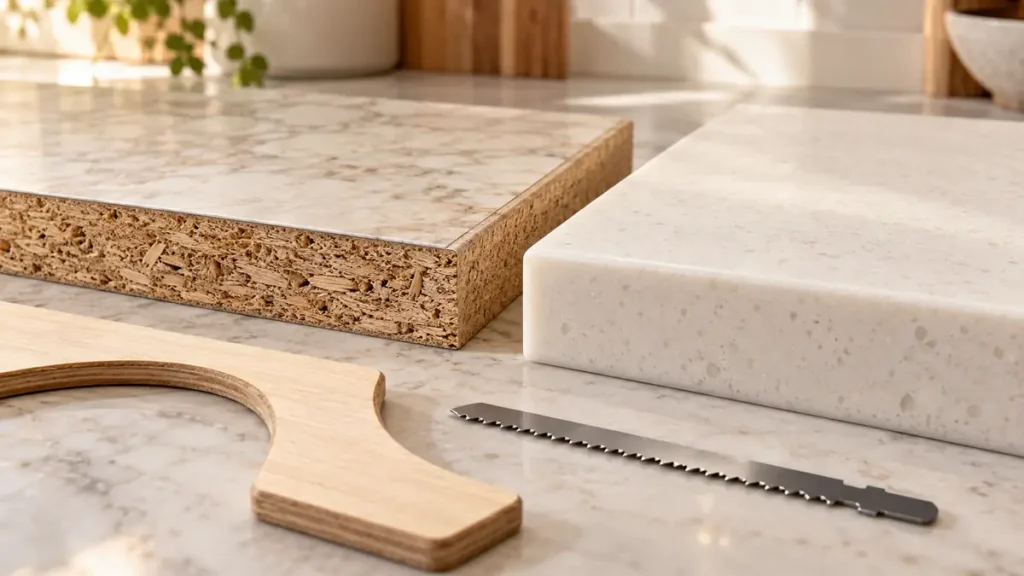
Laminate and solid-surface countertops need different cutting decisions. Laminate usually combines a decorative surface with a wood-based core; solid surface commonly uses a mineral-filled resin sheet. A jigsaw blade rated for one does not establish suitability for the other, and the countertop manufacturer’s fabrication instructions determine whether a jigsaw is appropriate for the particular cutout. For a permitted solid-surface application, compare jigsaw blades for solid-surface countertops by the exact material rating. Confirm the cutting method before selecting the blade, especially around sinks and heat-generating appliances.
Identify the Countertop Before Planning the Opening
Use the product paperwork, supplier information or an exposed edge to establish the construction. Surface appearance is not enough: a stone-look pattern can appear on laminate, solid surface or engineered quartz, which require different processes.
| Countertop construction | Selection starting point | Method to confirm |
|---|---|---|
| Decorative laminate over a wood-based core | Blade rated for the core and finished surface | Cutout support, corner treatment and exposed-core sealing |
| Mineral-filled resin solid surface | Dedicated solid-surface rating | Brand-specific cutting and finishing requirements |
| Engineered quartz | Specialized fabrication system | Do not apply a wood or solid-surface jigsaw method |
| Natural stone | Stone-specific fabrication | Appropriate tools, support and dust-control process |
| Unknown installed top | Product identification | Resolve construction and hidden services before cutting |
Do not make a trial cut in an installed countertop merely to identify it. Establish the material before altering a finished surface.
Separate the Surface Pattern from the Construction
A stone-look pattern tells you little about what the blade will meet. Look for product paperwork, an exposed edge or confirmation from the supplier. Do not assume that a heavy top is quartz or that a uniformly colored top is a specific resin material. The correct fabrication guide depends on the actual product, not the showroom description.
For an installed top, identify seams, supports and services before altering anything. A cut can affect more than the immediate opening, including the strength of a narrow remaining section or the support required by an appliance. If the product cannot be established reliably, pause the cutting plan and resolve the construction rather than using the jigsaw as a diagnostic tool.
Laminate: Protect the Face and Support the Core
For a wood-core laminate top, compare laminate-countertop jigsaw blades against the total thickness and desired face quality. Tooth direction affects which face is more exposed to breakout. The shoe must remain supported, and the waste needs support so it does not tear away at the end. The decorative surface and the core create different concerns. A clean-looking top edge can hide a sloping cut below it. A well-shaped opening can still need treatment of the exposed core under the countertop maker’s instructions. Check the sink or appliance template rather than tracing the outer rim and assuming it is the cut line. The required opening, support, clearance and corner geometry come from the installed product’s specifications.
Distinguish the Rim from the Cutout Line
A sink or appliance’s visible outer edge is not normally enough information to define its opening. Use the supplied template and installation dimensions for the exact item. Check which line is the cut line, which marks the rim and which establishes clearance or support. A neat opening can still be wrong if those references are confused.
Before cutting, place the template against the cabinet arrangement and inspect underneath. Confirm that the proposed route clears structural parts and services, while leaving the support the installation requires. Check the final waste-support plan too. The last part of the cut should not depend on an unsupported center dropping away from a thin decorative surface and wood-based core.
Solid Surface: the Fabrication Method Comes First
A blade can carry a solid-surface rating while a particular countertop system requires a router for a finished opening. Corian’s cutting and cutout guidance, for example, describes routed cutouts and additional requirements for heat-generating appliances. Its instructions also distinguish making a template from making the opening in the countertop itself. That distinction matters. A jigsaw used to shape a plywood template is not proof that the same method is approved for the finished solid-surface top. Read the instructions for the exact brand, application and stage of fabrication. Where a jigsaw is permitted, check the blade’s stated material and thickness range, use the required corner treatment and leave the specified finishing allowance. Do not transfer a generic laminate setup to a mineral-filled resin sheet.
Do Not Transfer a Template-Making Step to the Countertop
Fabrication instructions can describe a jigsaw shaping a wood template and then a router using that template to form the finished solid-surface opening. Those are different materials and stages. Read the whole sequence before extracting a tool recommendation. The presence of a jigsaw in the instructions does not, by itself, approve a jigsaw-cut finished opening in the countertop.
Pay particular attention to corner treatment, edge finishing and requirements around heat-generating appliances. These details belong to the countertop system and the appliance installation, so a blade’s application label cannot replace them. Where the product permits a jigsaw operation, follow the defined purpose and subsequent finishing steps rather than treating it as interchangeable with every other opening-making method.
Stone and Quartz Are a Separate Branch
Do not group engineered quartz or natural stone with resin-based solid surface simply because each looks homogeneous from above. A dedicated solid-surface jigsaw blade is not a universal countertop blade. These materials require their own fabrication and dust-control methods. Identify the product and arrange the appropriate process rather than trying to extend the jigsaw’s role with a harder cutting edge. This is especially important for installed tops whose support, seams and services are already fixed.
Plan the Cutout as a Supported Assembly
Before any permitted cutting, identify the template, retained top, waste, supports and clearance underneath. Check for plumbing, electrical equipment and cabinet parts. The blade must not strike anything beneath the surface. A useful planning checklist is:
- The countertop material and product are identified.
- The sink or appliance template is the correct revision.
- The chosen method is permitted for that opening.
- Corner geometry and finishing requirements are understood.
- The waste will remain supported through separation.
- Dust controls and protective equipment suit the actual material.
For a wood-core laminate job, follow the separate guide to cutting a laminate countertop with a jigsaw for the operating sequence. Keep the material decision made here: a familiar opening shape does not make the countertop constructions interchangeable.
Check the Result Before Installing the Fixture
After the permitted cutting and finishing process, inspect the opening against the template and installation dimensions. Check the retained edge, corners, underside and support arrangement. Do not force the fixture into an undersized opening or assume its rim will conceal a structural or clearance problem. Mark the exact interference and correct it using the allowed method.
Keep the material-specific treatment requirements in the completion checklist. An exposed wood-based core can have different needs from a resin solid-surface edge. Clean debris without damaging the surface or introducing an unsuitable solvent. The finished result must satisfy the countertop and fixture instructions together, rather than merely appearing close to the drawn line from above.
