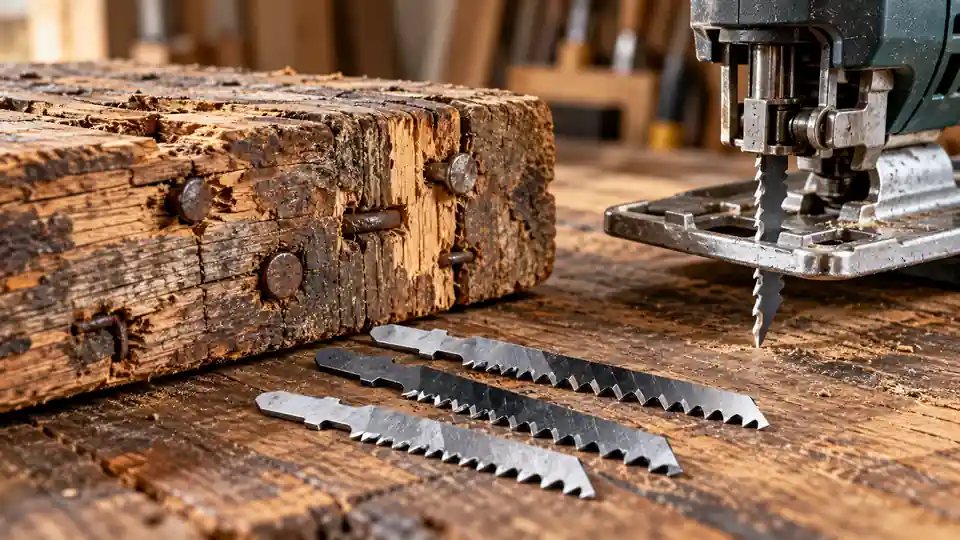
Wood with embedded nails calls for a blade designed to encounter both materials. A wood blade and a separate metal blade in the same case do not make the wood blade nail-resistant. Choose a mixed-material or demolition-rated profile and work within the tool’s capacity.
These four blades are intended for wood with nails or comparable mixed-material cuts. The Bosch T367XHM3 provides the carbide option, while the T345XF and T111CF offer bi-metal profiles. Remove visible fasteners where practical and support the work before making a controlled cut.
Quick Answer
Best Carbide Option: BOSCH T367XHM3. Carbide edge. 5-7 TPI progressive
Best Progressive Bi-Metal Blade: BOSCH T345XF. Bi-metal. 5-10 TPI progressive
Best Spyder Mixed-Material Option: Spyder 300098. 8% cobalt bi-metal. Not specified
Best Jigsaw Blades for Wood with Nails Comparison Table
| Product | Best For | Specifications / Compatibility | Key Features |
|---|---|---|---|
| BOSCH T367XHM3 | Best Carbide Option | Carbide edge | 5-7 TPI progressive |
| BOSCH T345XF | Best Progressive Bi-Metal Blade | Bi-metal | 5-10 TPI progressive |
| Spyder 300098 | Best Spyder Mixed-Material Option | 8% cobalt bi-metal | Not specified |
| BOSCH T111CF | Best Controlled Thin-Stock Blade | Bi-metal with HSS teeth | 8 TPI |
1. BOSCH T367XHM3 — Best Carbide Option

The T367XHM3 has the clearest match for demolition-style woodworking in this group. Its carbide-brazed edge is specifically described for wood containing nails and screws, and the listing states a longer service life claim compared with standard bi-metal blades.
Its 5-7 TPI progressive pattern combines smaller and larger teeth, while the 5-3/16-inch overall length gives it more reach than compact four-inch options. The exaggerated tip is intended to help with plunge cuts, useful when starting an opening inside a reclaimed board rather than from an exposed edge. Heat-optimized manufacturing and tooth geometry are also listed for heavy-duty use, although actual feed rate and life will depend on the wood, nail placement, and saw settings.
Pros
- Carbide edge is specifically listed for wood with nails and screws.
- Progressive 5-7 TPI pattern suits varied wood thicknesses.
- Exaggerated tip supports plunge-cut starts.
- Longer 5-3/16-inch overall length provides useful reach.
- T-shank interface suits compatible quick-change jigsaws.
Cons
- Three-blade pack offers less quantity for repeated demolition work.
- Carbide-edge construction is a specialized choice for buyers who mostly cut clean lumber.
This is the blade to choose when hidden fasteners are a recurring part of the job and replacing ordinary blades becomes tiresome. It also suits plunge openings in old boards, flooring, and renovation stock. Buyers who want a large supply of general-purpose blades may prefer the Bosch T345XF five-pack or a larger assortment, while those seeking the most direct documented nail-cutting match have the strongest case for this Bosch option.
To buy this product, click here.
2. BOSCH T345XF — Best Progressive Bi-Metal Blade

A five-pack of Bosch T345XF blades makes a sensible middle ground for cutting old framing pieces, plywood, and particle board where nails may appear without warning. The bi-metal construction is built for more abuse than a basic high-carbon steel blade, and the 5-10 TPI progressive tooth pattern is intended to handle different material thicknesses. The product information lists wood with nails, plywood, and particle board from 3/16 to 3-5/8 inches thick.
The 5-1/4-inch overall length and 4-1/4-inch working length give this blade useful reach for thick stock, while the milled, side-set teeth are listed for fast, general-purpose cutting. The same blade is also described for some metal and non-ferrous metal applications, but wood with nails remains its more relevant role here. A progressive blade can remove material briskly, though the edge may require more cleanup than a fine-tooth blade on visible joinery.
Pros
- Bi-metal construction is suited to interrupted cuts around nails.
- 5-10 TPI progressive teeth cover varied wood thicknesses.
- Listed for wood with nails, plywood, and particle board.
- 4-1/4-inch working length supports deeper cuts than short blades.
- T-shank design fits compatible Bosch-style jigsaws.
Cons
- Coarse progressive teeth are less focused on fine edge finishing.
- The listing does not provide a specialized carbide edge for the hardest nail-heavy stock.
This pack fits repair work where the board may contain a few old fasteners and the priority is keeping the cut moving. It is also a practical option for a homeowner who wants a dedicated nail-capable blade without committing to a large bulk pack. Choose the T367XHM3 for more specialized heavy-duty service, or move to a fine-tooth option when the cut edge will be highly visible.
To buy this product, click here.
3. Spyder 300098 — Best Spyder Mixed-Material Option

Renovation work can move from a nail-filled board to a metal bracket or thin aluminum piece in the same afternoon. The Spyder 300098 is aimed at that mixed-material reality. Its three blades use 8% cobalt bi-metal construction and are listed for steel, stainless steel, aluminum, and wood with nails. That broader material description gives this small set a different purpose from a wood-only assortment.
Each blade is listed at four inches overall, making the set more compact than the longer Bosch progressor blades. That can be useful for controlled work in tighter areas, but the available information does not provide a TPI figure, working length, or specific wood-thickness range. The T-shank interface is identified, and the product is described as compatible with major brands, but the exact acceptance of any particular saw should still be checked before purchase.
Pros
- Documented suitability for wood with nails.
- Also listed for steel, stainless steel, and aluminum.
- 8% cobalt bi-metal construction targets demanding materials.
- Compact four-inch overall blade length.
- T-shank format supports compatible jigsaws.
Cons
- Only three blades are included.
- TPI, working length, and wood-thickness limits are not specified in the product details.
This set makes the most sense in a repair kit that sees more than one material. A remodeler cutting through a nail-embedded board near a metal fitting may appreciate that breadth, while a woodworker doing repeated thick-stock work will get more guidance from the Bosch T345XF or T367XHM3. The missing tooth specification means buyers should avoid assuming it has the same feed behavior as a listed progressive blade.
To buy this product, click here.
4. BOSCH T111CF — Best Controlled Thin-Stock Blade

The T111CF takes a more controlled approach than the coarse progressor blades above. Bosch lists it for wood with nails, OSB, and plastics from 3/16 to 1-1/4 inches thick. Its eight teeth-per-inch pattern, milled and side-set teeth, and stated straight-cut benefit make it a better fit for thinner boards where a fast, rough cut is not the only goal.
The four-inch overall length includes a three-inch working length, so this blade has a narrower intended range than the longer T345XF. Extra-hard high-speed steel teeth are paired with bi-metal construction, giving the blade a documented focus on durability. It is still a T-shank blade, and the saw must accept that interface. For thick reclaimed beams or heavy nail clusters, the shorter working length and moderate depth range are meaningful limits.
Pros
- Specifically listed for wood with nails and OSB.
- Eight TPI pattern supports a more controlled straight cut.
- Bi-metal construction improves suitability for interrupted cutting.
- High-speed steel teeth are described as extra hard.
- Clear working range of 3/16 to 1-1/4 inches.
Cons
- Three-inch working length limits use on thicker material.
- Less appropriate for deep, aggressive demolition cuts than a progressor blade.
Use this Bosch when the reclaimed material is relatively thin and the cut line deserves more control. It may suit an OSB repair panel or a board with occasional nails better than a very coarse blade. Thick stock, repeated plunge cuts, and dense fastener clusters call for a longer or carbide-edge option instead.
To buy this product, click here.
Buying Guide
Match the named material
Use a blade rated for the actual board, not just one that fits the clamp. Material-specific tooth construction matters in abrasive boards.
For the differences between solid wood, MDF, OSB and particleboard, use the guide to blade selection for wood and engineered boards.
Check usable length
The blade must clear the full thickness throughout its stroke. Overall length and usable cutting length are different measurements.
Support the edge and waste
Clamp and support the material with clearance below the blade. A supported exit helps prevent the last section from breaking away.
Use the correct speed and feed
Follow the blade and saw recommendations. A suitable sharp blade and deliberate feed are more useful than forcing the teeth through the work.
Frequently Asked Questions
Does T-shank fit every jigsaw?
No. It fits compatible T-shank clamps. Check an older or unusual saw before ordering.
Will any carbide blade cut this material?
No. Carbide construction alone does not define the application. Match the named material and thickness rating.
Can I use a longer blade to increase saw capacity?
No. Stay within the tool’s rated capacity and choose sufficient usable blade length for the workpiece.
Final Verdict
BOSCH T367XHM3 is the best carbide option pick. Carbide edge. 5-7 TPI progressive
For progressive bi-metal blade, consider BOSCH T345XF. Bi-metal. 5-10 TPI progressive
