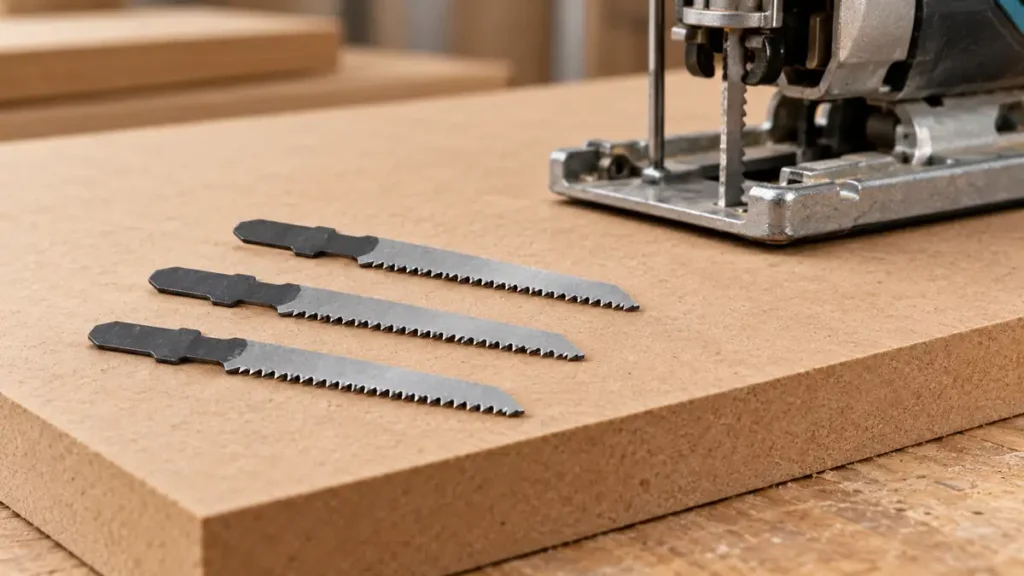
MDF can look deceptively easy to cut. Its dense, uniform core has none of the natural grain changes found in solid wood, yet a jigsaw can still leave fuzzy edges, chipped faces, or a rough curve if the blade is too aggressive. The right blade should match the job, whether you are cutting a cabinet panel, trimming a shelf, shaping a template, or opening a routed section in fiberboard. For this material, clean tooth engagement and a blade profile suited to the intended cut matter more than a large assortment by itself.
Many buyers make the same mistake: they choose a blade set because it contains the most pieces, then reach for a fast-cut blade designed for rough wood work. That can be useful for hidden cuts, but it is a poor match for visible MDF edges. Fine-tooth blades such as the T101AO profiles in this roundup are better suited to controlled curved work and clean finishes, while reverse-tooth or straight-cut options serve different purposes. Compatibility matters too. The products below use T-shank designs, but a T-shank blade still needs to match your jigsaw’s clamp and the thickness of the material.
Different buyers will prioritize different things. A cabinetmaker may want a dedicated fine-cut blade, a DIY user may prefer a mixed set with spare MDF-capable blades, and someone working on detailed shapes may need a narrow scrolling profile. The Bosch T101AO is the strongest focused choice for clean MDF curves, while the GINEPAN version offers more replacement blades in the same general cutting style. The rankings below compare those distinctions rather than treating every blade in a multipack as equally useful.
Quick Answer
Best Overall: BOSCH T101AO 5-Piece 3-1/4 In. 20 TPI Clean for Wood T-Shank Jig Saw Blades is the clearest match for MDF work that calls for clean, curved, or scrolling cuts. Its 20 TPI pointed-tooth profile and narrow body are specifically described for MDF, laminates, and similar sheet materials.
Best for Frequent Curved Cuts: GINEPAN T101AO 20-Piece Jigsaw Blades follows the same fine-cut concept with a larger supply of T101AO blades and a storage case.
Best for Mixed Workshop Use: 50 Piece Contractor Jigsaw Blades Set provides several wood-cutting profiles, including T101AO, T101B, and T101BR, so you can reserve fine blades for visible MDF and use other profiles for rougher work.
Best Jigsaw Blades for MDF Comparison Table
| Product | Best For | Shank and Material | Key MDF-Relevant Detail |
|---|---|---|---|
| BOSCH T101AO 5-Piece | Clean curved cuts | T-shank, HCS | 20 TPI, 3-inch length, narrow profile |
| GINEPAN T101AO 20-Piece | Frequent scrolling work | T-shank, high-carbon steel | 20 TPI, pointed teeth, 3-inch blades |
| 50 Piece Contractor Set | Mixed MDF and workshop tasks | T-shank, assorted construction | Includes T101AO, T101B, and T101BR |
| 20 Piece 10-Type Assortment | Mixed materials and occasional MDF | T-shank, HCS/HSS | Includes clean, reverse-tooth, and scroll profiles |
| Craluuur 30 Piece Set | Organized general-purpose use | T-shank, HCS/HSS | Includes T101AO, T101B, and T101BR |
| Leourae 54 Piece Set | Large blade variety | T-shank, HCS/HSS | Multiple T101 profiles and labeled case |
| DEWALT DW3741C 10-Piece | Wood and metal projects | T-shank, bi-metal/HCS | 6, 10, and 18 TPI assortment |
| T142HB 6-Pack | Flush and shaped cuts | T-shank, HCS | Special-shaped body for MDF and fiberboard |
| Romeda 10-Piece Assortment | Basic mixed-material cutting | T-shank, SK5 HCS | Includes T101AO, T101B, T101BR, and T244D |
The detailed reviews explain which blade profiles make sense for clean MDF faces, curved shapes, rough openings, and broader workshop use.
1. BOSCH T101AO 5-Piece 3-1/4 In. 20 TPI Clean for Wood T-Shank Jig Saw Blades — Best Overall

The Bosch T101AO is the most direct fit for MDF jobs where the edge will remain visible. Its 20 TPI pointed-tooth profile and narrow blade body are listed for MDF, laminated substrates, veneers, plywood, and hard and soft woods. That combination points toward controlled curves and scrolling rather than fast demolition-style cuts. Picture cutting a rounded speaker opening or shaping a small cabinet template. A narrow blade is easier to steer through that outline than a broad, coarse blade that wants to run straight.
The blade measures 3 inches in length, with a T-shank interface and a five-piece package. The pointed teeth are described as reducing splintering on both sides of the workpiece, although results still depend on support, feed pressure, blade condition, and the MDF thickness. The T-shank design also eliminates the set-screw mounting hole associated with older mounting styles. Buyers should still check their jigsaw’s clamp before ordering, especially with older tools. For a user who wants a focused MDF blade instead of a drawer full of unrelated profiles, this is the cleanest starting point.
Pros
- Documented suitability for MDF, laminates, and plywood
- 20 TPI pointed-tooth profile supports clean curved work
- Narrow blade body is suited to scrolling cuts
- 3-inch blade length provides a focused woodworking format
- T-shank design fits compatible jigsaws without a set-screw mounting hole
Cons
- Five-blade pack offers less variety than a mixed assortment
- Fine curved-cut profile is less suited to rapid rough cutting
This is the blade to choose for a visible MDF edge, a curved cutout, or detailed panel work where control matters more than speed. It is less compelling for someone who mainly makes long, rough cuts or needs blades for metal and plastic in the same case. Keep the blade moving steadily and support the sheet close to the cut line, since a fine profile cannot compensate for a poorly supported panel.
To buy this product, click here.
2. GINEPAN T101AO 20-Piece Jigsaw Blades — Best for Frequent Curved Cuts

GINEPAN takes the same basic T101AO direction and supplies it in a larger quantity. The listing describes these 3-inch, 20 TPI blades for curved and scrolling fine-finish cuts in MDF, laminated substrates, plywood, and hard or soft wood. That makes the set particularly practical for a project that involves repeated openings or several sheets. Instead of treating a fine blade as precious, you have replacements ready when the teeth become dull or a blade is damaged during a tight turn.
The pointed teeth are intended to reduce splintering on both sides of the workpiece, while the high-carbon steel construction is described as being processed for durability. The T-shank format is listed as compatible with many common jigsaw brands, but the product information does not replace checking your own tool manual. The supplied case is useful for storage, although the listing cautions that the small T101AO blades can move around inside it. That is a minor organizational nuisance rather than a cutting limitation, but it is worth knowing if a tidy toolbox matters.
Pros
- Explicitly listed for MDF and laminated substrates
- 20 TPI pointed teeth suit curved and scrolling cuts
- 20-piece quantity provides ample replacements
- T-shank format supports compatible Bosch, DEWALT, Makita, and similar jigsaws
- Storage case is included
Cons
- Blade case may allow the short blades to shift or scatter
- Dedicated T101AO assortment gives limited options for fast straight cuts
This set makes sense for a craft room, cabinet shop, or home workshop where MDF shapes appear regularly. It offers more breathing room than a five-piece pack while preserving the fine-cut focus. Choose another set if you want one case to cover rough wood, metal, aluminum, and detailed MDF with equal emphasis.
To buy this product, click here.
3. 50 Piece Contractor Jigsaw Blades Set — Best for Mixed MDF and Workshop Tasks
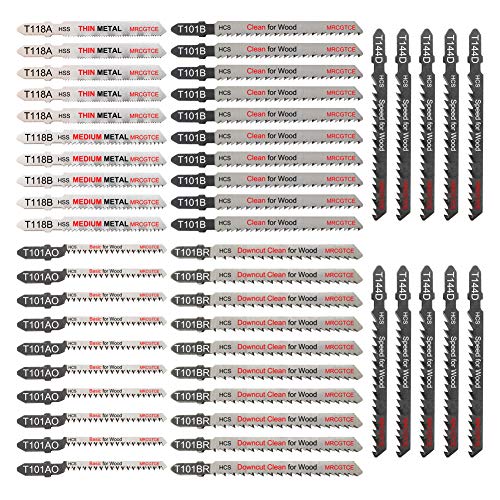
A large mixed set is useful when MDF is one part of a broader cutting routine. This assortment includes T101AO for fine curved work, T101B for a more conventional wood-cutting role, T101BR for reverse-tooth cutting, and T144D for faster wood cuts. It also includes T118A and T118B metal profiles. That spread lets a user keep the fine blade for a painted cabinet face, then switch to a faster profile for a rough opening hidden beneath trim.
The important distinction is that the 50-piece count does not make every blade equally suitable for MDF. The T101AO and T101BR options deserve the most attention for visible surfaces, while the faster profiles are better treated as task-specific tools. The T-shank format is intended for compatible jigsaws, and the supplied case gives the assortment a practical home. Buyers should identify the blade code before cutting rather than grabbing the first tooth pattern in reach, since the wrong profile can change the edge quality and control of an MDF cut.
Pros
- Includes several documented wood-cutting profiles
- T101AO gives the set a fine curved-cut option for MDF
- T101BR offers a reverse-tooth alternative for selected face-up cuts
- Metal-cutting blades add workshop flexibility
- Storage case keeps the large assortment together
Cons
- Large quantity can make blade selection less straightforward
- Some included profiles are intended for speed or metal rather than clean MDF edges
This is a sensible choice for a workshop where one jigsaw handles shelves, plywood, plastic, and occasional metal. It is less focused than Bosch or GINEPAN, so a user doing precision MDF work every day may prefer a dedicated fine-tooth pack. Its strength is flexibility, provided you read the shank markings and select the profile for the cut in front of you.
To buy this product, click here.
4. 20 Piece 10-Type T-Shank Jigsaw Blades Set — Best for Broad Material Coverage

This assortment is aimed at users who move between materials. For MDF, the relevant choices include T101AO, T101B, and T101BR. T244D, T144D, and T111D provide faster wood-cutting alternatives, while T118A and T118B are listed for basic metal and T127D for aluminum. The result is a compact box that can cover a garage project involving an MDF panel, a plastic fitting, and a small metal bracket without requiring separate blade purchases for every material.
The blades are described as using HCS and HSS construction, with clear markings on the shanks and divided storage slots. Those details matter in a busy workshop. A visible code reduces guesswork, and separated slots are easier to live with than a loose pile of nearly identical blades. Still, the MDF buyer should focus on the specific wood profiles rather than the metal capability. The fine or reverse-tooth options are the more relevant choices for face quality, while the aggressive wood profiles are better reserved for less visible cuts.
Pros
- Includes T101AO, T101B, and T101BR wood profiles
- Offers additional blades for metal and aluminum
- HCS and HSS construction covers different blade applications
- Printed markings simplify blade identification
- Divided storage case is included
Cons
- Only two T101AO blades are supplied
- Mixed material assortment requires careful profile selection for MDF
Choose this set if your jigsaw serves as a general workshop tool and MDF is one recurring material among many. It is a stronger all-rounder than a dedicated MDF pack, although it cannot provide the same depth of fine-cut replacements. The storage system and clear labels are useful for beginners who are still learning which blade shapes belong on the workbench for each cut.
To buy this product, click here.
5. Craluuur 30 Piece T-Shank Jigsaw Blades Set — Best for Organized General-Purpose Use

Craluuur’s 30-piece assortment places a useful number of MDF-capable profiles in a clearly organized package. It includes four each of T101AO, T101B, and T101BR, giving the user several ways to approach MDF work. The T101AO profile is the obvious choice for tighter curves, T101B is aimed at clean straight wood cuts, and T101BR provides a reverse-tooth option where reducing face splintering is a priority. The set also includes faster wood profiles and blades for basic metal and aluminum work.
The listing describes HCS and HSS construction, precision-ground teeth, and clear markings on each shank. Those specifications help with selection, but they should not be read as a promise of a perfect MDF edge in every situation. MDF thickness, support, feed pressure, and the jigsaw’s adjustment settings still influence the result. The case is the practical highlight for a mixed assortment because it keeps fine blades from disappearing under coarse ones, much like separating small drill bits from large masonry bits in a crowded toolbox.
Pros
- Four T101AO blades are included for curved MDF work
- Includes T101B and T101BR for different wood-cutting approaches
- HCS and HSS construction supports mixed applications
- Printed blade codes make selection easier
- Storage box keeps the assortment protected and sorted
Cons
- Mixed profiles are less focused than a dedicated MDF blade pack
- Metal and aluminum blades may remain unused by MDF-only buyers
This set is a good middle ground for someone who wants more replacements than a small specialty pack without moving to a very large assortment. It suits home renovation and furniture projects where MDF, plywood, and occasional metal appear in the same season. A specialist focused on repeated scroll cuts may still get more value from a box filled entirely with T101AO-style blades.
To buy this product, click here.
6. Leourae 54 Piece T-Shank Jigsaw Blades Set — Best for Blade Variety

The Leourae set supplies the widest selection among the ranked products, with nine blade types and 54 pieces. For MDF, the most useful groups are the T101AO, T101B, and T101BR profiles. The listing also identifies T244D for curved wood cuts and T144D for faster straight cuts. That gives a homeowner room to change approach as the project changes from a visible curved edge to a rough internal opening.
Clear markings and a reusable yellow case make the large assortment easier to manage. The listing specifically says the set is intended for standard T-shank jigsaws and is not compatible with tools that accept only U-shank blades. That warning is valuable because physical appearance alone is not a reliable compatibility check. A large supply is helpful for a busy shop, but the number of blades can also encourage indiscriminate selection. MDF buyers should identify the profile before fitting the blade, especially because the assortment includes metal and aluminum options that have a different purpose.
Pros
- Includes 10 T101AO blades for repeated curved work
- Provides T101B and T101BR options for straight and reverse-tooth cuts
- Includes T244D and T144D for other wood-cutting tasks
- Blade codes and use markings support quick identification
- Reusable storage case is included
Cons
- Requires a compatible T-shank jigsaw
- Large assortment may be excessive for occasional MDF cutting
This set suits a workshop that wants one broad blade inventory and has enough storage discipline to keep each type in its place. It is especially useful for users who cut MDF alongside plywood, solid wood, sheet metal, and aluminum. Someone buying specifically for a handful of clean MDF curves may find the dedicated Bosch or GINEPAN format simpler and more targeted.
To buy this product, click here.
7. DEWALT Jigsaw Blades Set DW3741C — Best for Wood and Metal Projects

The DEWALT DW3741C is a mixed T-shank set built around wood and metal applications. Its documented assortment includes bi-metal and HCS blades, with 6, 10, and 18 TPI options. The 18 TPI profile is the closest fit for a smoother MDF-oriented cut among the listed tooth choices, while the lower TPI blades are more relevant to faster or less delicate work. The set therefore earns its place through material flexibility rather than a specialized MDF tooth design.
For a homeowner repairing a cabinet one weekend and cutting a thin metal bracket the next, that range can be convenient. It also avoids filling a drawer with only one type of blade. However, the product specifications do not identify a dedicated MDF profile, blade length, or a specific reverse-tooth configuration. Buyers seeking highly controlled curves should therefore rank it below the Bosch and GINEPAN options. Check that your jigsaw accepts T-shank blades before purchase, since the blade interface remains the first compatibility requirement.
Pros
- T-shank design is suited to compatible jigsaws
- Includes both HCS and bi-metal blade construction
- 6, 10, and 18 TPI choices cover different cutting approaches
- Suitable for documented wood and metal applications
- Storage case is included
Cons
- No dedicated MDF-specific blade profile is identified in the product details
- The set provides less detail about blade dimensions and tooth geometry
Pick this set if MDF is part of a broader list of household and workshop materials. It is a weaker specialist choice for delicate curved panels, where a narrow 20 TPI scrolling blade gives clearer documented intent. Its appeal lies in keeping wood and metal options together, especially for users who prefer a recognized mixed-material assortment.
To buy this product, click here.
8. T142HB T-Shank Jigsaw Blades for Wood, 6 Pack — Best for Flush and Shaped Cuts
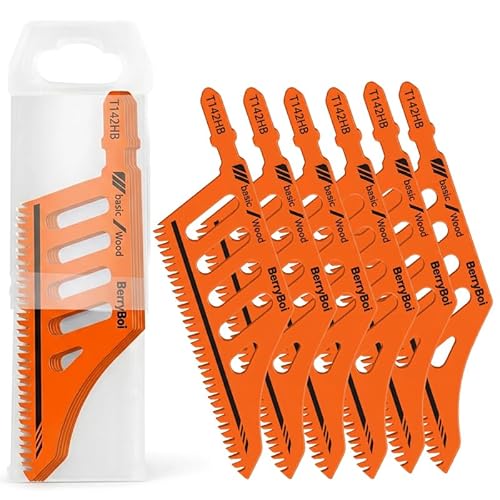
The T142HB set takes a different route from the fine T101AO blades. Its special-shaped body is listed for flush cuts, edge trimming, corner work, and shaped cuts in wood, plastic, fiberboard, and MDF. That makes it relevant for a task such as trimming a projecting MDF edge or working into a confined corner where a conventional blade shape may be awkward. The listing also describes a black-coated high-carbon steel construction intended to reduce friction and resist wear.
There is less specific information here about TPI, blade length, or the exact geometry of the teeth, so this is not the easiest product to rank for a fine visible edge. Its strength is the unusual body shape and the stated suitability for fiberboard-based materials. A user cutting a gentle curve through the middle of a panel may still prefer Bosch’s clearly documented 20 TPI scrolling profile. A user shaping an edge, making a flush trim, or handling a tight corner may appreciate the T142HB’s more specialized format.
Pros
- Listed for MDF and fiberboard applications
- Special-shaped body supports flush and edge-trimming work
- High-carbon steel construction is documented
- Black coating is intended to reduce friction and wear
- Standard T-shank format suits compatible jigsaws
Cons
- TPI and blade dimensions are not specified in the product details
- Six blades provide less reserve capacity than the larger assortments
This is the most application-specific alternative for flush or shaped MDF work. It should not replace a fine scrolling blade in a cabinetmaker’s kit, but it fills a different niche. Select it when the cut involves trimming, corners, or a special shape, and verify the blade’s dimensions against your tool and workpiece before starting.
To buy this product, click here.
9. Romeda 10-Piece Assorted T-Shank Jigsaw Blades — Best Compact Mixed Set

Romeda’s 10-piece set is a compact introduction to several common jigsaw profiles. The wood selection includes T101AO, T101D, T101B, T101BR, T144D, T244D, T111D, and T111C, while T118A and T118B are listed for basic metal cutting. For MDF, T101AO is the most relevant choice for a curved or detailed cut, T101B is aimed at a cleaner straight wood cut, and T101BR offers a reverse-tooth alternative.
The set is described as using SK5 high-carbon steel and a T-shank design that requires no mounting screw. The small assortment is easy to keep in a portable toolbox, and it avoids the storage burden of a 50-piece case. The tradeoff is obvious: there may be only one or a small number of each useful MDF profile, so frequent users will run out of their preferred blade sooner. The product information also uses a broad compatibility claim, which should be treated as a general indication rather than a substitute for checking your jigsaw’s clamp.
Pros
- Includes T101AO for curved MDF work
- Provides T101B and T101BR wood-cutting alternatives
- Compact 10-piece assortment is easy to store
- SK5 high-carbon steel is documented
- Includes basic metal profiles for broader workshop use
Cons
- Small assortment may provide few replacements for repeated MDF cuts
- Mixed profiles require careful selection before cutting
This set works well for occasional DIY jobs where a jigsaw needs a few different blades without a large case. It is less suited to repeated MDF production work, where the dedicated Bosch or larger GINEPAN package provides a deeper supply of fine blades. For a compact emergency kit, however, its mix of clean, reverse-tooth, fast wood, and metal profiles is practical.
To buy this product, click here.
Buying Guide
Confirm the T-Shank Interface
Every selected product in this roundup uses a T-shank format, but that does not mean every jigsaw accepts every blade system. Check the tool’s blade clamp and manual before ordering. Older jigsaws may use a different mounting arrangement, and a blade that looks close enough may still fail to lock securely. The Leourae listing expressly warns that its set is not for tools that accept only U-shank blades. That kind of distinction matters more than a broad universal-fit phrase.
Match the Tooth Profile to the MDF Cut
For a visible edge or a curved opening, the T101AO-style 20 TPI profile is the clearest documented match in this group. Bosch and GINEPAN both describe pointed teeth, narrow bodies, and curved or scrolling applications in MDF. T101B is more appropriate for a conventional clean straight cut, while faster profiles such as T144D are better reserved for speed-oriented work where edge appearance matters less. A large tooth count alone does not guarantee a better result, since blade shape and intended application matter too.
For the differences between solid wood, MDF, OSB and particleboard, use the guide to blade selection for wood and engineered boards.
Choose a Dedicated Pack or Mixed Assortment
A dedicated pack gives you repeated access to one blade profile. That is useful if every Saturday brings another MDF panel with a curved cutout. Mixed sets provide more flexibility for plywood, plastic, metal, and rough wood, but they require more attention at the moment of selection. Look for the blade code printed on the shank, then match it to the cut rather than relying on the blade’s color or position in the case.
Check Blade Length Against the Workpiece
The Bosch T101AO and GINEPAN blades are listed at roughly 3 inches in length, while the other products do not provide the same complete dimensional information in the product details. Blade length should be appropriate for the MDF thickness and leave enough usable cutting length for the jigsaw’s movement. A published length does not guarantee a perfectly square cut through a thick panel. Support the sheet firmly and avoid forcing the blade through the material.
Understand Reverse-Tooth Options
Reverse-tooth profiles can be useful where the visible face needs a different cutting approach, but they are not automatically the best choice for every MDF job. Some mixed sets include T101BR, giving you an alternative to the conventional tooth direction. Compare that option with the manufacturer’s stated use and the face of the panel you need to keep clean. Test an unfamiliar profile on scrap MDF before committing to a finished cabinet side or decorative panel.
Use Mixed-Material Blades Only for Their Intended Role
Several sets include T118 metal blades, T127D aluminum blades, or bi-metal construction. Those additions can be valuable in a general workshop, but they do not make the blade a better MDF choice. A metal profile and a fine wood profile solve different problems. If your projects are almost entirely MDF, a focused T101AO pack may provide more practical value than a large case filled with blades you will rarely use.
Plan for Support and Feed Control
MDF dust can be fine and abundant, and the broad sheet can vibrate if it is poorly supported. Clamp the workpiece securely, support both sides of the cut where practical, and keep the jigsaw moving at a controlled pace. A fine blade can still wander if the operator pushes too hard. Dust extraction, ventilation, and suitable eye and respiratory protection may also be relevant, particularly for repeated indoor cutting.
Best Jigsaw Blades for MDF FAQ
What type of jigsaw blade is best for MDF?
A fine-tooth wood-cutting blade with a profile documented for MDF is the strongest starting point. In this roundup, the Bosch T101AO and GINEPAN T101AO use 20 TPI pointed teeth and narrow bodies intended for clean curved and scrolling cuts in MDF and related sheet materials. The best choice still depends on whether your cut is curved, straight, visible, or hidden.
Are T101AO blades suitable for MDF?
Yes. The Bosch and GINEPAN product information specifically lists MDF among the compatible materials. T101AO profiles are especially relevant for curved or scrolling work. Use the blade only with a compatible T-shank jigsaw, and match the blade length to the thickness of the panel.
Is a T-shank blade compatible with every jigsaw?
No. T-shank blades fit many modern jigsaws, but the tool must have a compatible clamp. Check the jigsaw manual or the blade-holder specification before purchase. A product listing’s broad compatibility statement should not override the exact requirements of your tool.
Should I use a coarse blade or a fine blade for MDF?
Use a fine blade for a cleaner visible edge or a controlled curve, and reserve a coarser or faster profile for rough openings or hidden cuts. The Bosch T101AO has a documented 20 TPI fine profile, while several mixed sets include lower-tooth-count blades for faster wood cutting. The correct choice depends on the finish you need and the shape of the cut.
Can I use a metal-cutting jigsaw blade on MDF?
A blade listed for metal should not be treated as the preferred MDF blade. Mixed sets in this roundup include metal profiles for separate applications. Select a blade whose documented material and tooth design match wood-based sheet material, such as MDF, rather than assuming that every jigsaw blade can provide the same edge.
Are reverse-tooth blades useful for MDF?
They can be useful for selected face-up cutting situations, and several assortments in this roundup include T101BR reverse-tooth blades. Their suitability depends on the cut direction, the visible face, the jigsaw setup, and the manufacturer’s intended application. Test the blade on scrap before using it on a finished panel.
Do I need a large blade set for MDF?
No. A five-piece dedicated Bosch T101AO pack may be more useful than a 54-piece assortment if MDF is your only regular material. A larger set makes more sense if you also cut plywood, solid wood, plastic, metal, or aluminum. Compare the number of useful MDF profiles rather than judging a set by its total blade count.
How can I reduce rough edges when cutting MDF with a jigsaw?
Start with a blade intended for MDF and the type of cut you are making. Secure the panel, support it close to the cut line, mark the face clearly, and feed the jigsaw steadily without forcing it. A fine T101AO-style blade may help with curved work, but no blade eliminates the effects of poor support, excessive pressure, or a worn tooth edge.
Final Verdict
The BOSCH T101AO 5-Piece is the best overall choice for MDF because its documented purpose is unusually clear. It is a T-shank, 20 TPI, narrow-profile blade listed for MDF, laminates, veneers, plywood, and curved or scrolling cuts. That makes it the most convincing option for visible panel edges, decorative openings, and shaped work where a rough fast-cut blade would leave too much cleanup.
Choose the GINEPAN T101AO set if you want the same general fine-cut direction with a larger supply of replacements. The 50 Piece Contractor Set is the more flexible workshop choice, while the T142HB deserves attention for flush trims and special-shaped cuts. The larger Leourae, Craluuur, and other mixed assortments make sense when MDF shares the bench with wood, plastic, or metal. Before buying, confirm the T-shank interface, select the tooth profile for the exact cut, and support the MDF securely. A focused blade and controlled technique will usually matter more than the biggest number printed on the package.
