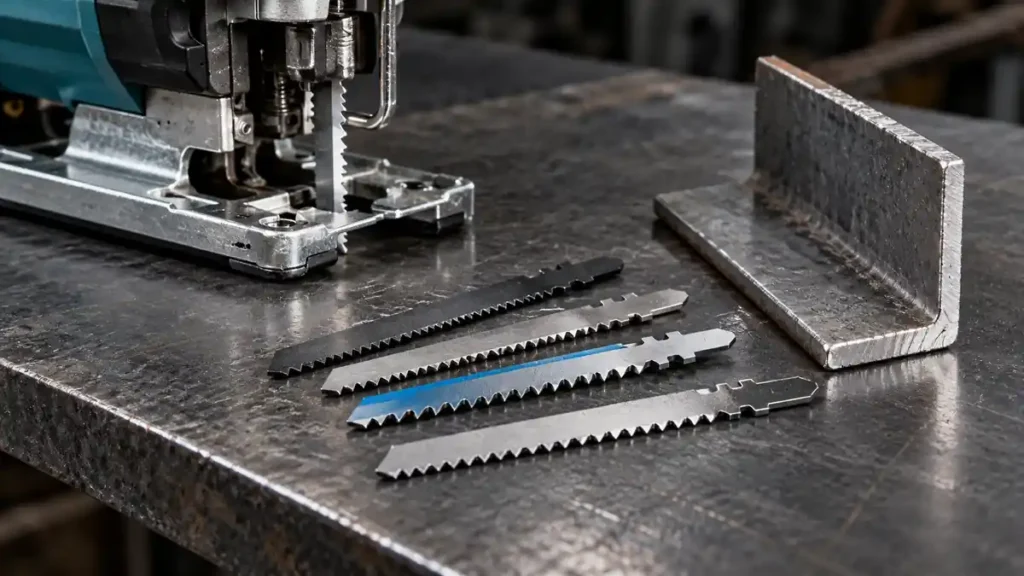
Metal cutting puts very different demands on a jigsaw blade than plywood or softwood. A blade that glides through a cabinet panel can chatter, heat up, or lose its edge quickly against sheet steel, angle iron, tubing, or stainless steel. The right choice depends on the workpiece thickness, the metal type, the blade’s tooth count, its construction, and whether your jigsaw accepts a T-shank or U-shank blade.
A common mistake is choosing by blade count alone. A large mixed set may include only one or two metal-specific blades, while the rest are intended for wood or plastic. Another is using a fine-tooth blade on material that needs a more open tooth pattern, or selecting a short blade for a workpiece that calls for extra reach. Bi-metal blades generally suit demanding metal work, while high-speed steel blades can make sense for specific straight-cut applications. Lubrication, secure workpiece support, and a controlled feed rate still matter after the blade is installed.
This comparison focuses on documented metal applications rather than generic jigsaw assortments. The selections cover thin sheet metal, medium-gauge stock, thicker metal, tubing, profiles, stainless steel, and mixed thicknesses. The Bosch TPM005 set is the strongest overall choice for shoppers who want several metal-specific blade designs in one package, while the individual Diablo and Bosch blades offer a more focused match for particular materials.
Quick Answer
Best Overall: The Bosch TPM005 Pro-Metal Set offers the broadest documented range, including basic, progressive, speed, and stainless-steel blades.
Best for Medium Metal: The Diablo DJT121AF5 uses a 21 TPI bi-metal design aimed at medium metal applications.
Best for Thin Sheet Metal: The BOSCH T118G has 36 TPI teeth and a documented range covering 17 to 26 gauge sheet metal and very thin metal.
Best Jigsaw Blades for Metal Comparison Table
| Product | Best For | Suitable Material | TPI | Construction |
|---|---|---|---|---|
| Bosch TPM005 Pro-Metal Set | Mixed metal applications | Metal and stainless steel | Varies by blade | HSS and carbide-edge blade included |
| Diablo DJT121AF5 | Medium metal | Medium metal applications | 21 | Bi-metal |
| BOSCH T118G | Thin sheet metal | 17 to 26 gauge sheet metal | 36 | High-speed steel |
| Bosch T321AF3 | Pipes and profiles | 10 to 16 gauge metal | 21 | Bi-metal |
| BOSCH T123X Progressor | Variable metal thicknesses | Metal, stainless steel, and non-ferrous metal | 10 to 24 progressive | HSS |
| Diablo DJT121BF5 | Thicker metal | Thick metal applications | 12 | Bi-metal |
| Diablo DJT121GF5 | Thin metal | Thin metal applications | 30 | Bi-metal |
| JMD T118A Set | Repeated thin-sheet work | 1 to 3 mm sheet metal | 21 | HSS |
| Micro Traders T136A Set | Long straight cuts | 1.5 to 3 mm materials and metal stock | Not specified | HSS |
The detailed reviews explain where each blade fits, what its shank and tooth design mean, and which limitations deserve attention before purchase.
1. Bosch TPM005 5-Piece T-Shank Jigsaw Blade Set for Pro-Metal : Best Overall

The Bosch TPM005 earns the top position because it addresses several metal-cutting situations without pretending that one tooth pattern suits every workpiece. The set includes a T118B basic metal blade, a T123X Progressor blade, T121AF and T121BF speed blades, plus a T118EHM blade intended for stainless steel. That spread gives a shopper a practical starting point for thin stock, changing thicknesses, faster cuts, and harder specialty material.
Its value lies in selection rather than sheer quantity. A homeowner repairing a metal cabinet may need a fine basic blade, while a fabricator working across profiles and sheet stock may need a progressive or speed design. The set also uses a T-shank interface and is described as fitting over 90 percent of current jigsaw makes and models, though the exact tool should still be checked before ordering. Stainless steel work has its own demands, so the included specialty blade is a meaningful distinction rather than filler.
Pros
- Includes five distinct blade types for metal-related applications.
- Includes a blade specifically described for stainless steel.
- Provides basic, progressive, and speed-oriented options.
- Uses the widely used T-shank format.
- Offers a more useful assortment than a wood-heavy mixed set.
Cons
- The set does not provide multiple replacements of each blade design.
- Exact suitability still depends on the workpiece thickness and jigsaw compatibility.
This is the best fit for readers who cut different kinds of metal and prefer a small, purposeful assortment. It may be excessive for someone who cuts one thin sheet once a year, while a dedicated blade pack could make more sense for a single recurring task. For a general metal-focused workshop drawer, the mixture of blade geometries gives the Bosch set the strongest overall match.
To buy this product, click here.
2. Diablo Bi-Metal DJT121AF5 21 TPI Jigsaw Blades : Best for Medium Metal

The Diablo DJT121AF5 is a focused five-pack for medium metal applications. Its 21 TPI tooth pattern sits between the very fine pitch used for thin sheet and the more open pitch associated with thicker metal. That makes the blade a sensible match for projects where the material is substantial enough to need durability but still benefits from a controlled, relatively fine cut.
Bi-metal construction combines a high-speed steel cutting edge with a more flexible backing, according to the product description. Diablo also identifies an ultra-hardened cutting edge and a tooth design intended for medium metal. Those claims describe the blade’s intended construction and application, rather than guaranteeing a particular lifespan in every workshop. The T-shank format fits compatible jigsaws, and the listing also mentions compatibility with many combo and U-shank machines, so the tool’s clamp design deserves a quick check before purchase.
Pros
- 21 TPI configuration is aimed at medium metal work.
- Bi-metal construction suits demanding cutting applications.
- Five blades provide replacements for recurring projects.
- T-shank design fits compatible corded and cordless jigsaws.
- The blade is dedicated to metal rather than split across wood and plastic.
Cons
- It is less specialized for very thin sheet than a 30 or 36 TPI blade.
- The product information does not specify a precise metal thickness range.
Pick this pack for repeated cuts in medium metal where a dedicated 21 TPI blade is more useful than a broad assortment. It is a weaker match for delicate thin sheet or unusually thick stock, since those tasks call for different tooth spacing. Buyers who know their material falls into the medium-metal category get a clear, uncomplicated option here.
To buy this product, click here.
3. BOSCH T118G 36 TPI Basic for Metal Jigsaw Blades : Best for Thin Sheet Metal
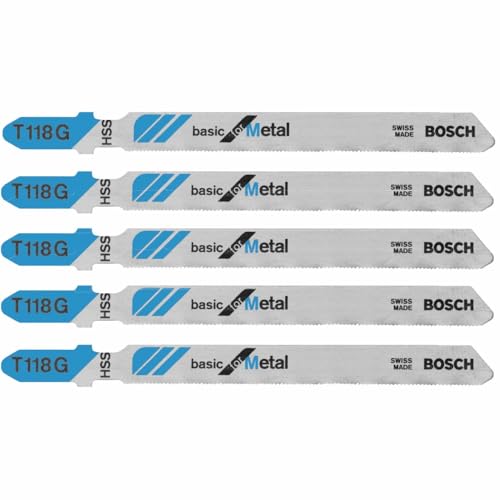
Thin sheet metal rewards a fine tooth pattern, and the Bosch T118G is built around that requirement. Its 36 TPI design is specified for 17 to 26 gauge sheet metal and very thin ferrous or non-ferrous metals from 1/64 to 3/64 inch thick. That narrow application range is useful because it gives shoppers a clearer boundary than a vague “metal” label.
The blade uses high-speed steel construction with wavy-set, milled teeth and measures 3-5/8 inches overall, with a 2-5/8-inch working length. Bosch describes it as intended for straight cuts and recommends proper lubricant for metal cutting. A person trimming a thin panel for an enclosure or making a straight opening in light sheet will find that specification more relevant than a larger blade count. Curved work and thicker stock call for a different profile.
Pros
- 36 TPI tooth design suits very thin metal.
- Documented range covers 17 to 26 gauge sheet metal.
- Suitable for ferrous and non-ferrous very thin metals.
- High-speed steel construction is intended for straight cuts.
- Works with Bosch and other compatible T-shank or combination T-U jigsaws.
Cons
- Its very fine tooth pattern is specialized for thin material.
- The 2-5/8-inch working length limits its usefulness on thicker workpieces.
This is the precise choice for thin sheet rather than a general-purpose metal blade. It should be skipped for heavy plate, large tubing, or projects that require aggressive material removal. Use it with steady support and appropriate lubricant, since a fine blade can be a poor match for forceful feeding.
To buy this product, click here.
4. Bosch T321AF3 21 TPI Speed for Metal Jigsaw Blades : Best for Pipes and Profiles
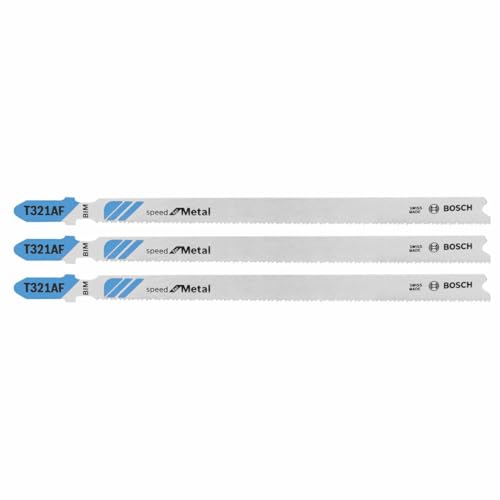
The Bosch T321AF3 brings extra reach to metal cutting. Its 5-1/4-inch overall length and 4-1/4-inch working length are considerably more substantial than the short blades commonly used for light sheet. Bosch lists it for pipes, profiles, tube stock, angle iron, and 10 to 16 gauge sheet metal, with pipes under 2-1/2 inches in diameter included in the application guidance.
A 21 TPI pattern gives this blade a middle-ground profile for the listed materials, while bi-metal construction is intended to improve durability for repeated metal work. The longer body can be useful around a pipe or profile where a short blade leaves limited working reach. It still does not turn a jigsaw into a pipe-cutting specialist, and the workpiece needs secure support so the blade does not wander or bind.
Pros
- Long 4-1/4-inch working length provides useful reach.
- Documented for pipes, profiles, tube stock, and angle iron.
- 21 TPI design suits the listed medium-thickness applications.
- Bi-metal construction is intended for durability.
- Suitable for 10 to 16 gauge sheet metal.
Cons
- The three-piece pack provides fewer replacements than larger sets.
- The longer blade may be unnecessary for thin, flat sheet work.
Choose this Bosch when your metal projects include tubing, profiles, or angle iron and a longer blade is genuinely useful. For small sheet-metal openings, the length can feel like extra blade rather than an advantage. Its intended application range makes it one of the more task-specific selections in this roundup.
To buy this product, click here.
5. BOSCH T123X Progressor for Metal Jigsaw Blades : Best for Variable Thicknesses

The Bosch T123X Progressor is aimed at shoppers whose metal work changes from one job to the next. Its progressive 10 to 24 TPI tooth pattern covers a range of thicknesses, and Bosch lists applications that include sheet metal up to 8 gauge, metal from 5/64 to 3/8 inch thick, stainless steel from 1/16 to 1/8 inch, and non-ferrous metal from 5/64 to 3/4 inch.
That range makes the blade more adaptable than a fixed-pitch design, but adaptability has boundaries. A progressive blade still needs to be matched to the actual material and the jigsaw’s capacity. The 4-inch overall length and 3-inch working length offer a practical middle ground, while the HSS construction and milled, side-set teeth are intended for long life and faster cutting across varied thicknesses.
Pros
- Progressive 10 to 24 TPI design covers varied metal thicknesses.
- Documented for metal, stainless steel, and non-ferrous material.
- Suitable for sheet metal up to 8 gauge according to the listing.
- 4-inch length and 3-inch working length suit general metal work.
- Five-blade pack provides useful replacements.
Cons
- Progressive teeth may be less specialized than a fine fixed-pitch blade for very thin sheet.
- The broad application range still requires careful material matching.
The T123X is a strong choice for a maintenance drawer or workshop that sees occasional stainless, aluminum, profiles, and sheet metal. Someone who cuts one consistent gauge every day may get a more targeted result from a fixed-pitch blade. Its appeal is the documented spread of applications, not a promise that one blade replaces every metal-cutting design.
To buy this product, click here.
6. Diablo Bi-Metal DJT121BF5 12 TPI Jigsaw Blades : Best for Thick Metal

The Diablo DJT121BF5 is the most open-toothed dedicated option in this group, with 12 TPI and a stated focus on thick metal. Its 3-5/8-inch length keeps it in the familiar jigsaw-blade format, while the tooth pattern is aimed at applications where a very fine sheet-metal blade would be too restrictive.
Diablo describes this model as a bi-metal blade with an ultra-hardened cutting edge and tooth technology intended for thick metal. Those details explain its position in the ranking, although the product specifications do not provide a specific thickness range. The five-pack is practical for repeat work, and the T-shank design suits compatible jigsaws. A thicker-workpiece blade still needs careful feed pressure and solid clamping.
Pros
- 12 TPI pattern is specifically aimed at thick metal applications.
- Bi-metal construction is suited to demanding metal cutting.
- Ultra-hardened cutting edge is a documented design feature.
- Five-pack provides replacement blades for repeated work.
- T-shank format fits compatible jigsaws.
Cons
- The listing does not give a precise maximum metal thickness.
- The open tooth pattern is a poor match for very thin sheet requiring a fine finish.
Buy this Diablo pack when thick metal is the central task and your jigsaw accepts its T-shank. It is less attractive as a one-blade solution for a mixed workshop because thin sheet and stainless steel may call for finer or specialty teeth. The tradeoff is clear: broader tooth spacing for thicker material, with less specialization for delicate sheet.
To buy this product, click here.
7. Diablo Bi-Metal DJT121GF5 30 TPI Jigsaw Blades : Best for Thin Metal

The Diablo DJT121GF5 takes the fine-tooth route for thin metal. Its 30 TPI configuration is less fine than the Bosch T118G’s 36 TPI pattern but is still positioned specifically for thin metal applications. That gives it a useful place for shoppers who want a dedicated Diablo blade rather than a general assortment.
Bi-metal construction and an ultra-hardened cutting edge are the main features. Diablo also describes a tooth design intended to keep cuts controlled in thin metal. The product data does not specify an exact gauge range, so the blade should be matched by the manufacturer’s application description and the actual workpiece rather than assumed suitable for every thin sheet.
Pros
- 30 TPI design is aimed at thin metal.
- Bi-metal construction provides a dedicated metal-cutting format.
- Five blades support repeated projects.
- T-shank design fits compatible jigsaws.
- Fine tooth spacing is better aligned with thin stock than open-tooth blades.
Cons
- Check an exact metal thickness range for the exact product configuration.
- It is less suitable for thick metal than the 12 TPI Diablo model.
This pack suits a shopper who already knows thin metal is the recurring job and wants five matching blades. Choose a different design for thick stock, tubing, or changing material thicknesses. Its focused 30 TPI profile gives it a clearer purpose than a mixed pack, but the missing gauge specification means buyers should verify the application before cutting.
To buy this product, click here.
8. JMD T118A 21 TPI Metal Cutting Jigsaw Blade Set : Best for Repeated Thin-Sheet Work

The JMD T118A set is built around one metal-cutting format rather than a mix of wood, plastic, and metal blades. It includes 30 T118A blades with 21 TPI teeth, and the listing identifies them for thin solid sheet metal from 1 to 3 mm. That makes the set especially relevant for repeated straight cuts where keeping replacements nearby matters.
Each blade uses fully hardened high-speed steel, with milled and wavy-set teeth. The T-shank interface is intended to fit most current jigsaws, while the storage tube keeps a large group of narrow blades together. The product description emphasizes straight cuts, so shoppers planning tight curves or changing thicknesses should look at a different blade design.
Pros
- Includes 30 matching metal-cutting blades.
- Documented for 1 to 3 mm thin sheet metal.
- 21 TPI tooth design suits the listed application.
- HSS construction with milled, wavy-set teeth.
- Storage tube helps organize the large set.
Cons
- The set is limited to one T118A blade style.
- Its documented use centers on straight cuts in thin sheet metal.
This is a practical stock-up choice for a workshop, repair bench, or fabrication project that repeatedly cuts thin sheet in the stated range. It is less flexible than the Bosch TPM005 because every blade has the same basic purpose. The large quantity is useful only when the application is consistent, so occasional users may prefer a smaller multi-design set.
To buy this product, click here.
9. Micro Traders T136A High-Speed Steel Jigsaw Blades : Best for Long Straight Cuts

The Micro Traders T136A stands apart through its extended dimensions. The blades measure 132 mm overall with a 107 mm working length, making them substantially longer than many standard metal jigsaw blades. The listing describes them for straight, fast cuts in 1.5 to 3 mm sandwich materials, wood, angle iron, metal bars, and iron plate.
High-speed steel construction and a T-shank design give the set a clear metal-cutting identity, while the longer working section may help when the workpiece is deeper or the cut requires more reach. The product data does not state the TPI, exact maximum thickness, or a specific stainless-steel application. That missing information matters, so this set belongs with buyers who need the documented long format rather than shoppers seeking a finely specified sheet-metal blade.
Pros
- 107 mm working length provides substantial reach.
- HSS construction is intended for wear tolerance and service life.
- Documented for angle iron, metal bars, and iron plate.
- Suitable for 1.5 to 3 mm sandwich materials according to the listing.
- T-shank design improves compatibility with compatible jigsaws.
Cons
- The product data does not specify TPI.
- Its long straight-cut format is less targeted for fine sheet-metal work or tight curves.
Choose the Micro Traders set for a specific long-blade requirement, especially where short blades do not provide enough working length. It should not be treated as a universal metal solution because the tooth specification and detailed thickness limits are not supplied. Buyers who value documented TPI and precise gauge guidance will find the Bosch and Diablo options easier to match.
To buy this product, click here.
Buying Guide
Confirm the Jigsaw’s Shank Requirement
Most selections in this roundup use a T-shank, but the shank style still needs to match the blade clamp on your jigsaw. A blade can be suitable for metal and still be unusable in a tool that accepts a different interface. The product information for the Bosch T118G also mentions Bosch and other T-shank or combination T-U jigsaws, while the JMD, Diablo, Bosch T321AF3, Bosch T123X, and Micro Traders options are presented as T-shank blades. Check the tool manual or existing blade before ordering.
Match TPI to Metal Thickness
Tooth count should follow the workpiece rather than personal preference. The 36 TPI Bosch T118G is specified for very thin metal, while the 30 TPI Diablo blade is also aimed at thin metal. The 21 TPI designs cover medium metal, pipes, profiles, and thin sheet in their documented applications. The 12 TPI Diablo blade is positioned for thick metal. These labels are useful starting points, but the exact material range still matters.
Use the steps for how to cut metal with a jigsaw to plan clamping, blade action and feed before starting the job.
Choose Blade Construction for the Job
High-speed steel appears in the Bosch T118G, Bosch T123X, JMD T118A, and Micro Traders sets. Bi-metal construction appears in both Diablo packs and the Bosch T321AF3. The Bosch TPM005 combines several designs, including an edge intended for stainless steel. Construction alone does not make a blade suitable for every metal, so read it alongside the stated application, tooth pattern, and workpiece thickness.
Use the guide to metal blade selection by alloy and thickness before choosing a tooth profile for the stock.
Check Working Length, Not Only Overall Length
The cutting portion of a blade determines how much material it can practically reach. The Bosch T118G has a 2-5/8-inch working length, the Bosch T123X has a 3-inch working length, and the Bosch T321AF3 has a 4-1/4-inch working length. The Micro Traders T136A reaches 107 mm of working length. A long blade can help with deeper stock, while a shorter blade may be easier to control on thin sheet.
Separate Straight-Cut Blades From Flexible Assortments
Several selections are explicitly intended for straight cuts, including the Bosch T118G, JMD T118A, and Micro Traders T136A. The Bosch TPM005 provides several blade styles for changing tasks, but it does not mean every blade in the set suits every cut. Curves, profiles, thin sheet, stainless steel, and thick metal each place different demands on the tooth design. Choose a specialized blade when the project has a narrow requirement.
Use Lubrication and Secure Support
The Bosch T118G and Bosch T321AF3 listings recommend proper lubricant when cutting metal. Lubrication can be relevant to heat management and blade life, but the correct product and operating method should follow the blade and tool guidance. Clamp or otherwise support the workpiece securely, keep hands clear of the cutting path, and use appropriate eye protection. A compatible blade does not remove the need for controlled feed pressure or safe material handling.
Evaluate Sets by Useful Variety
A five-piece set with five different metal designs can be more useful than a larger package of near-identical blades. The Bosch TPM005 includes basic, progressive, speed, and stainless-steel options. The JMD set includes 30 matching T118A blades, which is a better fit for repeated thin-sheet work. Decide whether your priority is variety or replacement quantity before treating blade count as a benefit.
Best Jigsaw Blades for Metal FAQ
What type of jigsaw blade is best for metal?
The right blade depends on the metal and its thickness. Fine-tooth blades such as the Bosch T118G are documented for very thin sheet metal, 21 TPI blades suit several medium-metal applications, and the 12 TPI Diablo model is aimed at thicker metal. A set such as the Bosch TPM005 is useful when the material changes from one project to another.
Are T-shank blades compatible with every jigsaw?
No. T-shank blades fit many current jigsaws, but the clamp must accept that interface. Some tools use U-shank blades, while others accept more than one style. Check the tool documentation or the blade currently installed before buying a replacement.
Can metal jigsaw blades cut stainless steel?
Some can, but a general metal label is not enough to guarantee stainless-steel suitability. The Bosch TPM005 includes a blade described for stainless steel, and the Bosch T123X is listed for stainless steel within specific thickness ranges. Match the blade’s intended application to the material and thickness.
Is a higher TPI blade always better for metal?
No. Higher TPI generally indicates a finer tooth pattern, which can suit thin sheet metal. Thicker material may require a more open tooth pattern, such as the 12 TPI Diablo blade. The workpiece thickness, blade design, and manufacturer guidance should be considered together.
Why do some metal jigsaw blades have longer working lengths?
A longer working length gives the blade more reach into deeper material, tubing, profiles, or metal stock. The Bosch T321AF3 has a 4-1/4-inch working length, while the Micro Traders T136A lists 107 mm. Extra length is less important for light sheet and may be unnecessary for small openings.
Should metal be lubricated when using a jigsaw blade?
The supplied Bosch product information recommends proper lubricant for the T118G and T321AF3 when cutting metal. Follow the guidance for the specific blade, tool, and workpiece. Lubrication is one part of the setup, alongside secure support, suitable blade selection, controlled pressure, and eye protection.
Can one metal blade cut aluminum, steel, and stainless steel?
Do not assume that one blade is equally suitable for every metal. The Bosch T123X is documented for metal, stainless steel, and non-ferrous metal within different thickness ranges, while other products have narrower descriptions. Read the material and thickness guidance for the exact blade rather than relying on a general “metal” label.
Final Verdict
The Bosch TPM005 is the best overall choice because its five blades cover several documented metal-cutting needs, including basic metal, progressive cuts, speed-oriented designs, and stainless steel. It is the most sensible starting point for a workshop where the material changes from thin sheet to profiles or specialty metal. The Diablo DJT121AF5 is a stronger focused alternative for medium metal, while the Bosch T118G is the clearer match for very thin sheet with its 36 TPI design and stated gauge range.
Buyers with more specialized work should choose accordingly. The Bosch T321AF3 brings extra working length for pipes and profiles, the Diablo DJT121BF5 targets thick metal with 12 TPI teeth, and the JMD set supplies a large quantity of matching blades for repeated 1 to 3 mm sheet-metal cuts. Before ordering, verify the shank type, compare working length with the material, and select TPI based on the actual workpiece. A carefully matched blade will give your jigsaw a far better starting point than a broad assortment chosen by count alone.
