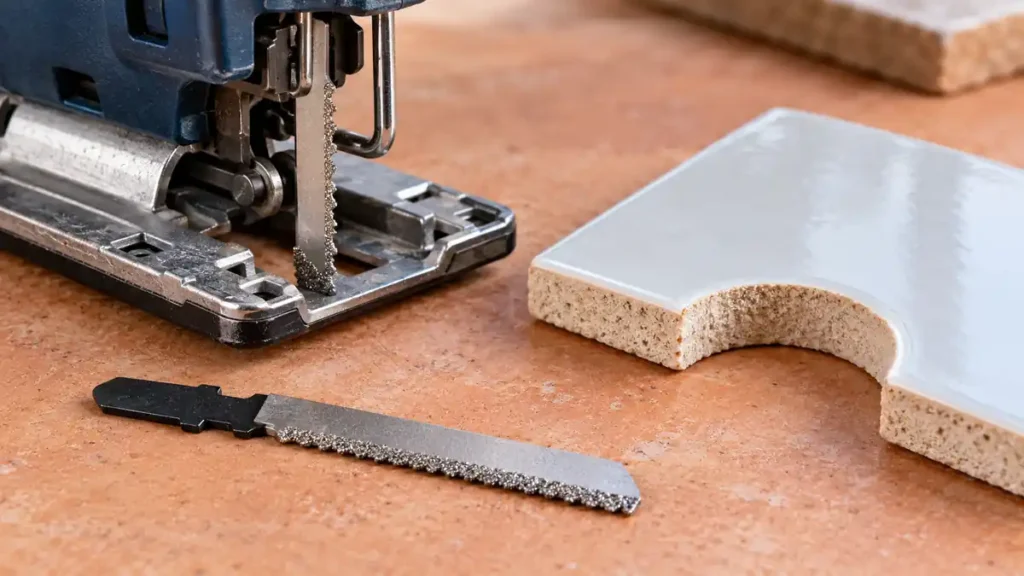
A ceramic tile cut can go from a neat notch to a chipped, dusty mess in seconds, especially when the blade is meant for wood rather than abrasive mineral material. A jigsaw can be useful for outlet openings, curved cuts, plumbing notches, and small adjustments, but the blade must have a carbide or diamond cutting edge intended for tile. The best jigsaw blade for cutting ceramic tile depends on the tile hardness, the thickness, the shape of the cut, and whether the jigsaw accepts a T-shank or U-shank blade.
Blade compatibility is the first trap. Most of the specialty options here use a T-shank, while the IVY Classic uses a U-shank and therefore suits a different group of jigsaws. Material claims also deserve a close look. A blade listed for soft ceramic tile may be a poor choice for dense porcelain, while a diamond-grit blade intended for hard tile may remove material more slowly but offer a better match for abrasive surfaces. Working length matters too, since the blade needs enough usable edge to pass through the tile without forcing the tool.
The products below are ranked by documented tile suitability, cutting-edge material, shank design, stated thickness range, and useful limitations. The Bosch T130DG takes the top position because its diamond matrix is specifically listed for hard tile and related abrasive materials, while the Bosch T130RF1 is a strong choice for ceramic, fiberglass, and glass in a broader thickness range. Several multi-packs also make sense for repeated soft-tile work, but their own restrictions should guide the purchase.
Quick Answer
Best Overall: BOSCH T130DG Diamond for Hard Tile. Its 30-grit diamond matrix is listed for porcelain, ceramic-related hard materials, granite, marble, slate, glass, and cement board from 3/64 inch to 1/2 inch.
Best Ceramic-Tile Specialist: BOSCH T130RF1 Carbide Special for Ceramics. Its carbide-grit edge is listed for ceramics, fiberglass, and glass from 3/64 inch to 5/8 inch, with straight and curved cutting capability.
Best for Soft Tile in Multipacks: SHDIATOOL 4-Inch Diamond Blades. The three-pack uses vacuum-brazed 46-grit diamond and supports controlled straight or curved cuts, but it is specifically unsuitable for hard porcelain and very hard ceramic tile.
Best Jigsaw Blade for Cutting Ceramic Tile Comparison Table
| Product | Best For | Edge Type | Shank |
|---|---|---|---|
| BOSCH T130DG | Hard tile and porcelain | 30-grit diamond | T-shank |
| BOSCH T130RF1 | Ceramic, fiberglass, and glass | 30-grit carbide | T-shank |
| QEP 3-Inch Diamond Edge | Hard ceramic tile | Diamond edge | Not specified |
| HIGHDRIL 4-Inch Diamond | Wet straight or curved cuts | 46-grit diamond | T-shank |
| Briny River T150RFF | Repeated ceramic and stone work | 50-grit carbide grain | T-shank |
| BOBEINI T150 | Ceramic tile and synthetics | 50-grit carbide grain | T-shank |
| LENOX 1991606 | Single-blade diamond use | Diamond grit | T-shank |
| SHDIATOOL 4-Inch, 3-Pack | Soft tile and curved cuts | 46-grit diamond | T-shank |
| IVY Classic 26504 | U-shank jigsaws and tight radii | Carbide grit | U-shank |
For a closer look, the reviews explain where each blade fits, which tile materials it suits, and where its documented limitations become important.
1. BOSCH T130DG 30-Grit Diamond Blade: Best Overall

The Bosch T130DG is the clearest match for demanding ceramic and hard-tile work in this group. Its 30-grit diamond matrix is bonded along the cutting edge, and the listed application includes grade 5 porcelain, granite, marble, slate, glass, and cement board. That broader abrasive-material coverage makes it a sensible first choice for a tile installer who may move between ordinary ceramic tile and harder surfaces.
Its listed cutting range is 3/64 inch to 1/2 inch, with a 3-1/4-inch overall length and 2-1/4-inch working length. Those figures give a useful reference for checking the tile before cutting. Since this is a one-piece blade, it is better suited to a defined job than to a large batch of repeated cuts where replacements may be convenient. The T-shank interface also means the jigsaw must accept that style of blade.
Pros
- 30-grit diamond matrix is intended for hard, abrasive materials.
- Listed for porcelain, granite, marble, slate, glass, and cement board.
- Documented cutting range spans 3/64 inch to 1/2 inch.
- Suitable for specialized tile and trade applications.
- Compact 3-1/4-inch blade format suits controlled jigsaw cuts.
Cons
- Only one blade is included.
- Its listed working length is shorter than some four-inch alternatives.
This is the blade to choose when hard tile is the main concern and the jigsaw already accepts T-shank blades. It has a more specific hard-material identity than the softer-tile multipacks, although buyers cutting tile thicker than the listed range should look for a different method rather than forcing the blade. For a bathroom cutout in dense porcelain, the material match matters more than having several spare blades in a box.
To buy this product, click here.
2. BOSCH T130RF1 Carbide Special for Ceramics: Best for Ceramic and Glass

The T130RF1 takes a different route from the diamond-edged Bosch above. Its edge uses a 30-grit carbide matrix, and the product information specifically names ceramics, fiberglass, and glass. The stated range reaches from 3/64 inch to 5/8 inch, giving it a slightly broader documented thickness window than the T130DG for buyers working with ordinary ceramic wall or floor tile.
A file-like carbide edge is useful for controlled straight and curved cuts, especially when a project calls for a small opening rather than a long exposed edge. The 3-1/4-inch overall length and 2-5/16-inch working length are easy dimensions to compare against the tile thickness. It is a single T-shank blade, so the apparent simplicity of the product should not distract from the fit check before purchase.
Pros
- Specifically listed for ceramic tile, fiberglass, and glass.
- 30-grit carbide matrix provides an abrasive cutting edge.
- Documented range extends to 5/8 inch.
- Supports straight and curved cuts.
- Longer stated working length than the T130DG.
Cons
- One blade is included.
- Carbide construction is a less specific match than diamond for the hardest porcelain.
Choose this Bosch when the work centers on ceramic rather than exceptionally hard porcelain, or when the extra stated thickness range is useful. It is also a practical option for a mixed repair box where fiberglass and glass may appear alongside tile. Buyers tackling grade 5 porcelain or dense stone should lean toward the diamond T130DG instead.
To buy this product, click here.
3. QEP 3-Inch Diamond Edge Jigsaw Blade: Best for Hard Ceramic Tile

QEP positions this blade for hard materials, including porcelain and ceramic tile. That direct application makes it a strong alternative to the Bosch options, particularly for someone who wants a short, focused blade for a tile-specific task. The listing also describes a heat-treated alloy steel backer and durable diamonds intended to support a thinner cut.
The available information does not specify the shank style, exact working length, or thickness range. That missing information matters more here than it would with an ordinary wood blade, since tile cutting leaves less room for a poor fit or insufficient blade reach. Confirming the jigsaw holder and checking the blade dimensions before ordering should be part of the purchase decision.
Pros
- Listed for both porcelain and ceramic tile.
- Diamond edge is intended for hard materials.
- Heat-treated alloy steel backer is specified.
- Product information emphasizes thinner cuts.
- Short three-inch format suits compact cutting tasks.
Cons
- Shank type is not specified in the product specifications.
- Exact cutting thickness range is not provided.
This QEP blade suits buyers who are comfortable verifying fit details and want a direct hard-tile option. It is less convenient for shoppers seeking a fully documented specification sheet, but its porcelain and ceramic application is clearer than that of many general-purpose diamond blades. Use it when the jigsaw compatibility is confirmed and the tile thickness falls within the product guidance.
To buy this product, click here.
4. HIGHDRIL 4-Inch Diamond Jigsaw Blades: Best for Wet Straight or Curved Cuts

The HIGHDRIL set brings a longer format and a clear wet-use recommendation to small tile-cutting jobs. Each blade is listed at four inches overall, with a 76 mm diamond section, a 0.8 mm steel body, and a 2 mm diamond height. The 46-grit diamond edge is described for straight and curved cuts across materials that include ceramics, fiberglass, marble, glass, and tile.
Three blades are included, which is useful when a project involves several openings or when the abrasive work is likely to consume an edge. The product information also mentions a heat-treated alloy steel backer and vacuum-brazed diamond construction. Its material list is broad, but broad compatibility should not be read as proof that every tile type will cut identically. Hardness and thickness still need to be checked.
Pros
- Three-piece set provides replacements for repeated cuts.
- 46-grit diamond edge is listed for ceramic and tile applications.
- Four-inch overall length offers a longer blade format.
- Wet use is recommended in the product information.
- Supports straight and curved cutting.
Cons
- Exact maximum tile thickness is not specified.
- Broad material claims do not identify a hard-porcelain limit.
HIGHDRIL is a useful middle ground for buyers who want diamond construction, multiple blades, and the option of wet use. It makes sense for a homeowner cutting several soft or moderate ceramic pieces, provided the jigsaw and work area are appropriate for the recommended conditions. For especially hard porcelain, the Bosch T130DG offers a more specific documented match.
To buy this product, click here.
5. Briny River T150RFF Carbide-Grain Blades: Best Multipack for Ceramic and Stone

Briny River offers six T-shank blades with a carbide-grain edge and a compact 76 mm overall length. The listing names ceramics, granite, marble, and quartz, so this set is aimed at buyers who want a supply of specialty blades for more than one abrasive surface. A 54 mm tooth length is also provided, giving shoppers a useful reference when comparing the blade against the tile thickness.
The six-piece configuration is its most practical distinction. A single blade can be enough for one careful opening, but spare blades are helpful for a renovation involving several tiles or repeated plumbing cutouts. The product information describes a secure T-shank fit in most jigsaws, though “most” should not replace checking the exact holder on an older or unusual tool.
Pros
- Six blades are included for repeated work.
- Carbide construction is listed for ceramic and stone materials.
- Applications include granite, marble, quartz, and ceramics.
- 76 mm overall length and 54 mm tooth length are documented.
- T-shank design suits compatible jigsaws.
Cons
- Exact ceramic-tile thickness limit is not stated.
- Carbide grain is less specifically documented for hard porcelain than the Bosch diamond blade.
This set is best for a project where several blades may be useful and the materials vary between ceramic and softer stone. It offers more replacement capacity than the single-blade choices, though the buyer gives up some application specificity compared with the hard-tile Bosch. Verify the T-shank fit and avoid treating the six-pack as a guarantee of equal results across every stone type.
To buy this product, click here.
6. BOBEINI T150 Carbide-Grain Blades: Best Three-Pack for Ceramic Tile

BOBEINI keeps the specification simple: three three-inch T150 blades with a 50-grit carbide grain edge, intended for ceramic tile and synthetic materials. That narrow description can be useful for a homeowner who needs a small set for a bathroom or kitchen repair and does not need a mixed assortment for wood, metal, and plastic.
The three-inch size gives the product a compact profile, but the product specifications do not state the working length or a maximum tile thickness. The blades are listed as T-shank, which is the key compatibility detail, yet the jigsaw still needs a holder that accepts that interface. Since only the blades are included, the listing should not be interpreted as a kit with a guide, coolant system, or other tile-cutting accessories.
Pros
- Three blades are included.
- 50-grit carbide grain is listed for ceramic tile.
- Three-inch format suits compact work.
- T150 T-shank interface is clearly identified.
- Also listed for synthetic materials.
Cons
- Maximum cutting thickness is not specified.
- The package includes blades only, with no documented accessories.
BOBEINI is a reasonable fit for a small ceramic-tile repair where three T-shank replacements are more useful than one premium specialty blade. Its application description is less expansive than the Briny River set, and there is no stated hard-porcelain range. For dense tile, compare the material against the Bosch T130DG or QEP before choosing this compact option.
To buy this product, click here.
7. LENOX Tools 1991606 Diamond-Grit Blade: Best Single Diamond Blade

The LENOX 1991606 is a single T-shank diamond-grit blade measuring 3-1/2 inches by 3/8 inch. Its nickel-alloy-brazed diamond particles are listed as maintaining the cutting edge, while the chrome-alloy backing steel is intended to provide stability. Those construction details give it a more defined identity than a generic abrasive blade listing.
There is no stated tile thickness range or detailed material list in the product specifications, so its ranking rests on the documented diamond-grit construction and blade interface rather than a broad ceramic specification. A one-piece package suits a single planned cut, an emergency replacement, or someone who prefers buying a specific blade rather than storing a multipack.
Pros
- Diamond-grit edge is intended for abrasive cutting.
- Nickel-alloy brazing is specified.
- Chrome-alloy backing steel is listed for stability.
- T-shank interface is identified.
- 3-1/2-inch blade format offers a useful compact size.
Cons
- Tile thickness limits are not provided.
- Only one blade is included.
LENOX is best for buyers who value a clearly described single diamond blade and already know that the dimensions suit their jigsaw and tile. It is less suitable for shoppers who need a documented porcelain range or several replacements for a large project. Check the material thickness and holder before relying on it for a critical visible cut.
To buy this product, click here.
8. SHDIATOOL 4-Inch Diamond Blades, 3-Pack: Best for Soft Tile and Curves

SHDIATOOL gives buyers three four-inch T-shank blades with a vacuum-brazed 46-grit diamond edge. The product is listed for fiberglass, marble, fiber cement, foam cement, drywall, plastic, wood, and softer tile, with straight and curved cutting supported in suitable materials. That makes it a flexible option for a renovation box where ceramic tile is only one part of the job.
The limitation is unusually clear and should shape the purchase. The listing says these blades are not recommended for hard porcelain or very hard ceramic tile, thick stone, glass, or aluminum. It also advises against forcing the blade or making excessively sharp turns. Those restrictions reduce its suitability for dense floor tile, but they make the intended soft-tile application easier to understand.
Pros
- Three blades are included.
- Vacuum-brazed 46-grit diamond construction is specified.
- Four-inch overall length suits moderate cutting depths.
- Supports straight and controlled curved cuts.
- Clear application guidance for softer materials.
Cons
- Not recommended for hard porcelain or very hard ceramic tile.
- Not intended for thick stone, glass, or aluminum.
Buy this set for softer ceramic tile, fiberglass, or mixed renovation materials, especially where a curved opening is part of the job. Skip it for dense porcelain simply because the word “diamond” appears in the title. The product’s own restrictions are the deciding factor, and they point buyers toward the Bosch T130DG for harder tile.
To buy this product, click here.
9. IVY Classic 26504 Carbide-Grit Blade: Best U-Shank Option

The IVY Classic earns a place because it serves a different compatibility group. This is a three-inch U-shank carbide-grit blade, and the product information lists ceramic tile, metal, and fiberglass as suitable materials. It is also described for tight-radius cutting, which may help with a small curved notch where a broader blade would be awkward.
The U-shank design is the central issue. The listing names Bosch, DeWalt, Hitachi, Craftsman, Makita, Metabo, Milwaukee, and Porter Cable jigsaws, but buyers should still confirm that the specific tool uses a U-shank holder. A T-shank jigsaw cannot be assumed compatible merely because the brand appears in the list.
Pros
- Carbide-grit edge is listed for ceramic tile.
- U-shank design serves compatible older or specialty jigsaws.
- Three-inch size suits compact openings.
- Product information identifies tight-radius cutting.
- Listed for ceramic tile, metal, and fiberglass.
Cons
- U-shank compatibility excludes many modern T-shank holders.
- Maximum tile thickness is not specified.
This is the right kind of alternative for a buyer whose jigsaw requires a U-shank blade. It should not be selected as a universal substitute for the T-shank products above. If the fit is correct, its carbide grit and tight-radius description make it useful for small ceramic cutouts, while buyers with a T-shank tool should choose a compatible blade instead.
To buy this product, click here.
Buying Guide
Confirm the Shank Before Comparing Cutting Edges
A blade that cannot lock into the jigsaw is unusable, regardless of its carbide or diamond construction. Most selections in this roundup use a T-shank, while the IVY Classic uses a U-shank. Check the actual blade holder on the tool, especially if it is an older jigsaw or a model with a manufacturer-specific clamp. Brand names alone do not establish compatibility.
Match Carbide or Diamond to the Tile
Carbide-grit blades are listed for ceramic and related abrasive materials, while diamond edges are generally the more direct match for hard tile and porcelain in the product descriptions. The Bosch T130DG has the clearest hard-material specification. A diamond blade advertised for soft tile should not automatically be treated as a hard-porcelain blade, as the SHDIATOOL listing makes clear.
Use the guide to blade ratings for abrasive board and tile materials to separate material ratings and tool-approved applications.
Check the Stated Thickness Range
Only some products provide a useful thickness window. The Bosch T130RF1 is listed from 3/64 inch to 5/8 inch, while the Bosch T130DG is listed from 3/64 inch to 1/2 inch. Several other blades do not state a maximum thickness in the product specifications. Measure the tile and compare it with the product guidance rather than assuming a three-inch or four-inch blade can handle any thickness.
Choose the Blade Length for the Cut
Overall length and working length are different measurements. The portion carrying the abrasive edge is what engages the tile, and it needs enough reach for the workpiece. A shorter blade may be easier to control around a small opening, while a longer four-inch format may offer more reach for moderate-depth cuts. Longer does not automatically mean more precise, so match length to the job rather than choosing by size alone.
Decide Whether You Need Straight or Curved Cuts
Some listings specifically mention straight and curved cutting, while the IVY Classic is described for tight-radius work. Curves demand controlled feed pressure and a blade that can follow the intended path without being twisted. The SHDIATOOL product information warns against excessively sharp turns, which is a useful reminder that a curved-cut claim still has practical limits.
Think About Single Blades Versus Multipacks
A one-piece blade is sensible for a single planned opening, particularly when the application is highly specific. Three- and six-piece sets offer replacements for repeated cuts, but extra blades do not compensate for a poor material match. A six-pack intended for ceramic and stone may be useful during a renovation, while a three-pack restricted to soft tile should remain in that application.
Plan for Dust, Debris, and Workpiece Support
Tile cutting produces abrasive debris, and the product data should be read alongside the jigsaw manufacturer’s operating guidance. The HIGHDRIL listing recommends wet use, while other products do not provide the same instruction. Support the tile securely, use the correct blade for its material, and avoid forcing the jigsaw through a resistant cut. A blade cannot remove the need for controlled setup.
Best Jigsaw Blade for Cutting Ceramic Tile FAQ
What Is the Best Jigsaw Blade for Ceramic Tile?
The BOSCH T130DG is the strongest overall choice in this selection for hard tile because its 30-grit diamond matrix is listed for porcelain and several other abrasive materials. The BOSCH T130RF1 is a strong alternative for ceramic, fiberglass, and glass, with a stated range reaching 5/8 inch.
Can Any Jigsaw Blade Cut Ceramic Tile?
No. Ordinary wood blades are not appropriate simply because they fit the tool. Ceramic tile requires a carbide-grit or diamond-style cutting edge listed for abrasive materials. The blade also needs the correct shank and enough working length for the tile thickness.
Are T-Shank Blades Better Than U-Shank Blades for Tile?
Neither interface is automatically better for cutting tile. T-shank blades are common among the specialty products in this roundup, while the IVY Classic is a U-shank option. The correct choice is the one that matches the jigsaw holder and has a suitable ceramic or tile application.
Can These Blades Cut Porcelain Tile?
Some can. The Bosch T130DG is specifically listed for grade 5 porcelain, and the QEP blade is listed for porcelain and ceramic tile. The SHDIATOOL three-pack is expressly not recommended for hard porcelain or very hard ceramic tile, so the word “diamond” should not be treated as a universal porcelain guarantee.
Is a Diamond Blade Better Than a Carbide Blade for Tile?
Diamond is the more direct documented match for several hard-tile products, particularly the Bosch T130DG. Carbide-grit blades can still be appropriate for ceramic tile, fiberglass, and glass, as shown by the Bosch T130RF1 and other selections. The tile hardness, thickness, and product-specific application matter more than the material name alone.
Can a Jigsaw Make Curved Cuts in Ceramic Tile?
Several listed blades are described for straight and curved cuts, including the Bosch T130RF1, HIGHDRIL, and SHDIATOOL options. Curves should remain controlled and within the blade’s intended application. The SHDIATOOL listing warns against excessively sharp turns, and no product should be treated as suitable for unlimited tight-radius work.
Should Tile Be Cut Wet With a Jigsaw?
The HIGHDRIL listing recommends wet use, but the product specifications do not give the same instruction for every blade. Follow the blade and jigsaw manufacturer’s operating guidance, keep the workpiece secure, and manage water and electrical equipment carefully. Do not assume that wet cutting is appropriate for a product simply because another blade recommends it.
Final Verdict
The BOSCH T130DG is the best overall jigsaw blade for cutting ceramic tile in this group because its 30-grit diamond matrix and listed 3/64-inch to 1/2-inch range provide the clearest match for hard tile and porcelain. It is a single blade, so it suits a defined job more than a large renovation requiring many replacements. For ordinary ceramic, fiberglass, or glass with a slightly broader stated thickness range, the BOSCH T130RF1 is the more natural alternative.
Buyers who need several blades can look at HIGHDRIL or Briny River, while SHDIATOOL is a sensible choice for soft tile only because its limitations are clearly stated. QEP offers another hard-material option, and the IVY Classic fills the U-shank niche for compatible jigsaws. Before ordering, verify the shank, measure the tile, check the stated material range, and distinguish ceramic from dense porcelain. Those details will determine whether the blade is genuinely suited to the cut.
