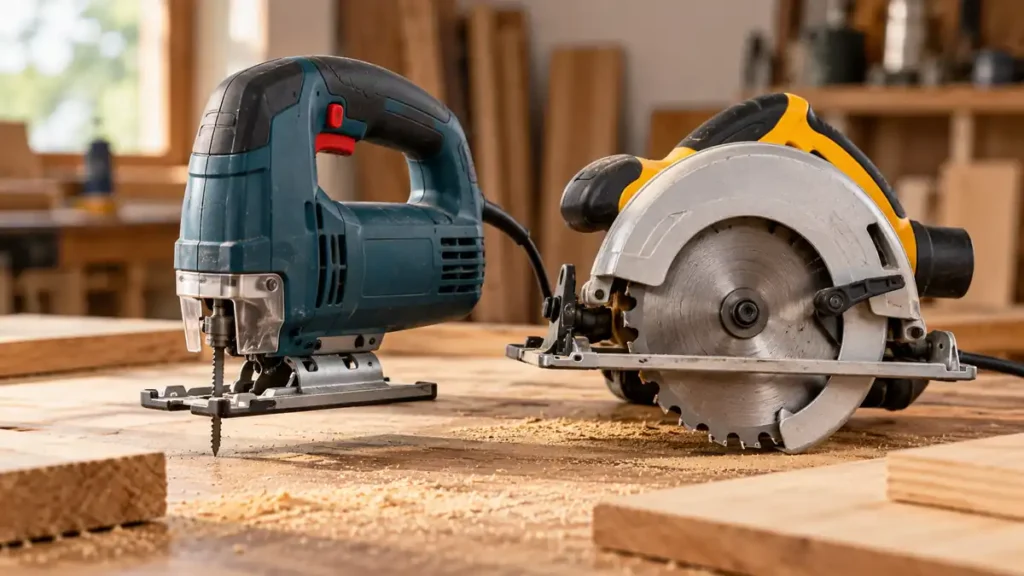
A jigsaw and a circular saw solve different cutting problems. A jigsaw uses a narrow reciprocating blade to cut curves, interior openings, and short straight lines. A circular saw uses a rotating round blade and is generally more efficient for long, straight cuts through sheet goods and dimensional lumber.
Neither tool is universally better. Choose a jigsaw for curved or irregular shapes and a circular saw for fast, straight cuts. Many woodworking and home-improvement projects benefit from having both because their capabilities overlap only in a few areas.
If your project calls for curves or interior openings, compare these jigsaws for woodworking cutouts and shaped cuts after checking the tool differences below.
Jigsaw vs. Circular Saw at a Glance
| Comparison | Jigsaw | Circular Saw |
|---|---|---|
| Blade movement | Narrow blade moves up and down | Round blade rotates continuously |
| Best suited for | Curves, cutouts, notches, and irregular shapes | Long straight cuts, crosscuts, and rip cuts |
| Curved cuts | Yes, within the blade’s turning limitations | No, an ordinary circular saw should follow a straight path |
| Long straight cuts | Possible, but slower and more vulnerable to blade deflection | Generally faster and easier, especially with a guide |
| Interior openings | Can begin through a properly prepared starter hole | Can make some plunge cuts, but is less suitable for detailed openings |
| Cut depth | Depends on the tool, material, and usable blade length | Depends on the saw, blade diameter, depth setting, and bevel angle |
| Bevel cuts | Available on models with an adjustable baseplate | Commonly available through an adjustable base and bevel mechanism |
| Main control concern | Blade wandering or deflection | Kickback and maintaining a straight cutting path |
How the Cutting Mechanisms Differ
A Jigsaw Uses a Reciprocating Blade
A jigsaw holds a narrow blade in a blade clamp and drives it through a repeated up-and-down stroke. Many models also provide orbital action, which adds a forward-and-back component to the blade movement. The exact orbital settings and their intended uses vary by model.
The blade’s narrow profile allows the operator to steer the saw around curves. Blade width, thickness, tooth geometry, material, and workpiece thickness all affect how tightly and accurately it can turn. Forcing a blade sideways through a radius that is too tight can bend or deflect it.
The jigsaw’s baseplate, also called the shoe, rests on the workpiece. Keeping it flat and applying controlled forward pressure helps stabilize the tool. A jigsaw can follow a straightedge, but the guide controls the tool body rather than the lower portion of the blade. The blade can still deflect beneath the surface.
A Circular Saw Uses a Rotating Blade
A circular saw drives a toothed round blade through the material. The saw’s base rides across the workpiece while the blade projects below it. Most models allow the operator to set cutting depth, and many have an adjustable bevel mechanism.
The rigid blade and continuous rotation make the circular saw well suited to efficient straight cuts. A guide, straightedge, or compatible guide rail can help control the path. The operator still needs to account for blade-to-base offset, blade kerf, workpiece movement, and proper support.
An ordinary circular saw is not intended to follow curves. Turning it during a cut can bind the blade and increase the risk of kickback.
Which Saw Makes Better Straight Cuts?
A circular saw is usually the stronger choice for long straight cuts. Typical examples include shortening boards, ripping plywood, cutting OSB, and trimming sheet materials to size. It cuts efficiently and can maintain a straighter path when used with a suitable guide and a properly supported workpiece.
A jigsaw can make straight cuts, particularly across smaller pieces or in locations where a circular saw is awkward to position. Its narrow blade is more likely to wander or deflect, especially in thick or dense material. Excessive feed pressure can make this problem worse.
For a straighter jigsaw cut:
- Use a compatible blade intended for the material and cut type.
- Select sufficient working length while maintaining clearance beneath the workpiece throughout the stroke.
- Keep the baseplate firmly supported on the material.
- Use a straightedge or compatible parallel guide when appropriate.
- Guide the saw at a controlled rate rather than forcing it forward.
- Replace worn, bent, or damaged blades.
A jigsaw may follow the marked line at the top while producing an angled cut surface underneath. A guide cannot fully prevent this because the unsupported portion of the blade can flex.
For a short straight cut within the jigsaw’s limits, review how to cut straight with a jigsaw.
Which Saw Is Better for Curves and Cutouts?
The jigsaw is the clear choice for curved paths, rounded corners, and irregular openings. Common applications include cutting a sink opening in a wood-based countertop, shaping a furniture component, creating a notch, or cutting an opening in a panel.
For an interior cut, a starter hole can provide an entry point for the jigsaw blade. The hole must offer enough clearance for the selected blade without forcing it against the edge. The workpiece and waste section also need support so the cutout does not fall, pinch the blade, or tear the material as the cut nears completion.
Some jigsaws can perform plunge cuts in certain materials, but this technique depends on the model, blade, material, and manufacturer instructions. A starter hole is often the more controlled approach.
A circular saw can make plunge cuts under appropriate conditions, but it remains a straight-cutting tool. It is poorly suited to detailed openings, tight corners, or curved outlines. A common approach for a large rectangular opening is to make straight portions with a circular saw where suitable, then finish corners or curved sections with a jigsaw. Cutting methods must remain within each tool manufacturer’s instructions.
For smaller and more intricate work, compare jigsaws versus scroll saws for finer patterns before choosing a stationary tool.
For shaped layouts, use the technique for following curves with a jigsaw.
Material and Thickness Affect the Choice
Tool selection cannot be separated from the material. Plywood, solid wood, laminate, plastic, aluminum, and steel require different blade designs and operating practices.
Sheet Goods and Lumber
A circular saw is commonly used to break down plywood and crosscut or rip lumber. The blade must suit the material, and the depth should be set according to the tool manufacturer’s instructions. Full support is especially important with large panels.
A jigsaw is useful for shorter cuts, curved panel edges, notches, and openings. Thick wood increases the chance of blade deflection. A longer blade does not guarantee a square cut, and total blade length is not the same as usable cutting length.
Laminate and Composite Panels
Either saw may cut certain laminate-faced or composite materials with the correct blade and technique. Tooth direction influences which face is more vulnerable to tear-out. Surface construction also varies, so blade guidance from the blade and material manufacturers should take priority over a universal face-up or face-down rule.
A circular saw is practical for straight sizing cuts. A jigsaw is better suited to shaped cutouts. Neither tool guarantees a chip-free edge.
Metal and Plastic
A jigsaw can cut certain metals and plastics when fitted with a compatible, material-specific blade. Steel, stainless steel, aluminum, acrylic, polycarbonate, and PVC do not behave identically. Speed, tooth geometry, workpiece thickness, and heat buildup all matter.
Some circular saws can cut certain nonferrous metals or other materials with an approved blade and configuration. This should never be assumed from the saw’s power rating alone. Confirm that the saw, blade, and guarding arrangement are approved for the material.
Accuracy, Speed, and Surface Quality
A circular saw generally cuts straight material faster than a jigsaw, but speed does not guarantee accuracy or a clean edge. Blade condition, tooth design, guide setup, base stability, and workpiece support all influence the result.
A jigsaw trades straight-line efficiency for maneuverability. It can navigate shapes that a circular saw cannot, though tight turns and thick stock increase the likelihood of wandering or blade deflection. Narrow blades may handle tighter curves, while wider, stiffer blades may track straighter. Exact performance depends on the individual blade and material.
Both tools can produce splintering, chipping, or rough edges if the blade is poorly matched to the work. Orbital action on a jigsaw may increase cutting aggressiveness in suitable wood applications, but higher orbital action can reduce edge quality. Selector positions are model-specific, so consult the operating manual rather than applying one setting across all jigsaws.
Portability and Working Space
Jigsaws and circular saws are both handheld tools available in corded and cordless configurations. Cordless operation can reduce cord-management concerns, while corded tools provide a continuous electrical supply near a suitable outlet. Performance cannot be determined from the power source alone.
A jigsaw’s smaller cutting zone can be useful around installed panels, openings, and confined areas. A circular saw needs enough room for its base, blade path, guard movement, and a stable approach to the cut. Its blade also projects beneath the workpiece, which makes clearance below the material critical.
For cordless tools, battery compatibility depends on the exact manufacturer platform and model. Matching voltage labels from different brands do not establish compatibility.
Safety Differences That Affect Tool Selection
Both saws can cause severe injuries. Read the manual for the exact model, inspect the tool and blade before use, and use suitable eye, hearing, and material-specific respiratory protection.
Circular Saw Safety
Kickback is a central circular saw hazard. It can occur when the blade becomes pinched, bound, misaligned, or improperly controlled. Support the work so the kerf does not close on the blade, keep both hands in the intended operating positions, and never reach beneath the workpiece while cutting.
Confirm that the lower guard moves freely and returns as specified by the manufacturer. Never tie, wedge, or otherwise defeat the guard. Wait for the blade to stop before setting the saw down.
Jigsaw Safety
A jigsaw blade extends below the workpiece and continues moving briefly after the trigger is released. Check for adequate clearance beneath the cut and keep hands away from both the visible cut line and the underside of the material.
Secure the workpiece so it cannot vibrate, rotate, or close around the blade. Disconnect a corded tool or remove the battery, as directed by the manufacturer, before changing the blade or making adjustments. Allow a hot blade to cool before handling it.
Safety Practices for Both Tools
- Inspect the cutting area for hidden fasteners, wiring, pipes, or other hazards.
- Clamp and support the material on a stable surface.
- Position supports so the blade will not cut into them.
- Keep power cords away from the cutting path.
- Use blades approved for the tool and material.
- Do not operate a tool with a damaged cord, battery, guard, base, or blade clamp.
- Let the blade reach normal operating motion before entering the material, following the manufacturer’s procedure.
- Allow all moving parts to stop before setting the tool down or inspecting the cut.
How to Choose Between a Jigsaw and a Circular Saw
Use a jigsaw for:
- Curved and irregular cutting lines
- Rounded corners and decorative shapes
- Interior openings started from a prepared hole
- Notches and short trimming cuts
- Tasks requiring maneuverability around a marked outline
Use a circular saw for:
- Long straight cuts in sheet goods
- Crosscutting and ripping suitable lumber
- Efficient repeated straight cuts
- Straight bevel cuts within the saw’s documented capacity
- Panel sizing with a straightedge or compatible guide system
Use both when a project combines long straight sections with curves or detailed corners. For example, a large panel may be sized with a circular saw before a jigsaw cuts the shaped opening. Plan the sequence so every remaining section stays securely supported.
Frequently Asked Questions
Can a Jigsaw Replace a Circular Saw?
A jigsaw can complete some short straight cuts, but it is generally slower and more susceptible to blade deflection. It is a limited substitute for occasional trimming, not an equivalent replacement for efficient long rip cuts or repeated crosscuts.
Can a Circular Saw Replace a Jigsaw?
A circular saw can handle straight sections, but it cannot follow curved paths like a jigsaw. It is also less practical for detailed interior openings and small-radius shapes.
Which Saw Is Easier for a Beginner to Control?
The answer depends on the cut. A jigsaw’s slower progress may feel manageable for short cuts and gentle curves, while a guided circular saw can make straight panel cuts more efficiently. Each tool has distinct hazards and requires instruction, stable support, and correct blade selection.
Which Tool Makes a Cleaner Cut?
Cut quality depends on the blade, material, tool setup, feed rate, and support. A circular saw often produces a more consistent straight edge with an appropriate blade and guide. A jigsaw provides better shape control but may leave a rougher or less square edge, especially in thick material.
Select the Saw According to the Cut
A jigsaw is the practical choice for curves, notches, and shaped openings. A circular saw is generally preferable for fast, long, straight cuts. Match the blade to the tool and material, support the workpiece securely, and follow the operating manual for blade installation, adjustments, and safe cutting procedures.
