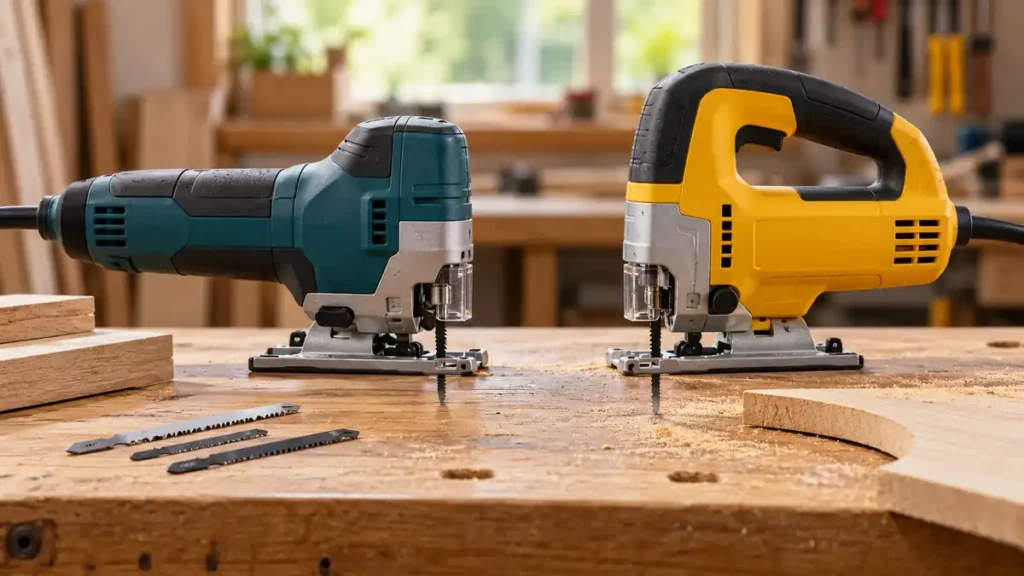
A barrel-grip jigsaw places the operator’s hand around the motor housing, close to the baseplate and cutting area. A D-handle jigsaw has a raised upper handle, usually with a trigger under the fingers. Both can make straight cuts, curves, cutouts, and bevel cuts when equipped with a suitable blade. The better configuration depends mainly on hand fit, control layout, cutting position, and personal comfort. Grip style alone does not determine accuracy, power, or cut quality.
Barrel grips often appeal to users who prefer a low hand position and direct steering through curves. D-handles provide a familiar power-tool grip, convenient trigger control, and additional clearance between the hand and workpiece. Specific models vary considerably, so two jigsaws with the same grip type may feel and operate differently.
If you prefer a low steering position, compare these barrel-grip jigsaws while checking the grip and switch differences below.
Barrel Grip vs. D-Handle Jigsaw at a Glance
| Feature | Barrel-Grip Jigsaw | D-Handle Jigsaw |
|---|---|---|
| Primary hand position | Around the motor housing | On a raised upper handle |
| Typical control arrangement | Separate on/off switch and speed control are common | Trigger-style speed control is common |
| Hand height | Usually closer to the baseplate | Usually higher above the baseplate |
| Common ergonomic appeal | Low steering position and close control of the saw body | Familiar grip and easy access to a finger-operated trigger |
| Possible concern | A wide housing may be uncomfortable for smaller hands | The higher grip may feel less direct to some users |
| Cutting capability | Depends on the complete tool, blade, settings, and technique | Depends on the complete tool, blade, settings, and technique |
| Best fit | Users who prefer a low grip and body-switch controls | Users who prefer a conventional upper handle and trigger |
These are typical patterns rather than universal specifications. Control placement, grip circumference, balance, battery location, and switch behavior vary by model.
How a Barrel-Grip Jigsaw Is Held and Controlled
The motor housing serves as the main gripping surface on a barrel-grip jigsaw. This places the operator’s hand relatively close to the baseplate, which can make steering inputs feel direct. Some users find this position comfortable for following curved lines or guiding the saw through detailed cutouts.
Many barrel-grip models use a dedicated on/off switch rather than a spring-loaded trigger. Cutting speed may be selected through a separate dial or electronic control. This arrangement can support a consistent preset speed without continuous trigger pressure, but stopping the tool may require moving a finger or thumb to the switch. The exact operation should be checked in the tool’s manual before cutting.
Housing diameter matters. A motor housing that feels secure in one person’s hand may feel too wide or difficult to grasp in another’s. Gloves can change the effective grip size and access to controls. The housing can also become warm during demanding work, although heat behavior depends on the model and operating conditions.
How a D-Handle Jigsaw Is Held and Controlled
A D-handle jigsaw uses an upper loop or top handle separated from the motor housing. Most models place a trigger beneath the handle, allowing the operator to start, stop, and often vary speed with the index finger. Some tools include a lock-on function, while others do not.
The raised handle creates space for the fingers and may feel familiar to anyone accustomed to drills, circular saws, or other trigger-controlled power tools. It can also provide a clear physical reference for lifting and repositioning the saw while it is switched off.
Because the hand sits farther above the baseplate, steering may feel different from a barrel grip. Some operators appreciate the leverage and open grip area. Others prefer to hold the saw closer to the work surface. Neither response establishes a general performance advantage.
For the raised-grip option, compare these D-handle jigsaws by trigger access and controls.
Which Grip Provides Better Control?
Control depends on how securely the operator can hold the tool while keeping the baseplate flat against the workpiece. A barrel grip’s lower hand position can feel stable during curved cuts. A D-handle’s trigger and open handle can make speed changes and stopping feel more immediate. Hand size, wrist position, cutting direction, and access to the workpiece all influence the result.
Accuracy is affected more broadly by:
- Using a blade compatible with the jigsaw’s blade clamp
- Selecting a blade suitable for the material and type of cut
- Supporting and clamping the workpiece securely
- Keeping the baseplate in firm contact with the surface
- Using controlled feed pressure rather than forcing the saw
- Choosing suitable speed and orbital-action settings
- Watching for blade wear, damage, or deflection
A straightedge can help control the tool’s path during a straight cut, but it cannot guarantee a square cut surface. The blade may still deflect below the top face, especially in thick material or under excessive feed pressure. The same limitation applies to both handle styles.
Cut-Line Visibility and Cutting Orientation
The lower profile of a barrel-grip jigsaw may give some users a favorable view of the blade area. Yet visibility also depends on the motor housing shape, blade guard, dust blower, lighting, extraction equipment, and the side from which the line is viewed. A D-handle does not automatically block the cut line, and a barrel grip does not automatically provide a clearer view.
Tool orientation can change the ergonomic comparison. A low grip may help where overhead clearance is limited, while a raised handle may provide easier access in other positions. Cutting from below or operating a jigsaw in an inverted position introduces control and visibility concerns. Such use should occur only if the manufacturer permits it and the work can be secured safely. A grip that feels comfortable does not make an unsupported cutting position safe.
Curves, Straight Cuts, and Bevels
Curved Cuts
Barrel grips are frequently associated with curved cutting because the hand sits close to the saw body. That may help an operator make small directional inputs. The achievable curve still depends heavily on blade width, blade construction, material thickness, and the radius of the intended path.
A narrow blade intended for curves can turn more readily than a broad blade intended for straight cuts, within the blade manufacturer’s stated applications. Forcing either jigsaw sideways can twist or deflect the blade. Relief cuts may help remove waste around tight shapes where suitable for the project.
For a shaped molding joint, see the workflow for coping molding with a jigsaw and choose a compatible setup.
Straight Cuts
Both configurations can follow a marked line or compatible guide. Blade stiffness, baseplate alignment, workpiece support, and steady feed pressure matter more than handle shape. A jigsaw is useful for shorter straight cuts and cuts that begin as internal openings, but long cuts requiring high precision may be better suited to another properly configured saw.
Bevel Cuts
Grip style does not determine bevel capability. Bevel adjustment comes from the baseplate mechanism and varies by model. Tilting the baseplate changes the saw’s working geometry and can make blade deflection more noticeable. Disconnect a corded tool or remove the battery, where the manufacturer directs, before changing the baseplate angle. Confirm that the adjustment is locked before restarting.
Controls May Matter More Than Handle Shape
The switch arrangement can be more significant than the physical grip. A variable-speed trigger allows speed to respond to finger pressure, while a separate dial establishes a selected speed range or operating speed according to the tool’s design. Some barrel-grip saws use an on/off slide switch. Some D-handle saws combine a trigger with a speed dial.
Before selecting either style, examine these practical details:
- Can the main switch be reached without weakening the grip?
- Can the tool be stopped promptly from the normal operating position?
- Is accidental switch activation adequately controlled?
- Are the speed and orbital selectors easy to identify while the tool is stopped?
- Does the grip remain comfortable with the hand protection appropriate for the task?
- Can the baseplate stay flat without an awkward wrist angle?
Switch operation should never be assumed from appearance. Review the manufacturer’s instructions, particularly for lock-on controls and restart behavior after a power interruption or battery installation.
Corded and Cordless Options
Barrel-grip and D-handle jigsaws are available in corded and cordless configurations. The power source is separate from the handle comparison.
A corded jigsaw receives continuous power from an appropriate electrical supply, but its cord must be kept clear of the blade and cutting path. A cordless jigsaw removes that cord-management issue, while adding a battery that can affect weight distribution and grip balance. Runtime varies with the battery, material, blade, settings, and workload.
Battery compatibility depends on the exact manufacturer platform and model. A shared voltage label does not establish compatibility across brands or every product generation. Use batteries and chargers approved in the tool documentation, and do not modify battery connections to fit another system.
Blade Compatibility Is Independent of Grip Style
A barrel grip and a D-handle may use the same general blade shank type, but that cannot be presumed. The blade must match the specific tool’s clamping mechanism and be suitable for the material being cut.
T-shank blades are common in modern jigsaws, while some tools use U-shank blades or a holder with particular compatibility requirements. Physical insertion alone does not prove that a blade is correctly retained. Check the tool manual for accepted shank types, blade installation, and clamp operation.
Cutting performance then depends on blade characteristics such as tooth geometry, blade material, width, thickness, working length, and intended application. The grip configuration does not turn an unsuitable blade into a suitable one.
How to Choose Between the Two Grip Styles
Choose by evaluating the complete jigsaw rather than treating the handle as an isolated feature. If possible, handle the tool while it is disconnected from power or has its battery removed. Keep fingers away from the blade area during this assessment.
- Check hand fit. Confirm that the barrel diameter or upper handle can be held securely without excessive finger stretch.
- Assess wrist position. Simulate a normal cutting stance with the baseplate resting on a stable surface. The wrist should not need an uncomfortable bend to keep the shoe flat.
- Locate the controls. Identify the power switch, speed control, orbital selector, blade release, and bevel adjustment. Confirm that their use is understandable from the manual.
- Consider the usual cuts. A low barrel grip may suit someone who frequently guides curves, while a trigger-controlled D-handle may suit someone who values familiar start-stop operation.
- Account for the power source. A cord or battery can change balance and access independently of the handle.
- Verify blade compatibility. Confirm the supported shank interface and available blades for the intended materials.
- Review the entire tool. Baseplate construction, blade guidance, speed control, orbital action, dust handling, and service requirements can outweigh grip preference.
Safe Operation Is the Same Priority for Both
Whichever configuration is used, secure the workpiece and provide clearance beneath the cut. Keep hands away from the blade path and from the underside of the material. Inspect the cutting area for hidden wiring, fasteners, or other hazards before starting.
Install blades with the tool disconnected from mains power or with the battery removed as directed by the manufacturer. Confirm that the blade is retained correctly, and avoid touching a blade that may be hot after cutting. During use, keep the baseplate supported and guide the tool without excessive forward or sideways pressure.
Wait for the blade to stop before setting the jigsaw down. Disconnect the power source before inspecting the blade, clearing a jam, changing settings that require access near moving parts, or performing maintenance.
Whichever grip you choose, follow the basic jigsaw operating sequence for supported, controlled cutting.
Which Jigsaw Grip Is the Better Fit?
A barrel-grip jigsaw is a strong candidate for someone who prefers a low hand position, close contact with the motor housing, and separate switch controls. A D-handle jigsaw may suit someone who wants an open upper handle and familiar trigger operation.
Neither design is inherently more accurate or powerful. The practical choice rests on secure hand fit, comfortable wrist alignment, accessible controls, suitable blades, and the requirements of the complete tool. Comparing those details provides a more reliable answer than choosing by handle shape alone.
