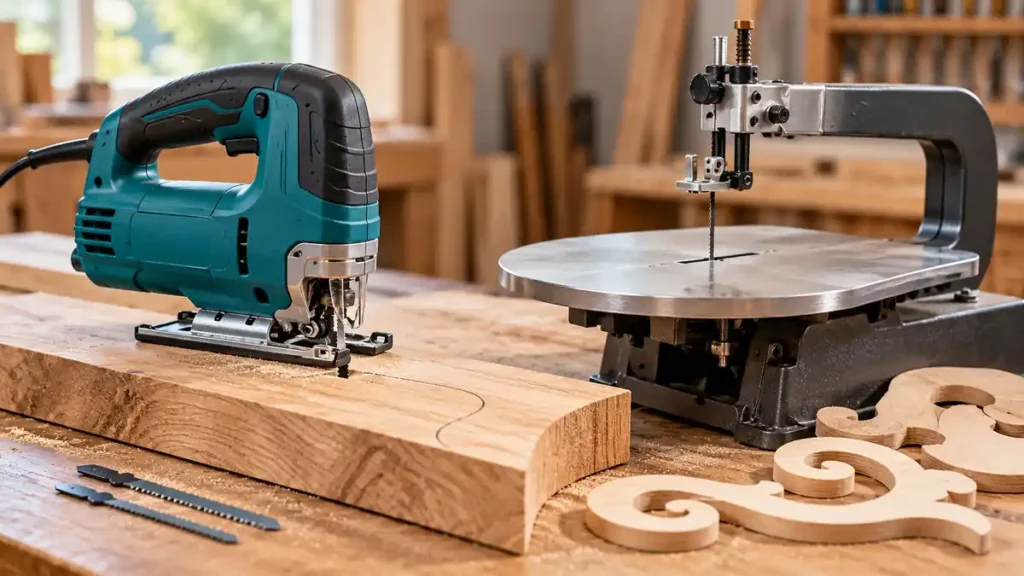
A jigsaw is a handheld power saw that moves across a supported workpiece, while a scroll saw is a stationary machine that requires the operator to guide the workpiece across a table. A jigsaw is better suited to portable cutting, larger workpieces, construction materials, and general curved cuts. A scroll saw is better suited to intricate patterns, tight curves, small components, and detailed internal cutouts.
Neither tool is universally better. The right choice depends mainly on the size of the workpiece, the complexity of the pattern, the material thickness, and whether portability matters.
If you need to move the saw around a larger workpiece, compare these jigsaws for portable curved cuts rather than choosing a stationary scroll saw for the job.
Jigsaw vs. Scroll Saw at a Glance
| Comparison | Jigsaw | Scroll Saw |
|---|---|---|
| Tool configuration | Handheld and portable | Stationary benchtop or stand-mounted machine |
| Workpiece handling | The workpiece remains supported while the saw moves | The saw remains stationary while the operator moves the workpiece |
| Blade support | Blade is clamped at one end | Thin blade is held under tension between upper and lower blade holders |
| Best curve type | Broad curves and general-purpose shapes | Tight curves and intricate patterns |
| Internal cutouts | Blade enters through a drilled starter hole, or through a plunge cut where the tool, material, and procedure permit it | Blade can be released, threaded through a starter hole, and reattached |
| Typical workpiece size | Suitable for large panels and installed materials | Limited by the table and the saw’s throat capacity |
| Typical material thickness | Generally better suited to thicker stock within the tool and blade capacities | Commonly used for thinner workpieces and detailed work |
| Portability | High, especially with cordless models | Low |
| Blade compatibility | Uses jigsaw blades compatible with its blade clamp | Uses scroll saw blades compatible with its blade holders |
| Common applications | Panel cutouts, countertops, flooring, broad curves, and general repairs | Fretwork, ornaments, lettering, puzzles, and decorative patterns |
How the Cutting Mechanisms Differ
A Jigsaw Moves Around the Workpiece
A jigsaw uses a short reciprocating blade that projects below its baseplate, also called the shoe. The operator places the baseplate on the material and guides the entire tool along a marked line. The blade is secured at its upper end and remains unsupported at its lower end.
This arrangement gives the jigsaw considerable freedom. It can cut a large panel without the panel having to fit on a machine table. It can also make openings in countertops, cabinets, sheet materials, and other workpieces that would be awkward to maneuver through a stationary saw.
The unsupported blade end creates a practical limitation. Excessive feed pressure, thick material, a dull blade, or a curve that is too tight can cause the blade to deflect. The cut may follow the line at the top surface while drifting away from square underneath.
A Scroll Saw Holds Its Blade Under Tension
A scroll saw has a table with a thin blade passing through an opening. The blade is attached to upper and lower holders and is kept under tension as it reciprocates. Instead of pushing the saw across the material, the operator guides the material around the blade.
The narrow, tensioned blade supports precise directional changes in relatively thin stock. This makes the machine particularly useful for detailed silhouettes, lettering, fretwork, small-radius curves, and repeated internal openings.
Workpiece size is constrained by the machine. The distance from the blade to the rear frame, commonly called throat capacity, limits how far the blade can reach into a workpiece. The table must also support the material while allowing it to rotate through the required pattern.
Which Saw Produces Better Curves?
A scroll saw usually offers better control for small, intricate curves. Its fine blade removes a narrow path of material, and the operator can rotate a small workpiece around the stationary cutting point. This configuration is well suited to delicate patterns with frequent changes in direction.
A jigsaw works well for broader curves in panels, lumber, laminate, and similar materials. Narrow jigsaw blades can follow tighter paths than wide blades, but each blade has a practical turning limit. Forcing the tool sideways through a radius that is too tight can twist or bend the blade.
Relief cuts can help a jigsaw navigate complex outlines. These short cuts run from the waste edge toward the pattern line, allowing sections of waste to fall away as the main curve progresses. They reduce the amount of material pressing against the sides of the blade.
Curve quality with either saw depends on the blade, material, feed pressure, and operator control. A narrow blade does not guarantee a clean result if it is unsuitable for the material or pushed beyond its intended radius.
Internal Cutouts Favor Different Types of Work
Both saws can make internal cutouts, but the setup differs.
With a jigsaw, the usual approach is to drill a starter hole large enough for the selected blade. The blade is inserted through the opening before the saw starts, with the baseplate resting firmly on the workpiece. Some jigsaws and applications permit plunge cutting, but that technique requires greater control and must be supported by the tool manufacturer’s instructions. A starter hole is generally the more controlled method.
For a scroll saw cutout, the operator typically drills a small access hole, releases one end of the scroll saw blade, threads it through the hole, and reconnects and tensions it according to the machine’s instructions. The process can be repeated for each enclosed section of a pattern.
The jigsaw approach is practical for openings such as sink cutouts, ventilation openings, and access holes. A scroll saw is more efficient for patterns containing numerous small enclosed shapes, provided the workpiece fits the machine.
Material Size and Thickness Affect the Choice
Large Panels and Installed Materials
A jigsaw has the advantage when the workpiece cannot be brought to a stationary machine. Plywood sheets, laminate countertops, flooring, wall panels, and installed cabinetry can be cut while supported in place or on suitable work supports.
The workpiece must be clamped or stabilized, with clearance below the cutting path. For a large cutout, support the waste section so it cannot fall and tear the remaining material as the cut is completed.
Small and Delicate Components
A scroll saw provides a table-supported cutting surface for smaller workpieces. Its fine blade and stationary cutting point help with decorative wooden parts, thin plastic pieces, craft patterns, and similar detailed projects.
Very small pieces still require careful handling. Hands must remain clear of the blade, and any hold-down or guard components should be set and used according to the machine manual.
Thicker Stock
Jigsaws are generally more practical for thicker wood and construction materials, subject to the documented capacity of the exact tool and blade. Blade working length, stiffness, tooth design, material type, and clearance through the full stroke all matter.
A scroll saw’s capacity varies by model, but these machines are primarily associated with detailed cutting rather than deep cuts through heavy stock. Thick or dense material also reduces maneuverability and can make a fine blade more prone to wandering or breakage.
Blade Designs Are Not Interchangeable
Jigsaw blades and scroll saw blades are separate accessory types. A blade made for one tool should never be modified to fit the other.
A jigsaw commonly uses a T-Shank or, on some tools, a U-Shank blade. The required interface depends on the blade clamp specified by the jigsaw manufacturer. Physical attachment is only the first compatibility check. The blade must also suit the material, thickness, curve, and desired cut quality.
Scroll saw blades are much thinner and are held at both ends. Depending on the machine, the holders may accept plain-end blades, pin-end blades, or specific compatible configurations. Plain-end blades are often associated with fine internal work because they can pass through small access holes, but exact compatibility must be confirmed in the scroll saw manual.
Blade selection affects control on both machines:
- Narrow blades can generally negotiate tighter curves, within the blade manufacturer’s limitations.
- Wider or stiffer jigsaw blades can provide more support for broad curves and straighter cuts.
- Tooth geometry and pitch must match the material and its thickness.
- Blade working length must provide safe clearance through the entire jigsaw stroke.
- Blade condition matters because worn, bent, or damaged blades can wander or produce rough cuts.
Choose from curve-cutting jigsaw blades when the work calls for a handheld saw and a tighter turning profile.
Neither Saw Is Ideal for Every Straight Cut
A jigsaw can make short or moderate straight cuts, particularly with a suitable blade and a compatible straightedge or parallel guide. The baseplate should remain flat against the material, and the saw should advance without excessive pressure.
A guide controls the path of the tool body, but it cannot fully prevent blade deflection beneath the surface. Long cuts requiring consistently square edges are often better handled by a saw intended for efficient straight cutting.
A scroll saw can cut straight sections in small workpieces, but its fine blade can follow grain or wander if the material is pushed carelessly. It is also inefficient for breaking down large panels. Its main strength is controlled pattern cutting rather than long, straight ripping or crosscutting.
Choosing the Right Saw for the Project
For the portable option, follow the method for cutting a curve with a handheld jigsaw.
Use a Jigsaw For:
- Curved openings in plywood, countertops, and sheet materials
- Broad arcs and irregular shapes
- Workpieces that are too large for a scroll saw table
- Cutting installed or difficult-to-move materials
- Portable work away from a fixed bench
- Thicker stock within the jigsaw and blade manufacturers’ stated capacities
Use a Scroll Saw For:
- Intricate decorative patterns
- Tight curves in relatively thin material
- Letters, ornaments, puzzles, and fretwork
- Patterns containing many small internal cutouts
- Small components that can be maneuvered safely on the table
- Projects where fine control matters more than portability or cutting speed
Using Both Tools
The two tools can complement each other. A jigsaw can rough-cut a project blank from a larger sheet, leaving material outside the pattern line. The smaller blank can then move to a scroll saw for detailed shaping, provided its dimensions and material fall within the scroll saw’s capacity.
Safety and Setup Differences
With a jigsaw, secure and support the workpiece before cutting. Check beneath the cutting path for clamps, benches, cords, fasteners, or hidden hazards. Keep the baseplate supported, maintain blade clearance, and keep hands away from both the visible cutting area and the underside of the material.
Disconnect a corded jigsaw or remove its battery, as directed by the manufacturer, before changing the blade or adjusting the baseplate. Confirm that the replacement blade is compatible and fully secured before reconnecting power.
At a scroll saw, keep the workpiece flat against the table while maintaining control around the blade. Set blade tension, guards, hold-down components, and table adjustments according to the machine manual. Disconnect power before installing a blade, threading it through an internal cutout, or changing machine adjustments.
Eye protection is relevant for both tools. Material-specific dust and chips also require suitable controls. A blower may improve line visibility, but it does not collect airborne dust. Use dust extraction and protective equipment appropriate to the material and the manufacturer’s instructions.
Frequently Asked Questions
Can a Jigsaw Replace a Scroll Saw?
A jigsaw can handle many general curved cuts, but it cannot match a scroll saw’s control on very small radii and intricate patterns. Its larger, one-end-supported blade also creates a wider cut and greater potential for deflection. For broad shapes or large workpieces, the jigsaw may be the more practical tool.
Can a Scroll Saw Replace a Jigsaw?
A scroll saw can perform detailed cuts that overlap with some jigsaw work, but its stationary design limits workpiece size and portability. It is poorly suited to cutting installed materials, large panels, and many thicker construction materials.
Which Saw Is Better for Making Wooden Puzzles?
A scroll saw is generally better for detailed wooden puzzles because its fine blade can follow tight, closely spaced shapes. A jigsaw may be useful for cutting a larger sheet into manageable blanks before the detailed work begins.
Which Saw Is Better for Cutting a Countertop Opening?
A jigsaw is the practical choice for most supported wood-based or laminate countertop cutouts. Blade selection must match the countertop construction, and the cutout section needs support near the end of the cut. Stone, metal, solid-surface, and other countertop materials can require different tools and manufacturer-approved procedures.
Are Jigsaw and Scroll Saw Blades Interchangeable?
No. Jigsaw blades attach at one end using a compatible shank and clamp, while scroll saw blades are held at both ends under tension. Use only blade types approved for the exact tool.
Which Tool Should You Use?
Choose a jigsaw for portable work, larger pieces, broad curves, panel openings, and materials that exceed the practical scope of a scroll saw. Choose a scroll saw for fine pattern work, tight curves, delicate components, and projects with numerous internal cutouts.
The central difference is how the work is controlled. A jigsaw moves around a stationary workpiece, while a scroll saw keeps the blade stationary and lets the operator guide the workpiece. That distinction determines each tool’s strengths, limitations, and most suitable applications.
