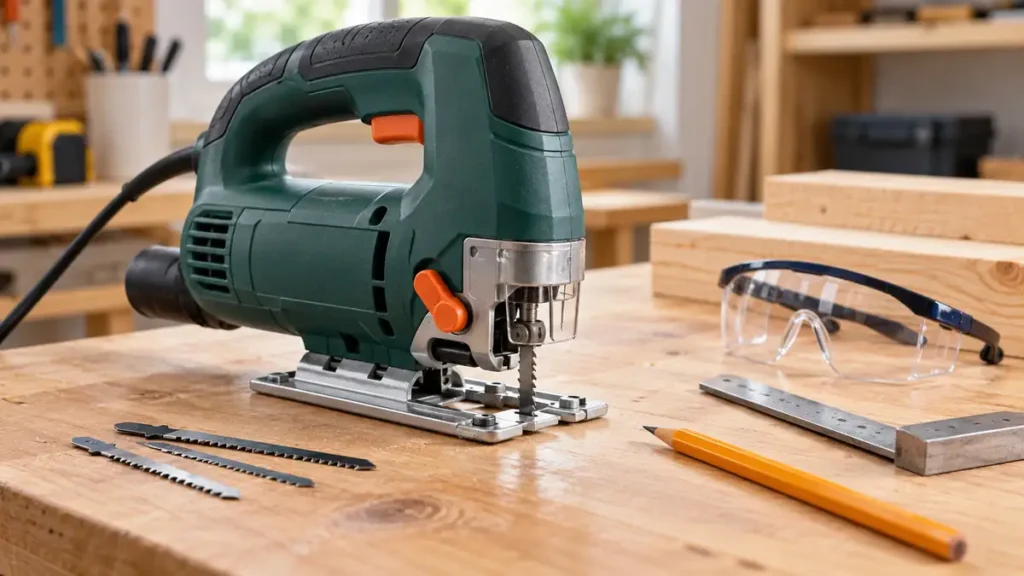
The best beginner jigsaw is one whose controls make sense before the blade touches the board. A stable shoe, a visible pencil line, and a convenient blade clamp make learning easier. Variable speed lets you start deliberately, and a supported scrap piece gives you a safe place to practice curves before cutting a finished part.
This selection compares electric jigsaw tools for first woodworking and home-repair projects. The BLACK+DECKER BDEJS300C is the simplest starting point, while the other picks add orbital control, lighting, compact handling, or compatibility with batteries you may already own.
Quick Answer
Best Simple Starter: BLACK+DECKER BDEJS300C. The compact body and quick clamp keep setup straightforward. Practice short straight cuts and gentle curves on supported scrap before trying a detailed shape.
Best Basic Feature Mix: Hammerhead HAJS048. Orbital adjustment gives you a useful learning tool: compare straight action with a more aggressive wood setting on the same offcut. The tool-free clamp makes changing to a fresh blade easier.
Best for Controlled Stops: SKIL JS313101. Variable speed and a brake help with short cuts that finish at a marked point. Start slowly and wait for the blade to stop before lifting the saw away.
Best Jigsaws for Beginners Comparison Table
| Product | Best For | Specifications / Compatibility | Key Features |
|---|---|---|---|
| BLACK+DECKER BDEJS300C | Best Simple Starter | Corded, 4.5A | Compact body; wire sightline guard; quick clamp |
| Hammerhead HAJS048 | Best Basic Feature Mix | Corded, 4.8A | Variable speed; orbital action; dust port |
| SKIL JS313101 | Best for Controlled Stops | Corded, 5A | Variable speed; brake; switchable blower |
| DEKOPRO Corded Jigsaw | Best for Learning Guide Cuts | Corded | Six speed settings; four orbital settings; parallel guide |
| SKIL JS314901 | Best Work-Light Setup | Corded, 6A | Halo light; tool-free bevel; switchable blower |
| Makita 4329K | Best Compact Corded Step Up | Corded, 3.9A | Compact body; speed dial; through-body vacuum port |
| DEWALT DCS334B | Best for DEWALT Battery Owners | 20V MAX, bare tool | Brushless motor; trigger and dial; LED |
| BOSCH JS120N | Best Low-Grip Compact Option | 12V Max, bare tool | Compact barrel grip; LED; tool-free blade ejector |
| BLACK+DECKER BDCJS20B | Best for POWERCONNECT Owners | 20V MAX, bare tool | Variable trigger; U- and T-shank clamp; blower |
1. BLACK+DECKER BDEJS300C — Best Simple Starter

The BDEJS300C takes a straightforward approach to light cutting. Its 4.5-amp motor runs up to 3,000 strokes per minute with variable-speed control, giving you a way to ease into a marked line. The compact housing is useful for occasional repairs and small panels. A wire sightline guard and dust blower help keep the area ahead of the blade visible. The quick-clamp blade system allows tool-free changes, while the shoe adjusts for bevel cuts up to 45 degrees. It suits buyers who value simple controls over an extensive set of specialty adjustments.
The compact body and quick clamp keep setup straightforward. Practice short straight cuts and gentle curves on supported scrap before trying a detailed shape.
Pros
- Compact corded body
- Variable-speed control
- Wire guard preserves a sightline
- Dust blower
- Quick-clamp blade changes
Cons
- Corded design needs a nearby outlet
- Less suited to demanding daily production than larger professional saws
The BLACK+DECKER BDEJS300C is the best simple starter in this comparison. Its compact body; wire sightline guard; quick clamp make it worth considering when those features match your next project.
To buy this product, click here.
2. Hammerhead HAJS048 — Best Basic Feature Mix

The HAJS048 covers ordinary DIY cutting with a 4.8-amp corded motor, variable speed, and a four-stage orbital selector. The metal base adjusts for bevel cuts up to 45 degrees. Its T-shank blade clamp releases without a separate tool, which is convenient when moving from a wood curve to another material. Two wood blades are included for a basic start. The dust port can be connected to a suitable vacuum setup, making it a useful feature for a fixed workbench where a nearby outlet and hose are already available.
Orbital adjustment gives you a useful learning tool: compare straight action with a more aggressive wood setting on the same offcut. The tool-free clamp makes changing to a fresh blade easier.
Pros
- Corded power for bench projects
- Variable speed and orbital action
- Tool-free T-shank blade changes
- 45-degree bevel adjustment
- Dust port and starter wood blades
Cons
- Cord limits movement around large panels
- Included wood blades do not cover every material
The Hammerhead HAJS048 is the best basic feature mix in this comparison. Its variable speed; orbital action; dust port make it worth considering when those features match your next project.
To buy this product, click here.
3. SKIL JS313101 — Best for Controlled Stops
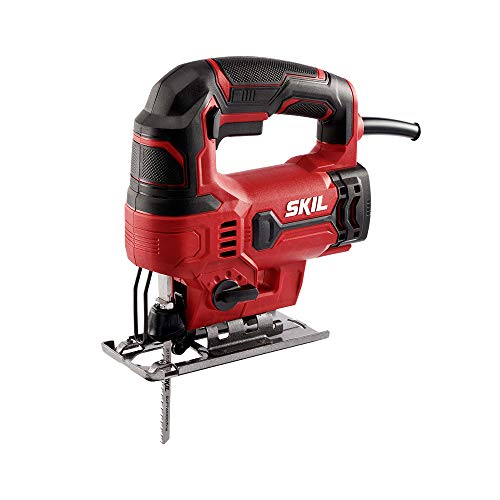
The JS313101 offers a 5-amp motor, variable-speed control, and a brake function in a corded DIY saw. Its four-stage orbital selector lets you adjust the cutting action to suit the blade and material. The shoe tilts for angled cuts, while the on/off blower helps keep the line visible. The tool-free clamp makes blade changes simpler during a mixed-material project. It is a practical entry point for buyers who want familiar top-handle operation and useful adjustments without paying for a separate battery system.
Variable speed and a brake help with short cuts that finish at a marked point. Start slowly and wait for the blade to stop before lifting the saw away.
Pros
- 5-amp corded motor
- Variable speed and brake function
- Four-stage orbital action
- Switchable blower
- Tool-free blade clamp
Cons
- No cordless freedom of movement
- No halo lighting system like the JS314901
The SKIL JS313101 is the best for controlled stops in this comparison. Its variable speed; brake; switchable blower make it worth considering when those features match your next project.
To buy this product, click here.
4. DEKOPRO Corded Jigsaw — Best for Learning Guide Cuts

This DEKOPRO corded model combines six speed settings with four orbital positions. That gives a home user useful ways to change the action between deliberate detail work and faster cuts in suitable wood. The base adjusts for bevels, with marked positions including 0, 15, 30, and 45 degrees. A tool-less blade release makes changes convenient, and the parallel guide helps establish an offset from a straight edge. The dust-port adapter is useful for a bench vacuum setup, although the hose is not part of the package.
The parallel guide is useful for learning how shoe position and offset affect a cut. Clamp the board and check the guide on scrap before relying on it for a visible edge.
Pros
- Six speed settings
- Four orbital positions
- Marked bevel positions
- Tool-less blade release
- Parallel guide and dust-port adapter
Cons
- Vacuum hose is not included
- Power cord must stay clear of the cut
The DEKOPRO Corded Jigsaw is the best for learning guide cuts in this comparison. Its six speed settings; four orbital settings; parallel guide make it worth considering when those features match your next project.
To buy this product, click here.
5. SKIL JS314901 — Best Work-Light Setup
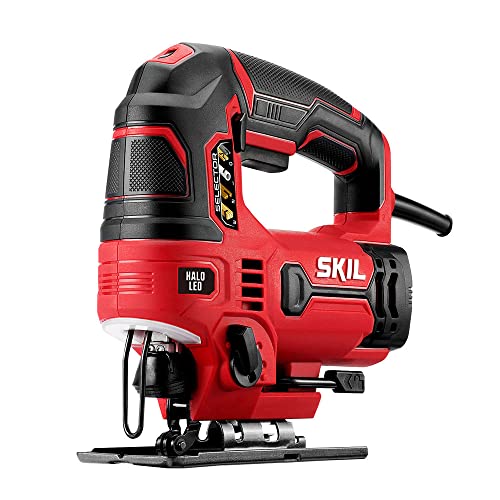
The JS314901 is SKIL’s 6-amp corded option with a two-finger trigger for speed control. Its four-stage orbital function lets you change the blade action, while the shoe bevel adjusts without a separate tool. The halo light surrounds the cutting area with illumination, helping reduce shadows around a pencil line. A switchable blower gives you a way to clear loose dust when needed. The tool-free blade clamp also saves setup time when a project moves between different blade types.
The halo light helps when workshop lighting leaves a shadow around the blade. Tool-free bevel adjustment is convenient once you progress from square cuts to angled edges.
Pros
- 6-amp corded motor
- Two-finger speed trigger
- Halo light illuminates the cut
- Tool-free bevel adjustment
- Switchable blower and tool-free blade clamp
Cons
- Needs cord clearance around the work
- Blower clears dust but does not collect it
The SKIL JS314901 is the best work-light setup in this comparison. Its halo light; tool-free bevel; switchable blower make it worth considering when those features match your next project.
To buy this product, click here.
6. Makita 4329K — Best Compact Corded Step Up
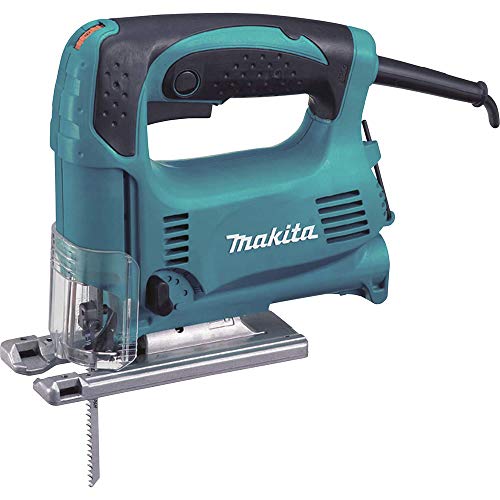
The 4329K is a compact corded jigsaw with a 3.9-amp motor and a 500–3,100 strokes-per-minute dial. Its counterweight mechanism and rubberized grip help make the tool manageable during longer cuts. Three orbital positions plus straight cutting give you a choice between stock removal and a less aggressive action. The aluminum base adjusts up to 45 degrees, and the clear front cover works with the through-body vacuum connection. Blade changes use the included hex wrench, a practical distinction from Makita’s tool-less models.
The compact housing and speed dial make a manageable bench setup. Blade changes use a wrench, so learn to disconnect the power and secure the blade correctly before starting.
Pros
- Compact corded body weighs about 4.2 pounds
- 500–3,100 SPM dial
- Three orbital positions plus straight cutting
- Through-body vacuum connection
- Case and hex wrench included
Cons
- Blade changes require a hex wrench
- Cord needs room to move around the work
The Makita 4329K is the best compact corded step up in this comparison. Its compact body; speed dial; through-body vacuum port make it worth considering when those features match your next project.
To buy this product, click here.
7. DEWALT DCS334B — Best for DEWALT Battery Owners
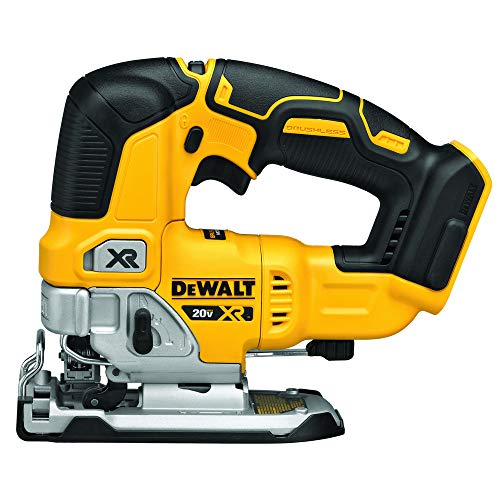
The DCS334B combines a top handle with a variable-speed trigger and a separate speed dial. That arrangement lets you set a working limit and ease into a cut without moving your grip. Its brushless motor runs up to 3,200 strokes per minute, and the four-position orbital selector changes the cutting action for different tasks. An LED illuminates the blade area, while the blower clears loose debris. The keyless clamp accepts T-shank blades, and the shoe has bevel detents at 0, 15, 30, and 45 degrees.
The trigger, dial, and LED give a new user useful control. This is a bare tool, so it is most convenient when the compatible battery and charger are already available.
Pros
- Trigger and dial offer flexible speed control
- Brushless motor and 20V MAX platform
- LED and blower help reveal the line
- Keyless T-shank blade changes
- No-mar shoe cover protects finished surfaces
Cons
- Battery and charger are sold separately
- Top handle sits higher above the work than a barrel grip
The DEWALT DCS334B is the best for dewalt battery owners in this comparison. Its brushless motor; trigger and dial; led make it worth considering when those features match your next project.
To buy this product, click here.
8. BOSCH JS120N — Best Low-Grip Compact Option
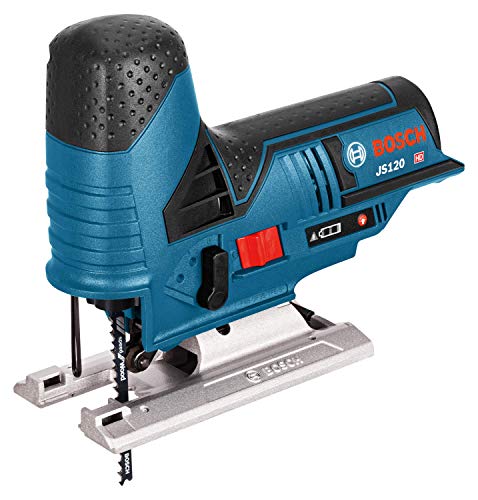
The JS120N is a compact 12V Max barrel-grip saw with a tool-only weight of about 3 pounds. Its short housing is useful where a full-size 18V saw feels cumbersome. The speed dial covers 1,500–2,800 strokes per minute, with orbital adjustment for changing the blade action. Bosch provides an LED and a blade-ejection mechanism that reduces the need to touch a hot blade during a change. It accepts T-shank blades and uses the Bosch 12V Max battery system.
The small barrel grip brings your hand close to the work. Check that you can reach the switch comfortably and keep both hands clear of the blade path.
Pros
- Compact barrel-grip housing
- Approximately 3 pounds without battery
- LED illuminates the cutting area
- Tool-free T-shank blade ejection
- Adjustable speed and orbital action
Cons
- Battery and charger are separate purchases
- Smaller platform favors manageable cuts over heavy stock removal
The BOSCH JS120N is the best low-grip compact option in this comparison. Its compact barrel grip; led; tool-free blade ejector make it worth considering when those features match your next project.
To buy this product, click here.
9. BLACK+DECKER BDCJS20B — Best for POWERCONNECT Owners

The BDCJS20B is a cordless option for homeowners who already use BLACK+DECKER’s 20V MAX POWERCONNECT batteries. Its variable-speed trigger controls the approach to a cut, and the tool-free clamp accepts both U- and T-shank blades. The shoe bevels up to 45 degrees in either direction. A wire guard preserves a view ahead of the blade, while the blower clears loose sawdust from the line. This bare-tool package includes a blade but excludes the battery, so it makes the most sense as an addition to an existing battery kit.
This cordless choice is convenient if you already own the battery system. The clamp accepts two common shank styles, but you still need a blade rated for the material.
Pros
- Uses 20V MAX POWERCONNECT batteries
- Tool-free U- and T-shank blade changes
- Variable-speed trigger
- Left and right bevel adjustment
- Wire sightline guard and blower
Cons
- Battery and charger are separate purchases
- Brushed DIY design is less suited to intensive production work
The BLACK+DECKER BDCJS20B is the best for powerconnect owners in this comparison. Its variable trigger; u- and t-shank clamp; blower make it worth considering when those features match your next project.
To buy this product, click here.
Buying Guide
Start with the blade
Read the shank and material label before fitting it. A narrow curve blade and a straight-cut wood blade serve different jobs.
New to the tool? Follow how to use a jigsaw before attempting a finished cut.
Clamp and support the work
Keep the shoe flat on a supported surface with clearance below the blade. Clamps are more reliable than holding a small board by hand.
Learn speed and orbital settings separately
Begin with a low orbital setting and a manageable speed on scrap. Change one setting at a time so you can see how it affects the cut.
Use relief cuts for tight shapes
Do not twist a broad blade around a tight corner. Use a suitable scrolling blade and relief cuts to give the waste material room to fall away.
Frequently Asked Questions
Is corded easier for a beginner?
It avoids battery planning and is convenient at a fixed bench. Cordless is useful when an existing battery system or the work location makes a cord awkward.
Do I need a laser?
No. A visible pencil line, a suitable blade, and steady shoe contact are more useful for learning than a projected line alone.
Why does my blade bend through the cut?
The blade may be too flexible, dull, or forced through too quickly. Reduce feed pressure, check the blade choice, and support the work.
Final Verdict
BLACK+DECKER BDEJS300C is the best simple starter pick. The compact body and quick clamp keep setup straightforward. Practice short straight cuts and gentle curves on supported scrap before trying a detailed shape.
For basic feature mix, consider Hammerhead HAJS048. Orbital adjustment gives you a useful learning tool: compare straight action with a more aggressive wood setting on the same offcut. The tool-free clamp makes changing to a fresh blade easier.
