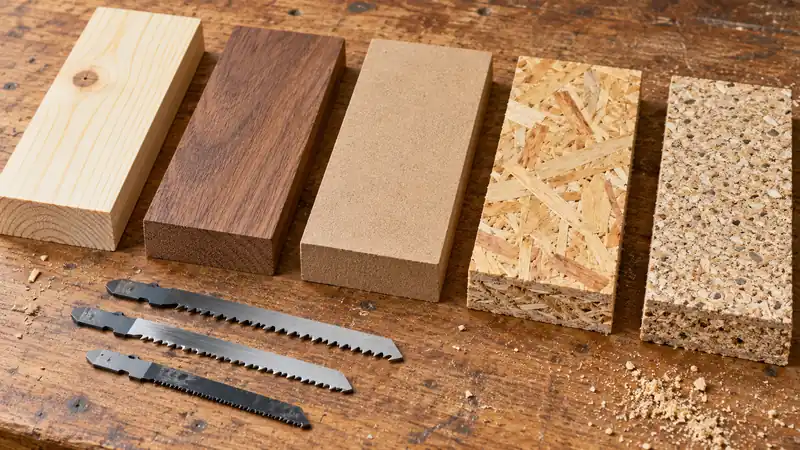
Choose a jigsaw blade for the board’s substrate, surface and thickness, then match the tooth shape to the cut. Solid softwood, hardwood, MDF, OSB and coated particleboard should not be treated as one interchangeable material. A clean visible edge may require a different blade and setup from a rough opening hidden behind trim. Our jigsaw blades for wood guide is the broad starting point. Use the material map below to narrow the choice before comparing individual blades.
Read the Board from the Inside Out
Identify what carries the load, what covers the face and whether anything is embedded in it. A decorative laminate can cover particleboard or another core. A painted board may hide a fixing. The surface affects chipping, while the core affects chip formation and resistance throughout the cut.
| Material | Main selection question | Setup priority |
|---|---|---|
| Softwood | Fast removal or a finished edge? | Support near the cut and a suitable tooth pattern |
| Hardwood | Thickness, species and curve radius? | Stiffness, usable length and moderate feed |
| MDF | Clean edge or concealed opening? | Extraction and stable support |
| OSB | Is the edge visible or structural? | Control loose strands and support the waste |
| Particleboard | Bare or coated on one or both faces? | Protect the finish and avoid unsupported breakout |
| Wood with nails | Is the exact blade rated for embedded metal? | Assess fixings and hidden hazards before cutting |
Match the Finish Requirement Before Choosing Speed
Decide what happens to the edge after cutting. A concealed clearance notch can tolerate a different surface from an exposed furniture curve. A joint that will be bonded or fitted against another part may also need attention to squareness, not just top-face appearance. Mark these requirements on the layout before selecting a blade.
A short trial should reproduce the real conditions: the same board, face orientation, blade and support. Cutting a thin scrap of solid timber is not a meaningful substitute for checking a thick coated panel. Inspect the retained side of the trial, including the underside, and note which defect would prevent the piece from working in the finished assembly.
Softwood: Let the Finish Determine the Teeth
A fast-cut wood blade can suit a concealed notch or rough opening. For a visible curved shelf edge, a cleaner-cut tooth pattern may be more useful even when it removes material more slowly. Narrow blades turn more readily; broader blades are generally better suited to resisting sideways movement on straighter cuts. Browse softwood jigsaw blades with that distinction in mind. Grain, knots and a poorly supported offcut can still interrupt the cut, so do not compensate by pushing harder.
Hardwood: Thickness and Turning Ability Work Together
A thick hardwood blank asks more of the blade than thin trim. Confirm that the usable blade length and saw capacity suit the stock. Then consider whether the blade can turn within the planned radius without being twisted sideways. Choose among jigsaw blades for hardwood according to that combination. A long blade solves a reach problem; it does not automatically solve deflection. If the top follows the line but the underside does not, reduce the cause of bending rather than steering more aggressively.
Separate Reach from Resistance to Bending
The blade needs enough usable length to clear the work through the stroke, but extra overall length does not automatically improve the cut. A longer projection can remain vulnerable to sideways loading. Select the shortest appropriate working arrangement that satisfies the manufacturer’s application requirements rather than using an unnecessarily long blade as a general upgrade.
The curve can impose a competing requirement. A broader blade may resist bending on a straighter route, while a narrow blade may be needed to turn. If the curve is too tight for a suitably stiff blade at the required thickness, reconsider the process. Forcing a wide blade around the layout can preserve the top line while leaving an unacceptable slope underneath.
MDF: Plan for Fine Dust and the Edge You Need
MDF does not have solid wood’s grain structure, but that does not make every wood blade equally suitable. Choose a blade rated for the board and the desired finish. Keep the work steady, avoid rubbing a dull blade through the cut and arrange extraction appropriate to the material. Our blades for MDF comparison separates choices by cutting task. A concealed service opening may prioritize progress, while an exposed shaped edge may need a cleaner cut and a finishing allowance.
Keep the Board Supported Through the Last Section
A cutout can remain stable at the beginning and become a lever as its connection narrows. Support the waste before the final pass so it does not drop, twist or tear material from the retained edge. Keep the supports outside the blade path and do not place a hand beneath the moving blade to catch the offcut.
The same principle applies to particleboard and OSB, although the visible damage can differ. Fine fibers, loose particles or larger strands can all break away when the waste moves. Correcting support may therefore improve an edge without changing the blade. If the material still chips, assess tooth direction, blade condition and finish requirements separately rather than changing every setting at once.
OSB: Support the Strands at the Exit
OSB’s larger strands make an unsupported edge vulnerable to breakout. Decide whether the edge will be visible, covered or part of an assembly with specified dimensions. Support the waste so it does not pull the final strands away as the cut closes. Compare jigsaw blades for OSB around thickness and finish. If the result is rough, inspect the underside and waste support before assuming a higher stroke rate will improve it.
Particleboard: the Coating Changes the Decision
Bare particleboard and melamine-faced shelving can share a core while needing different finish strategies. On coated boards, establish where the teeth exit and test the proposed orientation on an offcut. Check both faces if both will remain visible. Use particleboard jigsaw blades for the core and coating combination you actually have. Keep the shoe clean; scratching a finished face with trapped debris can spoil an otherwise acceptable cut.
Check Laminated Faces Independently
When both faces remain visible, orienting one favorable face is not the complete solution. Inspect the trial from both sides and consider a blade or support arrangement intended for the required finish. A setup that produces an acceptable front edge can still leave hidden breakout that becomes visible after assembly.
For a decorative face, also distinguish cutting damage from surface scratches. Debris trapped under a shoe can mark the board away from the kerf. Clean the contact surface and use compatible protection where appropriate. Do not judge a blade as unsuitable for tear-out when the actual defect is a scratch caused by the shoe or a clamp.
Nail-Embedded Wood Needs an Explicit Rating
An ordinary clean wood blade is not automatically suitable for reclaimed timber containing nails. Even a bi-metal label is insufficient without the named application. Remove visible fixings where practical and assess what lies in the cut path. For an approved application, compare blades rated for wood with nails. Unknown wiring, screws, masonry or other embedded material changes the task and should be identified before cutting.
Composite Decking Belongs in a Separate Branch
Wood-plastic composite decking is not simply another softwood board. Its formulation, cap layer and installation details can change the cutting and finishing method. Use the composite-decking cutting method for that work. For every board, make a short trial cut with the actual blade, orientation and support arrangement. Check the visible face, underside and squareness. That trial tells you which setup detail to correct before committing the finished piece.
