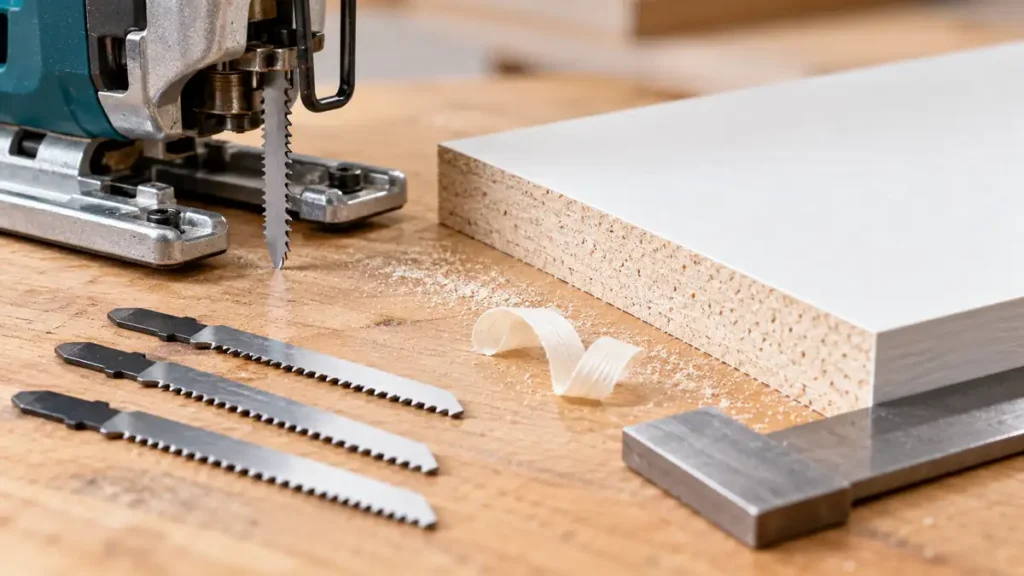
A clean jigsaw cut starts with the blade, not the saw alone. A blade that suits a scrolling cut in plywood may behave very differently in laminate, Plexiglas, or a thick hardwood panel. Tooth shape, TPI, blade width, working length, shank style, and the material recommendation all affect whether the edge comes out crisp or develops splintering, chipping, or a rough, wandering line.
Many buyers focus on blade count and overlook the actual cutting profile. A 50-piece assortment can be useful, yet it may contain only a few blades suited to fine woodworking. A narrow 20 TPI blade can handle curved detail work, while a broader 10 TPI blade is better suited to faster straight cuts in wood. Compatibility matters too. The products below use T-shank designs, but a T-shank blade still needs to match the jigsaw’s blade clamp and the thickness of the workpiece.
This comparison weighs documented tooth designs, construction, intended materials, blade dimensions, and useful variety rather than treating every clean-cut claim as universal. Some picks are specialized for laminate or Plexiglas, while others cover everyday wood projects. The right choice depends on whether your priority is a smooth visible edge, controlled curves, fast straight cuts, or one case that covers several materials.
Quick Answer
The BOSCH T10RC Blade Set is the strongest overall match because it combines several wood-cutting profiles, including reverse-tooth and extra-clean options, in one organized case. For fine curves and scrolling, the BOSCH T101AO is more focused, with a narrow body and 20 TPI pointed teeth. Buyers cutting laminate should look closely at the BOSCH T128BHM3, while the BOSCH T102BF is the specialized choice for clean Plexiglas cuts.
Best Jigsaw Blade for Clean Cuts Comparison Table
| Product | Best For | Blade Material | Tooth Design |
|---|---|---|---|
| BOSCH T10RC 10-Piece Set | Mixed wood projects | Varied by blade | Clean, reverse-tooth, precision profiles |
| BOSCH T101AO 5-Piece | Fine curves and scrolling | Not specified | 20 TPI pointed teeth |
| Diablo DJT308BFP5 | Fine top and bottom wood cuts | Bi-metal | 12 TPI, opposing tooth directions |
| Bosch TPW005 Pro-Wood Set | Wood and laminate variety | Varied by blade | Reverse, pointed, laminate, hardwood profiles |
| BOSCH T128BHM3 | High-pressure laminate | Carbide teeth | 14 TPI fine-cut profile |
| BOSCH T102BF | Plexiglas | Bi-metal | 13 TPI ground and taper-back teeth |
| GINEPAN T101AO Set | Curved wood cuts in quantity | High-carbon steel | 20 TPI pointed teeth |
| 25-Piece T101B Set | Straight wood cuts | High-carbon steel | 10 TPI |
| 10-Piece Assorted T-Shank Set | Mixed materials | SK5 high-carbon steel | Wood, metal, and plastic profiles |
The detailed reviews below explain which blade geometry fits each task and where each set’s limitations may matter.
1. BOSCH T10RC 10-Piece T-Shank Jig Saw Blade Set : Best Overall

A single blade rarely handles every woodworking job gracefully. The BOSCH T10RC addresses that reality with a compact selection of profiles: T144DP precision blades, T101B clean-for-wood blades, T101BR reverse-tooth blades, T101AO blades for detailed work, a T308B extra-clean blade, and a T119BO basic wood blade. That mix gives a user more control over the choice between a fast cut, a smoother visible edge, and reduced splintering on the top face.
The reverse-tooth option is especially useful for panels where the upper surface matters, while the T101AO blades bring a narrower, finer profile for curved work. The set also includes blades intended for plastics, according to the listed product information, so it has broader practical coverage than a pack filled with one repeated blade. A heavy-duty plastic case keeps the profiles separated, which is handy when a small blade can otherwise disappear in a crowded tool drawer.
Pros
- Includes ten blades across several wood-cutting profiles.
- Offers reverse-tooth options for reducing top-surface splintering.
- Includes narrow T101AO blades for curved and scrolling cuts.
- Provides extra-clean, precision, and basic wood options in one set.
- Includes a heavy-duty plastic storage case.
Cons
- The set does not provide the same depth of supply as a large single-profile pack.
- The exact material and cutting role varies by blade, so the labels require attention.
This is the most balanced choice for a workshop drawer that handles plywood, hardwood, laminate-faced panels, and occasional plastic. It suits someone who would rather select the correct profile before starting than force one blade through every job. A dedicated pack may make more sense for repeated production cutting, but the T10RC offers the broadest documented wood-cutting range among these selections.
To buy this product, click here.
2. BOSCH T101AO 5-Piece Clean for Wood Blades : Best for Fine Curves

The T101AO is a focused blade rather than an all-purpose assortment. Its 20 TPI pointed tooth profile and narrow body are intended for clean, curved cuts and scrolling in veneers, laminates, MDF, plywood, and both hard and soft woods. Picture a small decorative cutout or a gently winding template line. A narrow blade gives that kind of work more room to turn than a broad straight-cut blade.
Pointed teeth are listed as a way to reduce splintering on both sides of the workpiece, which makes this profile useful for visible panels and double-sided laminates. The blades are 3 inches long, so buyers should match that dimension to the thickness of the stock and avoid treating them as deep-cut blades. The T-shank mounting style suits many modern jigsaws, though the saw itself still needs a compatible T-shank clamp.
Pros
- 20 TPI pointed tooth profile favors fine cutting.
- Narrow blade body is suited to curved and scrolling work.
- Listed for veneers, laminates, MDF, plywood, and wood.
- Pointed teeth are intended to reduce splintering on both faces.
- Five blades provide a focused replacement supply.
Cons
- The 3-inch blade length limits its usefulness for thicker stock.
- Its fine profile is less appropriate for fast, long straight cuts.
Choose this pack for detail work where the line bends and the edge will remain visible. It is a sensible match for cabinet trim, craft panels, and laminate-faced material, provided the cut depth stays within the blade’s practical range. A broader 10 TPI blade is a better fit for quickly opening a long straight line in thick wood.
To buy this product, click here.
3. Diablo DJT308BFP5 Bi-Metal Jig Saw Blades : Best for Clean Top and Bottom Wood Cuts

Some panels show damage on the top, while others reveal it underneath after the cut is complete. The Diablo DJT308BFP5 is aimed at that two-sided problem. Its listed tooth arrangement faces in opposite directions at each end, with the stated goal of producing a fine finish on both the top and bottom of wood. That design makes this pack especially interesting for shelving, finished panels, and workpieces that cannot simply be flipped over.
The bi-metal construction and 12 TPI profile place it between very fine scrolling blades and aggressive coarse-cut options. The 4-5/8-inch length also gives it more reach than the 3-inch fine blades in this roundup, though practical cutting depth still depends on the stock and saw setup. The listing describes an ultra-hardened cutting edge and broad compatibility with combo and many U-shank jigsaws, but buyers should verify their specific clamp rather than rely on a universal claim.
Pros
- Opposing tooth directions are intended to improve both-side wood finishes.
- Bi-metal construction is suited to demanding wood applications.
- 12 TPI balances a fine finish with useful cutting progress.
- 4-5/8-inch length offers more reach than shorter detail blades.
- Five-blade pack supports repeat work.
Cons
- The listed design is specialized for wood rather than a broad mix of materials.
- Compatibility claims should be checked against the individual jigsaw clamp.
This pack suits a furniture or trim project where both faces matter and masking one side is inconvenient. It offers a more specialized answer than a mixed set, especially for users who repeatedly cut finished wood panels. Buyers focused on tight curves should choose a narrower scrolling blade instead, since this profile is aimed at clean wood work rather than maximum turning ability.
To buy this product, click here.
4. Bosch TPW005 Pro-Wood T-Shank Blade Set : Best Mixed Wood and Laminate Set

The TPW005 is built around material and surface differences that often appear in the same renovation. Its five blades include a reverse-pitch clean-for-wood blade, a basic wood blade, a T101BR reverse-tooth blade, a T101BIF laminate blade, and a T101BF clean-for-hardwood blade. That selection gives the user a way to switch profiles rather than using a wood blade on laminate simply because it is already installed.
The reverse-tooth designs are aimed at cleaner top surfaces, while the pointed-tooth options address splinter reduction across wood applications. The listed set also covers straight and gently curved laminate cuts, hardwood, OSB, and plywood. Each blade has a different job, so the set rewards buyers who read the markings and choose according to the workpiece. It is less useful for someone who wants five identical replacements for one repeated cut.
Pros
- Includes dedicated profiles for wood, hardwood, and laminate.
- Reverse-tooth blades address top-surface splintering.
- Includes a blade listed for straight or gently curved laminate cuts.
- Supports plywood, OSB, and hardwood applications.
- T-shank design fits over 90 percent of current jigsaw makes and models according to the listing.
Cons
- Only five blades are included, with no large supply of one profile.
- The set does not replace a specialty blade for Plexiglas or other unusual materials.
This is a practical pick for flooring repairs, cabinet work, and general remodeling where the material can change from one cut to the next. It offers more useful specialization than a generic assortment, especially for laminate and hardwood. A dedicated fine-curve pack remains preferable for intricate scrolling, but this set is easier to justify for a mixed wood shop.
To buy this product, click here.
5. BOSCH T128BHM3 Carbide-Tooth Laminate Blades : Best for High-Pressure Laminate

Laminate can be hard on ordinary wood blades, particularly when the surface is brittle and the edge must remain clean. The BOSCH T128BHM3 is specifically listed for high-pressure laminates and uses carbide teeth with a 14 TPI profile. Its thin blade kerf is intended to reduce material extraction and heat, while the tooth design targets clean cuts on both sides of the cutting surface.
This is a specialty product with three blades, so it should be selected for the material rather than for pack size. The 3.62-inch length and fine 14 TPI configuration suit controlled laminate work, but the listing does not establish that it is the right blade for every countertop, composite, or wood panel. The carbide-brazed construction is a meaningful distinction from HCS and bi-metal options, yet the blade still needs appropriate feed pressure and workpiece support for a clean edge.
Pros
- Purpose-built for high-pressure laminate applications.
- Carbide teeth offer a specialized alternative to standard steel blades.
- 14 TPI profile is intended for extra-clean cuts.
- Thin kerf is designed to reduce material extraction and heat.
- Tooth design targets clean cuts on both sides.
Cons
- Only three blades are included.
- Its narrow material focus makes it less useful for general wood cutting.
Choose the T128BHM3 for laminate flooring, laminate panels, or similar high-pressure surfaces where a general-purpose blade may leave a rougher edge. It is a poor fit for buyers seeking one blade for every household project, but its focused construction gives it a clear role. Confirm the T-shank requirement and match the blade length to the workpiece before starting.
To buy this product, click here.
6. BOSCH T102BF Bi-Metal Jig Saw Blades : Best for Plexiglas

Plexiglas needs a different blade conversation than plywood. The BOSCH T102BF is listed for Plexiglas from 5/64 inch to 3/4 inch thick, with a 13 TPI ground and taper-back tooth design intended for straight, clean cuts. That documented material range gives this three-piece pack a clear reason to exist in a workshop that cuts acrylic sheet rather than relying on a wood profile.
Bi-metal construction adds a distinction over basic high-carbon steel blades. The blade is aimed at straight cuts, so a buyer planning tight decorative curves should choose a narrower scrolling profile. Acrylic can chip or melt under unsuitable cutting conditions, which means the blade selection is only one part of the result. Support the sheet properly and follow the saw and material guidance.
Pros
- Documented for Plexiglas from 5/64 inch to 3/4 inch thick.
- 13 TPI profile is intended for straight, clean cuts.
- Ground and taper-back tooth design is suited to the listed application.
- Bi-metal construction provides a specialty acrylic-cutting option.
- Three blades provide replacements for repeated Plexiglas work.
Cons
- The product is specialized for Plexiglas rather than general woodworking.
- The straight-cut focus is less suitable for tight curves.
This is the sensible choice for signage, protective panels, and acrylic projects where the workpiece falls within the listed thickness range. It should not be selected simply because the teeth look fine. Buyers cutting wood, laminate, or MDF will get more useful coverage from a dedicated woodworking blade, while acrylic users gain the benefit of a clearly intended application.
To buy this product, click here.
7. GINEPAN T101AO 20-Piece T-Shank Blade Set : Best for Curved Cuts in Quantity

The GINEPAN set takes the same general T101AO approach as a fine scrolling blade, then supplies 20 pieces for users who work through small blades regularly. The listed 20 TPI profile, narrow format, and pointed teeth are aimed at curved and scrolling cuts in double-sided laminates, MDF, plywood, and hard or soft woods. For craft templates or repeated cutouts, having several matching blades nearby can be more convenient than rationing a small specialty pack.
The blades are described as high-carbon steel and the listing names compatibility with a range of common jigsaw brands. That claim should still be checked against the exact saw, since T-shank acceptance varies by blade clamp. The included case has relatively generous gaps, and the small T101AO blades may scatter inside it. Storage remains useful, but buyers should not expect a precision organizer that keeps every short blade locked in a separate slot.
Pros
- Twenty blades provide a substantial supply for repeated detail work.
- 20 TPI profile is intended for fine curved and scrolling cuts.
- Pointed teeth are listed for reduced splintering on both sides.
- High-carbon steel construction is documented.
- Listed for wood, MDF, plywood, and double-sided laminates.
Cons
- The case may allow the small blades to move or scatter.
- Its narrow fine-cut profile is not intended for fast heavy stock removal.
This set is a useful fit for hobbyists, sign makers, and anyone who repeatedly cuts curves in thinner wood-based sheets. It offers more replacement depth than the Bosch five-piece pack, though the Bosch product has a more established documented profile in the product details. Skip this style for long straight cuts or thick stock where a longer, broader blade will offer more appropriate support.
To buy this product, click here.
8. 25-Piece T101B T-Shank Contractor Blade Set : Best for Straight Wood Cuts

The T101B profile is aimed at a different job from the fine T101AO. These blades measure 4 inches overall with a 2.9-inch knife edge and use 10 TPI teeth for straight wood cuts. That makes the set a practical match for general boards, plywood, chipboard, fiberboard, plastic, and listed softwood or hardwood applications where the cut line is longer and less intricate.
High-carbon steel construction is documented, along with a T-shank interface and compatibility claims covering many major jigsaw brands. The blades arrive as 25 pieces divided into five paper packs, which is convenient for a jobsite or a workshop that wants replacements distributed between toolboxes. The product is less specialized than the fine-cut picks above, so edge quality will still depend on feed control, support, blade selection, and the material itself.
Pros
- Twenty-five blades provide a useful replacement supply.
- 4-inch overall length and 2.9-inch knife edge suit general board work.
- 10 TPI profile is intended for straight wood cutting.
- High-carbon steel construction is documented.
- Listed for wood boards, plywood, plastic, chipboard, and fiberboard.
Cons
- The straight-cut profile is less suitable for tight scrolling work.
- The listing does not document a reverse-tooth or specialty laminate design.
Choose this set for routine workshop cuts where quantity matters and the work is primarily straight. It is a sensible drawer staple for framing panels, shelves, and rougher shop projects. Buyers preparing a finished cabinet face or a tight decorative curve should move toward a fine 20 TPI or reverse-tooth blade rather than expecting this general-purpose profile to cover every edge-quality requirement.
To buy this product, click here.
9. 10-Piece Assorted T-Shank Jig Saw Blade Set : Best for Mixed Materials

This assortment is built for the user who opens a drawer and finds several different materials waiting: wood, plastic, and occasional metal. The ten blades include T118A and T118B profiles for basic metal, T101AO, T101D, T101B, and T101BR profiles for clean wood, faster wood profiles, and a T111C basic wood blade. That range is more useful than a large pack of near-identical wood blades for light repair and mixed household work.
The blades are described as SK5 high-carbon steel with a T-shank design. The listing also states compatibility with over 90 percent of power curve saws, but that remains a general claim rather than confirmation for every saw. Buyers should identify the blade intended for the material before cutting. A metal-compatible blade and a clean wood blade are different tools for different jobs, even when both fit the same jigsaw.
Pros
- Includes profiles for basic metal, wood, and plastic applications.
- Offers both clean-cut and faster-cut wood options.
- T-shank design supports many compatible jigsaw clamps.
- Ten-piece assortment suits occasional mixed-material work.
- SK5 high-carbon steel construction is documented.
Cons
- Each material-specific profile has limited quantity.
- The assortment is less focused than a dedicated clean-wood blade pack.
This set makes sense for a homeowner or general repair drawer that needs breadth more than specialization. It can cover a surprise plastic panel or thin metal task without requiring several separate purchases, but the limited count means it is not ideal for production work. For a visible wood project, choose the specific clean-cut profile from the set rather than treating the assortment as a single universal blade.
To buy this product, click here.
Buying Guide
Confirm the T-Shank Interface
Every selected product here uses a T-shank format, which is common on many modern jigsaws. That does not prove universal compatibility. Check the saw’s blade clamp, especially if it is an older model or uses a set-screw system. A blade can look physically close to the original and still fail to seat correctly. The saw’s holder determines whether the blade is compatible; the material recommendation determines whether it is appropriate for the cut.
Match the Tooth Design to the Cut
Fine 20 TPI blades such as the T101AO profiles are aimed at controlled curves, scrolling, and smoother detail work. A 10 TPI T101B blade is a better fit for a longer straight cut in wood. Reverse-tooth blades place cutting action in a different relationship to the workpiece and are intended to reduce splintering on the top surface. No tooth profile guarantees a flawless edge in every sheet, so use the blade as part of a complete setup that includes firm support and controlled feed pressure.
Before changing tooth direction or adding an insert, review tooth direction and tear-out control for the face you want to protect.
Choose the Material Before the Pack Size
Wood, laminate, Plexiglas, and metal demand different blade choices. The BOSCH T128BHM3 is listed for high-pressure laminate, while the T102BF is specifically listed for Plexiglas. A mixed set can be useful for occasional jobs, but it may contain only one or two blades for the material you actually cut. Start with the workpiece, then select the blade. A larger quantity does not compensate for the wrong application.
Check Length Against Workpiece Thickness
Blade length affects how much usable cutting edge is available. The Bosch T101AO is listed at 3 inches, with a narrow body intended for detail work. The T101B contractor set lists a 4-inch overall length and a 2.9-inch knife edge. The Diablo blades list a 4-5/8-inch length. These measurements should be compared with the stock thickness and the saw’s operating movement. Do not assume that the longest blade automatically produces the cleanest cut, or that a short fine blade is suitable for thick material.
Decide Between a Dedicated Pack and an Assortment
A dedicated pack gives you repeated access to one known profile. That is useful for a workshop cutting the same type of plywood, hardwood, or laminate throughout a project. An assortment offers more flexibility when the material changes from one job to the next. The Bosch T10RC and TPW005 provide purposeful variety, while the 25-piece T101B pack concentrates on straight wood cuts. Think about the work waiting on your bench rather than the number printed on the package.
Use Specialty Construction for Specialty Materials
Bi-metal construction appears in the Diablo wood blades and the Bosch Plexiglas blades. Carbide teeth distinguish the Bosch laminate blade. These materials can make sense for demanding or abrasive applications, but construction alone does not establish suitability for every hard material. Follow the listed material guidance and check the blade profile. A carbide laminate blade should not be casually reassigned to metal, and a Plexiglas blade should not be treated as a general woodworking replacement.
Separate Clean Cutting From Fast Cutting
A clean edge and a fast feed rate can pull in different directions. Fine teeth generally remove smaller chips and suit visible edges, while more aggressive profiles are intended to move through wood more quickly. The T10RC includes both precision and basic profiles because one project may contain several types of cut. Pick the blade based on the edge that will be seen, the path that must be followed, and the thickness of the workpiece.
Best Jigsaw Blade for Clean Cuts FAQ
What Is the Best Blade Type for Clean Wood Cuts?
There is no single profile for every wood cut. A pointed 20 TPI T101AO blade suits fine curves, scrolling, veneers, and thinner wood-based sheets. A reverse-tooth design can help reduce splintering on the top surface. For longer straight cuts, a 10 or 12 TPI wood blade may be more practical. The best choice depends on the wood, thickness, direction, and desired edge.
Are T-Shank Blades Compatible With Every Jigsaw?
No. T-shank blades fit many modern jigsaws, but the actual clamp must accept that interface. Older tools may require U-shank or set-screw blades. Check the tool documentation or the existing blade before ordering. A product listing’s broad compatibility claim should not replace confirmation for your particular saw.
Is a Higher TPI Always Better for a Clean Cut?
No. Higher TPI can support finer cutting and detail work, but it is not automatically the best choice for every material or thickness. A 20 TPI blade is useful for curves and fine edges, while a 10 TPI blade may provide more suitable tooth spacing for a longer straight cut in wood. Blade width, thickness, material, and feed control matter alongside TPI.
Which Blade Should I Use for Laminate?
Use a blade specifically listed for laminate or high-pressure laminate. The BOSCH T128BHM3 is the most specialized option in this roundup, with carbide teeth, a 14 TPI profile, and a thin kerf. The Bosch TPW005 also includes a laminate blade for straight or gently curved cuts. Confirm the exact laminate type and workpiece thickness before cutting.
Can a Wood Blade Cut Plexiglas?
A blade designed for Plexiglas is the safer product match for that application. The BOSCH T102BF is listed for Plexiglas from 5/64 inch to 3/4 inch and uses a 13 TPI bi-metal profile for straight cuts. A wood blade may physically fit the saw, but physical fit does not establish suitable tooth geometry or material compatibility.
Are Reverse-Tooth Blades Better for Preventing Splintering?
Reverse-tooth blades are designed to address splintering on the top surface, so they can be useful where that face will remain visible. They still require proper workpiece support, a controlled feed, and an appropriate blade for the material. The BOSCH T10RC and TPW005 include reverse-tooth options. Their presence does not guarantee a completely splinter-free edge in every panel.
Should I Buy a Blade Set or Individual Specialty Blades?
A set is useful when your projects vary between straight wood cuts, curves, laminate, plastic, or occasional metal. A dedicated pack is better when you repeatedly perform one task and want consistent replacements. The T101AO packs focus on fine curves, the T101B set focuses on straight wood cuts, and the T128BHM3 focuses on laminate. Select based on the workpiece rather than the largest blade count.
What Else Helps Produce a Clean Jigsaw Cut?
Blade choice is one part of the result. Secure the workpiece, mark the cut clearly, support the material near the cutting path, and use a feed rate that matches the blade. Select the correct face-up or face-down orientation for the tooth design, and follow the jigsaw manufacturer’s operating guidance. A clean-cut blade cannot compensate for loose material, excessive pressure, or a blade that is too short for the stock.
Final Verdict
The BOSCH T10RC earns the Best Overall position because its ten-piece selection covers the widest range of documented clean-wood needs in this group. It includes precision, basic, reverse-tooth, narrow scrolling, and extra-clean profiles, giving users a practical way to match the blade to the cut. Buyers who mainly cut tight curves should choose the BOSCH T101AO instead, while the Diablo DJT308BFP5 is the more focused option for fine wood cuts on both the top and bottom faces.
Specialty materials deserve specialty choices. The BOSCH T128BHM3 is the clearest fit for high-pressure laminate, and the BOSCH T102BF is the dedicated Plexiglas selection. For routine straight wood cutting, the 25-piece T101B set supplies a useful repeated profile. Before ordering, confirm the T-shank clamp, compare blade length with the workpiece, and choose the tooth design for the material and cut direction. That small check matters more than simply buying the largest assortment.
