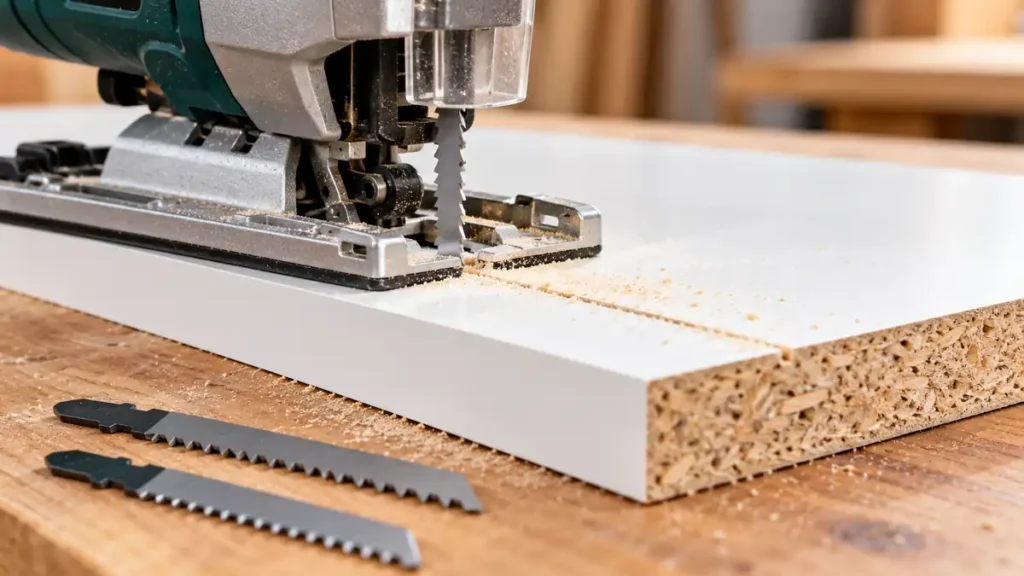
Melamine panels can look wonderfully clean on the shelf and surprisingly ragged after a poor jigsaw cut. The decorative surface is hard and brittle, while the particleboard or MDF core underneath can chip, splinter, or tear as the blade exits. That combination is why shoppers looking for the best jigsaw blades for melamine usually need a blade selected for laminate or fine-finish work, rather than an ordinary fast-cut wood blade.
A common mistake is choosing by blade count alone. A large assortment may contain plenty of coarse wood blades that cut quickly but leave a rough edge, while a blade with an unsuitable shank will not fit the jigsaw at all. For melamine, the useful details are documented laminate suitability, tooth density, blade direction, blade rigidity, cutting orientation, and whether the blade is intended to reduce chipping on the visible face. The correct approach also depends on the job. A cabinet installer may prioritize a clean straight cut, while a hobbyist making a curved shelf may need a narrower blade with finer teeth.
This comparison separates the strongest laminate-specific options from versatile T-shank sets that include suitable fine-tooth or reverse-tooth blades. The Bosch T128BHM3 earns the leading position because its carbide-tooth design and laminate-specific application make it the clearest match, while several Bosch and DEWALT alternatives offer different approaches for clean, down-cut, curved, or general workshop work.
Quick Answer
The BOSCH T128BHM3 is the strongest overall match for melamine because it is specifically listed for laminates, uses a fine 14 TPI profile, and has carbide teeth. For a narrow curved cut, the BOSCH T101AO is more purpose-built, with 20 TPI pointed teeth and a narrow body for scrolling. The DEWALT DW3762H2 is a useful alternative for down-cutting laminate when protecting the top face is the priority.
Best Jigsaw Blades for Melamine Comparison Table
| Product | Best For | Blade Type | Key Specification |
|---|---|---|---|
| BOSCH T128BHM3 | Laminate and melamine-style panels | Carbide-tooth T-shank | 14 TPI, 3.62 inches |
| BOSCH T101AO | Curved and scrolling cuts | Fine-tooth T-shank | 20 TPI, 3-1/4 inches |
| DEWALT DW3762H2 | Top-face protection | Down-cut HCS T-shank | 10 TPI, 4 inches |
| Diablo DJT308BFP5 | Fine-finish wood-based panels | Bi-metal T-shank | 12 TPI, 4-5/8 inches |
| DEWALT DW3741C | Mixed workshop use | HCS and bi-metal T-shank | 6, 10, and 18 TPI |
| DEWALT DW3742C | Broader wood and metal selection | T-shank assortment | 14-piece set |
| Leourae 54-Piece Set | Blade variety with storage | HCS and HSS T-shank | 9 blade types |
| Craluuur 30-Piece Set | Mixed materials and occasional laminate work | HCS and HSS T-shank | 9 blade types |
| Romeda 10-Piece Set | Basic replacement assortment | SK5 high-carbon steel T-shank | 10 listed blade types |
The detailed reviews below explain which blades have the closest documented connection to melamine and which sets are better treated as general-purpose backups.
1. BOSCH T128BHM3 3-Piece Laminate Jig Saw Blades — Best Overall

Among these options, this Bosch set has the clearest application match for melamine. Its listed purpose is high-pressure laminate, a closely related hard decorative surface, and the 14 TPI tooth pattern is intended for a cleaner cut than a coarse construction blade. That makes it a sensible first choice for cabinet panels, shelving, and similar sheet goods where a ragged edge can ruin an otherwise tidy project.
The carbide-brazed tooth construction is the major distinction. The product information describes the teeth as suitable for difficult, brittle materials and pairs that construction with a thin kerf intended to reduce heat and material removal. Those details matter on a melamine-faced panel, where excessive pressure or heat can turn a short cut into a chipped, glossy mess. It remains a T-shank blade, so the jigsaw must accept that interface, and the listing does not establish a universal fit for every older tool.
Pros
- Specifically listed for laminate applications.
- Carbide-tooth construction suits difficult, brittle surfaces.
- 14 TPI profile is oriented toward fine, chip-conscious cuts.
- Thin kerf is intended to reduce material removal and heat.
- T-shank format fits compatible modern jigsaws.
Cons
- Only three blades are included.
- Its specialized laminate design is less versatile than a mixed-material set.
This is the strongest selection for a shopper who wants the blade itself to match the surface rather than assemble a large collection of general-purpose options. It is especially appealing for visible straight cuts where edge quality matters more than aggressive feed speed. A buyer making frequent tight curves may prefer the Bosch T101AO, while someone with a U-shank-only jigsaw will need a different interface. For compatible tools, this is the most defensible starting point in the group.
To buy this product, click here.
2. BOSCH T101AO 5-Piece Clean-Cut Wood Jig Saw Blades — Best for Curved Cuts

A melamine project does not always involve a straight cabinet cut. Curved shelves, cutouts, and custom storage panels call for a blade that can turn without forcing the jigsaw around the curve. The Bosch T101AO uses a narrow blade body and 20 TPI pointed teeth, with the listed application covering double-sided laminates, laminated substrates, MDF, wood, plywood, veneers, and scrolling work.
That combination gives this blade a more specialized role than its simple product title suggests. The pointed tooth profile is intended to reduce splintering on both sides of the workpiece, while the 3-1/4-inch length and narrow body favor controlled curved cuts. It is not the closest match for long, fast cuts through thick panels, and it does not carry the carbide laminate-specific construction of the top Bosch pick. Still, for a small curved melamine component, the geometry may be more useful than a broader blade.
Pros
- Listed for double-sided laminates and laminated substrates.
- 20 TPI pointed teeth support a fine finish.
- Narrow body is suited to curved and scrolling cuts.
- Pointed teeth are intended to reduce splintering on both sides.
- Five-piece pack provides replacement blades for repeated projects.
Cons
- Shorter 3-1/4-inch blade length limits some thicker workpieces.
- Its narrow scrolling design is less suited to rapid straight cutting.
Choose this set for shaped melamine parts, openings, or gentle curves where blade maneuverability matters. It makes less sense as the only blade in a workshop built around long straight cuts, and the listing does not provide a specific melamine thickness range. Good support beneath the panel and a controlled feed remain important, since a fine blade cannot compensate for a poorly supported sheet.
To buy this product, click here.
3. DEWALT DW3762H2 Laminate Down-Cutting Jig Saw Blades — Best for Top-Face Protection

The DEWALT DW3762H2 takes a different route to laminate-friendly cutting. Its teeth face downward during the cut, and the listed application is laminate. That orientation can be useful when the visible decorative face is positioned upward and the priority is reducing damage on that upper surface. It is a practical detail for a countertop offcut, cabinet side, or shelf where the top face will remain visible.
The set contains two 4-inch, 10 TPI HCS T-shank blades. Compared with the Bosch T128BHM3, this is a simpler blade with fewer documented specialty features and a coarser tooth count. The down-cut configuration is the reason to select it, not broad material versatility. Users must also remember that down-cut blades can change the way the jigsaw feeds through the panel, so firm support and a steady hand are still needed.
Pros
- Listed specifically as a laminate blade.
- Down-cut configuration addresses visible top-surface damage.
- 4-inch blade length suits common sheet-material work.
- T-shank interface is suitable for compatible jigsaws.
- Two-blade pack provides a direct specialty option.
Cons
- 10 TPI is less fine than the 14 TPI Bosch laminate blade.
- Only two blades are included and the application is specialized.
This blade makes the most sense when face-side appearance matters and the cut is reasonably straight. It may be a better practical choice than a general blade for someone cutting finished laminate panels from the top, while the Bosch T101AO remains the more natural choice for tight curves. Confirm the jigsaw accepts T-shank blades and plan the cut direction before starting, since the down-cut design is central to its usefulness.
To buy this product, click here.
4. Diablo DJT308BFP5 Bi-Metal Jig Saw Blades — Best for Fine-Finish Wood-Based Panels

Diablo’s five-piece set is aimed at fine wood cutting rather than expressly naming laminate or melamine. Its useful feature is the tooth arrangement described as facing in opposite directions at each end, with the stated goal of producing a fine finish on the top and bottom of wood. That makes it relevant for a melamine-based project where both faces or the surrounding wood substrate deserve attention, although the product specifications do not establish it as a dedicated melamine blade.
The 4-5/8-inch length and 12 TPI configuration give this blade a different feel on paper from the fine 20 TPI Bosch scrolling blade. Bi-metal construction is intended for durability in demanding wood applications, while the T-shank design is listed as fitting compatible combo and many U-shank jigsaws. Compatibility language should be checked against the individual tool, since a broad listing statement is not a substitute for the jigsaw’s blade-holder requirements.
Pros
- Opposing tooth direction is intended to improve finish quality on both faces.
- Bi-metal construction is suited to demanding wood applications.
- 4-5/8-inch length offers useful reach for panel work.
- 12 TPI profile balances finish and cutting progress.
- Five blades provide replacements for repeated cuts.
Cons
- The product specifications identify wood as the primary application, not melamine.
- Compatibility should be checked carefully against the actual jigsaw holder.
This is a sensible secondary choice for wood-based panels when the project includes ordinary wood as well as coated sheet goods. It is less targeted than the Bosch T128BHM3 and lacks the explicit laminate designation that makes the top pick easier to justify. A buyer selecting it should treat the fine-finish tooth arrangement as the attraction, then match the blade to the panel thickness and cut shape rather than assuming it will behave like a dedicated laminate blade.
To buy this product, click here.
5. DEWALT DW3741C 10-Piece Jigsaw Blade Set — Best for Mixed Workshop Use

A mixed set can be useful when a melamine project shares bench space with ordinary wood, metal, or plastic work. The DEWALT DW3741C includes both bi-metal and HCS blades, with 6, 10, and 18 TPI options. That range gives the user more ways to match tooth density to the material and cut, though the set is not specifically identified as a melamine assortment.
The 18 TPI option is the most relevant part for fine panel work, while the coarser blades are better viewed as general workshop tools rather than first choices for a finished melamine edge. The product specifications do not identify individual model numbers or specify which blade is intended for laminate, so buyers will need to inspect the blade markings and select carefully. Its storage case also helps keep the assortment from becoming a loose handful in a drawer.
Pros
- Includes both HCS and bi-metal blade construction.
- 6, 10, and 18 TPI choices cover several cutting approaches.
- Suitable for a broader mix of wood and metal work.
- T-shank set fits compatible jigsaws.
- Storage case keeps the assortment organized.
Cons
- The set is not documented as a melamine-specific collection.
- Some coarse blades may be unsuitable for visible finished-panel cuts.
Pick this set if a single jigsaw serves many jobs and melamine is an occasional material rather than the main workload. It offers more workshop flexibility than a three-blade laminate pack, but that flexibility comes with more blade-selection responsibility. For a cabinet-focused project, the dedicated Bosch or DEWALT laminate blades remain more direct choices.
To buy this product, click here.
6. DEWALT DW3742C 14-Piece Jigsaw Blade Set — Best for Broader Blade Selection

The DW3742C expands on the mixed-material idea with a 14-piece assortment for wood and metal applications. Its T-shank design is listed for Bosch and DEWALT jigsaws, which gives the set a clear compatibility starting point for users with those tool families. It may suit a workshop where one day involves trimming a coated panel and the next involves a completely different material.
There is less detailed tooth information supplied for this set than for the Bosch and Diablo specialty blades. That limits how confidently it can be ranked for melamine itself. The selection is useful as a broad backup, but the buyer should identify the finest or laminate-appropriate blade in the case rather than treating every included piece as interchangeable for finished panel work.
Pros
- Fourteen-piece assortment supports varied workshop tasks.
- Designed for wood and metal applications.
- T-shank format is listed for Bosch and DEWALT jigsaws.
- Useful as a replacement collection for several cutting jobs.
- Broader selection than a single-material pack.
Cons
- Check included TPI range or blade models for the exact product configuration.
- There is no direct listing claim that the set is intended for melamine.
This set belongs in the general-purpose category rather than the specialty laminate category. It is suitable for buyers who value having multiple blade choices on hand and are comfortable matching each blade to the job. For a one-off melamine cut where edge finish is the priority, a clearly documented laminate or fine-cut blade reduces guesswork.
To buy this product, click here.
7. Leourae 54-Piece T-Shank Jigsaw Blade Set — Best for Blade Variety

The Leourae set is built around variety, with nine blade types covering straight wood cuts, curved cuts, reverse-tooth cuts, fast cuts, thin metal, metal, and aluminum. For melamine work, the T101AO, T101B, and T101BR types are the most relevant names in the assortment because they address clean or reverse-tooth cutting approaches. The set also supplies a reusable case and printed blade markings, which can make selection less frustrating when several nearly identical blades are nearby.
Its main limitation is that the listing does not identify the assortment as melamine-specific. It does clearly state standard T-shank compatibility and warns that the set is not for tools accepting only U-shank blades. That qualification is valuable. A large set is helpful only when the jigsaw accepts the interface and the user understands which blade type fits the visible-face requirement.
Pros
- Fifty-four blades cover nine listed blade types.
- Includes T101AO, T101B, and T101BR options relevant to fine wood-based panels.
- Printed markings make blade selection easier.
- Reusable case keeps the assortment sorted.
- Standard T-shank compatibility is clearly stated.
Cons
- It is not documented as a dedicated melamine blade set.
- It will not suit jigsaws that accept only U-shank blades.
This is a practical choice for a workshop that cuts many materials and wants several replacements for each common blade type. It is less appealing for someone who wants one clearly specified laminate blade with minimal decision-making. Before cutting melamine, identify the fine or reverse-tooth option, confirm the shank, and avoid assuming that the fastest wood blade will produce the cleanest face.
To buy this product, click here.
8. Craluuur 30-Piece T-Shank Jigsaw Blade Set — Best for Mixed Materials and Occasional Laminate Work

Craluuur’s assortment includes nine blade types across wood, metal, aluminum, and plastic applications. The relevant options for a melamine project include T101AO for curved clean cuts, T101B for clean wood cuts, and T101BR for reverse-tooth cutting. That spread gives a user room to adapt the blade to the shape and desired face of the cut, though the product information does not specifically identify melamine as a tested or designated material.
The set combines HCS and HSS blades and places them in a storage case with printed type markings. That organization is useful at the workbench, especially when a clean panel cut needs a different blade from a quick rough cut. Standard T-shank compatibility is listed, but the phrase should be treated as a starting point rather than a guarantee for every jigsaw. Check the tool’s clamp before ordering.
Pros
- Includes 30 blades across nine blade types.
- T101AO, T101B, and T101BR provide useful fine-cut choices.
- HCS and HSS construction covers different applications.
- Printed blade types simplify identification.
- Storage case helps protect and organize the assortment.
Cons
- Melamine is not named as a specific application in the supplied description.
- Mixed blade types require careful selection before cutting a finished panel.
This set suits a DIY user who cuts coated boards occasionally and also needs blades for ordinary wood, metal, or aluminum. It offers more choice than a dedicated pack, but it cannot replace the certainty of a laminate-labeled blade for repeated cabinet work. Its strongest role is as a flexible supporting set, with the fine or reverse-tooth types reserved for visible melamine faces.
To buy this product, click here.
9. Romeda 10-Piece Assorted T-Shank Jigsaw Blade Set — Best for Basic Replacement Coverage

Romeda’s 10-piece assortment is a compact way to cover several common cutting jobs. The listed types include T101AO, T101B, T101BR, T144D, T244D, T111D, T111C, T118A, and T118B. For melamine, the fine wood and reverse-tooth entries are more relevant than the speed-cut or metal choices, giving the user a few potentially useful options without buying a single-material pack.
The blades are described as SK5 high-carbon steel and use a T-shank design. The listing also describes compatibility with many power curve saws, but the product specifications do not provide a verified tool-by-tool compatibility list. The set is therefore best treated as a general replacement assortment. It can help a casual user prepare for a small panel project, yet the absence of a direct laminate designation keeps it behind the more specialized Bosch and DEWALT choices.
Pros
- Ten blades cover wood, metal, and plastic applications.
- Includes fine, reverse-tooth, and faster-cut wood blade types.
- SK5 high-carbon steel construction is documented.
- T-shank design supports compatible jigsaws.
- Compact assortment is useful for basic replacement needs.
Cons
- It is not specifically listed for melamine or laminate.
- The set provides less application detail than the larger assortments.
Romeda is a reasonable fallback for occasional DIY work, especially when the same jigsaw handles several materials and the user wants a modest selection. It is not the best fit for a cabinet shop cutting finished melamine regularly, where a laminate-specific blade offers clearer guidance. For a casual project, select the finest suitable wood blade, support the panel fully, and make a test cut on scrap first.
To buy this product, click here.
Buying Guide
Confirm the Jigsaw’s Shank Type
Start with the blade interface before comparing tooth patterns. The dedicated Bosch and DEWALT recommendations above use T-shank designs, as do the selected assortment sets. A T-shank blade does not automatically fit a jigsaw designed only for U-shank blades. Check the tool manual or blade clamp, especially with older jigsaws, before ordering a multipack.
Prioritize Documented Laminate Suitability
Melamine is a decorative surface bonded to a wood-based core, so the cleanest choice is a blade whose intended application is laminate or laminated substrate. The Bosch T128BHM3 and DEWALT DW3762H2 have the clearest laminate connection in this group. General wood blades can be useful, but their inclusion in a mixed set does not prove that they will produce the same edge quality on melamine.
Match Tooth Geometry to the Cut
Fine tooth patterns generally deserve attention for visible panel edges, but TPI alone does not guarantee a clean result. The Bosch T101AO uses 20 TPI pointed teeth and a narrow body for curves, while the Bosch T128BHM3 uses 14 TPI and carbide teeth for laminate-oriented work. A down-cut blade such as the DEWALT DW3762H2 approaches the problem through tooth direction and can be useful when protecting the upward-facing surface.
Choose Straight-Cut or Curved-Cut Design Deliberately
A broad, laminate-oriented blade and a narrow scrolling blade serve different jobs. For a long cabinet-side cut, stability and a suitable laminate profile matter. For an outlet opening or curved shelf, a narrow blade can turn more readily. Avoid forcing a straight-cut blade around tight curves, since the shape, feed pressure, and support beneath the panel all affect the result.
Check Blade Length Against the Panel
The listed blades range from 3-1/4 inches to 4-5/8 inches. Longer does not automatically mean better, since usable cutting length depends on the jigsaw stroke, the blade design, and the actual panel thickness. The Bosch T101AO is compact and curve-oriented, while the Diablo blade offers a longer 4-5/8-inch format. Keep the blade length appropriate for the workpiece and avoid treating maximum reach as a promise of precision.
Use Mixed Sets With Care
Large sets offer convenience, but they also contain blades intended for different materials and cutting speeds. A 6 TPI or fast-cut wood blade may be useful elsewhere in the workshop yet be a poor choice for a visible melamine edge. Look for the blade code, identify the intended application, and reserve fine or reverse-tooth options for finished surfaces. The Leourae and Craluuur cases are particularly useful because their listed blade types make that sorting process easier.
Plan the Cut Around the Visible Face
Blade direction changes where splintering is most likely to appear. A down-cut blade may be useful with the finished face upward, while a conventional blade may require a different panel orientation or sacrificial backing. No blade removes the need for firm support, a controlled feed, and a test cut on scrap from the same material. Melamine panels can vary in surface behavior, so a small trial is a sensible way to confirm the chosen blade before cutting the finished piece.
Before changing tooth direction or adding an insert, review tooth direction and tear-out control for the face you want to protect.
Best Jigsaw Blades for Melamine FAQ
What Is the Best Blade Type for Melamine?
A laminate-specific fine-tooth blade is the strongest starting point. In this selection, the BOSCH T128BHM3 is the clearest match because it is listed for laminates, uses a 14 TPI profile, and has carbide teeth. The DEWALT DW3762H2 is another relevant option when a down-cut design suits the visible face of the panel.
Are T-Shank Blades Compatible With Every Jigsaw?
No. T-shank blades fit jigsaws with a compatible T-shank clamp, but they are not automatically suitable for every older or U-shank-only tool. Confirm the holder type before buying. A blade that cannot lock securely into the jigsaw should not be used simply because its dimensions appear suitable.
Is a Down-Cutting Blade Better for Melamine?
It can be useful when the finished face is positioned upward and the goal is to reduce damage on that surface. The DEWALT DW3762H2 is listed as a laminate down-cutting blade. Cutting direction is only one part of the result, so support, feed control, and a suitable blade length still matter.
Should I Use a Fine-Tooth Blade for Melamine?
Fine teeth are often a sensible choice for visible finished-panel cuts, but tooth count should be matched with the blade’s intended application and the panel thickness. The Bosch T101AO uses 20 TPI pointed teeth for fine and curved work, while the Bosch T128BHM3 uses 14 TPI with a laminate-oriented design. More teeth alone do not guarantee a perfect edge.
Can I Use a General-Purpose Wood Blade on Melamine?
You can use a general-purpose wood blade only when its tooth design and application are suitable for the panel, but it may offer less guidance than a blade specifically listed for laminate. Mixed sets such as the DEWALT DW3741C, Leourae, Craluuur, and Romeda collections include potentially useful fine or reverse-tooth options, yet the user must choose the correct blade rather than treating the set as uniformly suitable.
Are Carbide Blades Necessary for Melamine?
They are not automatically necessary for every melamine cut, but carbide construction can be useful for hard, brittle laminate surfaces. The Bosch T128BHM3 is the only selected product with the supplied carbide-tooth laminate specification. A fine bi-metal or HCS blade may still suit an occasional cut, provided its intended application and tooth arrangement match the job.
Which Blade Is Best for Curved Melamine Cuts?
The BOSCH T101AO is the most relevant selection for curves because it has a narrow blade body, 20 TPI pointed teeth, and a listed scrolling application. It is a different tool from a broader straight-cut laminate blade. Keep the curve gradual enough for the blade, support the panel near the cut, and test the setup on scrap material first.
Final Verdict
The BOSCH T128BHM3 is the best overall choice for melamine from this group because its documented laminate application, 14 TPI tooth pattern, thin kerf, and carbide-brazed construction line up most closely with the material’s hard decorative surface. It is the recommendation for buyers who want a purpose-oriented blade rather than a drawer full of unrelated options. The BOSCH T101AO is the better specialist for curved or scrolling cuts, while the DEWALT DW3762H2 deserves attention when a down-cut configuration is useful for protecting the visible face.
The Diablo set and the broader DEWALT, Leourae, Craluuur, and Romeda assortments make sense for workshops that cut several materials and want replacement choices. Their melamine suitability is less direct, so blade selection becomes part of the job. Before cutting, verify the T-shank interface, match the blade length to the panel, support the workpiece, and make a test cut from the same sheet. For repeated cabinet or shelving work, the laminate-specific Bosch blade offers the clearest path to a controlled purchase.
