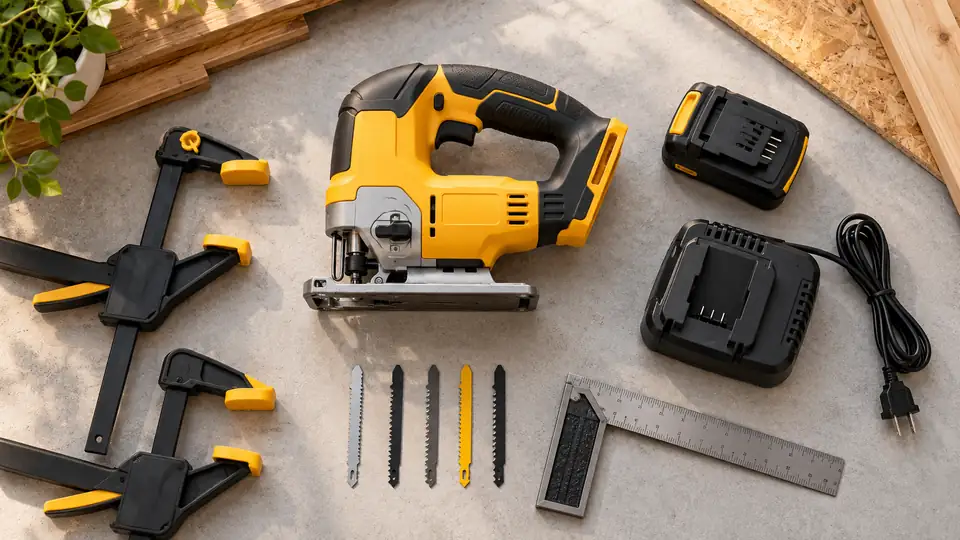
Spend enough to get a complete jigsaw setup that suits your material and workload. For occasional household cuts, a straightforward corded saw may leave more room for good blades and work support. A cordless kit becomes more attractive when you need mobility or already own compatible batteries. The right budget is the total needed to start the project properly, not just the amount on the bare-tool listing. Our budget jigsaw options are a useful starting point once you have decided what the setup must include. Use this guide to decide where additional spending will actually help.
Build the Budget Around a Ready-to-Cut Setup
List everything missing before comparing saws. A kit may include a battery but no spare, a case but no extraction adapter, or one general-purpose blade that does not suit your first project. Read the package contents for the exact listing rather than assuming every version includes the same accessories.
| Budget item | Why it belongs in the comparison | Check before ordering |
|---|---|---|
| Saw or kit | Provides the tool and possibly its power equipment | Exact model, package and regional electrical specification |
| Battery and charger | Required for a bare cordless tool | Approved platform and charger compatibility |
| Project-specific blades | Match material, thickness and finish | Shank, working length and material rating |
| Clamps and support | Keep the work steady and the blade path clear | Enough clearance beneath the entire cut |
| Dust connection | Connects the saw to an appropriate extractor | Tool-side part, hose interface and included fittings |
| Surface protection | Helps protect a finished face | Compatible shoe cover or splinter insert |
Treat this as a checklist, not a requirement to purchase every accessory. Buy what the work needs and what you do not already own.
Separate Essential Items from Convenient Extras
An essential item makes the planned cut possible: a compatible blade, stable support or an approved battery for a bare cordless tool. A convenient extra saves an adjustment or makes storage easier. Write these in separate columns. This prevents a case, promotional blade assortment or decorative feature from making an incomplete package appear ready for the project.
Use the first actual material to make the list concrete. Cutting a coated shelf requires an appropriate blade and a way to protect and support the face. Cutting a thin metal panel needs a different blade and workholding arrangement. A mixed accessory bundle is useful only when its contents match those requirements; the number of pieces in the box is not the same as usable project value.
What a Basic Saw Should Still Do Well
A lower-cost saw should have a shoe that locks securely, a blade clamp that suits readily available blades and controls you can operate comfortably. Variable speed is valuable when the project involves more than simple rough wood cuts. Check whether you can disable orbital action for work that calls for a less aggressive cut.
Our selection of jigsaws under $50 focuses on a budget search category. Availability and package contents determine whether a particular listing still fits your spending limit. The category name is a shopping filter, rather than a substitute for comparing the full setup. If the tool will be used for a few shelf cutouts and repair jobs, a basic corded model can be reasonable. Leave room for a fresh blade matched to the material; a premium saw with the wrong blade is a poor allocation of the budget.
Which Upgrades Are Worth Considering?
Pay attention to upgrades that remove a repeated difficulty. Tool-free blade changes help if you frequently switch materials. A more convenient bevel adjustment helps if the work repeatedly changes angle. Better low-speed control matters when starting delicate cuts. A compatible extraction port matters if the saw will live beside an extractor. A laser or light can improve the view of a line, but it does not replace blade support or workholding. Likewise, a long maximum cutting-depth specification is not useful if the main task is thin trim fitting. When comparing jigsaws under $100, identify the feature you gain over the simpler choice and the project step where it helps. If you cannot name that step, the upgrade may be less valuable than additional blades or better support.
Link Each Upgrade to a Repeated Task
Suppose two tools both satisfy the material and capacity requirements. One adds an easier blade release and the other adds a more convenient bevel adjustment. The first is more relevant if the work alternates between plastic, wood and metal; the second may be more useful when repeated angled fitting cuts are central. The choice follows the task frequency, not a general rule that every extra control deserves a larger budget.
Ask what happens without the upgrade. If the answer is an occasional extra adjustment you can perform comfortably, the simpler tool may be adequate. If the answer is an awkward operation repeated throughout the day, a better layout deserves more weight. Avoid assigning a monetary saving to that convenience without real information about your workload.
Bare Tool or Kit?
A bare tool makes sense when you already own an approved battery and charger of suitable size. Check that “same brand” also means the same battery family. A kit makes sense when you need the complete power system or the included pack suits the way you work. Compare like with like: one tool-only listing should not be treated as cheaper than a complete kit without accounting for the missing equipment. Consider corded versus cordless setup costs alongside where you will use the saw.
Check the Package Line by Line
Read the exact model suffix, included pack capacity, charger and accessory list. A photograph can show equipment used to illustrate a system rather than everything supplied in that listing. Keep a copy of the package description with the purchase record, especially when several versions of the same saw appear on the same shopping page.
For someone who owns suitable batteries, a kit can still be useful if its additional equipment is needed. For someone starting from nothing, a bare tool leaves a real gap that must be included in the comparison. Do not treat a spare charger as automatically valuable or an extra pack as automatically redundant. Match each included item to a specific place in the working setup.
Use a Three-Question Spending Rule
First, can the complete setup cut the intended material within the manufacturer’s limits? Second, can you hold and control it comfortably through the entire cut? Third, does the extra feature solve a problem you expect to encounter repeatedly? If all three answers are clear, you have a useful basis for spending. If the first answer is uncertain, resolve the blade or capacity mismatch before buying. If only the third answer is uncertain, choose the simpler option and preserve room in the budget for the project itself.
Diagnose Before Spending Again
If a recently purchased saw produces disappointing cuts, identify the defect before raising the budget. A chipped upper face, a sloped underside and a wandering top line are three different observations. They can involve tooth direction, blade deflection and guidance respectively. A more expensive tool may offer useful improvements, but it should solve the observed limitation rather than become a substitute for diagnosis.
Keep the successful trial setup in the project notes: material, thickness, blade code, face orientation and relevant controls. This record makes replacement blades easier to choose and reduces repeated trial-and-error purchases. A modest tool used with a clear setup can remain useful for years of suitable projects without needing to acquire every accessory in the range.
