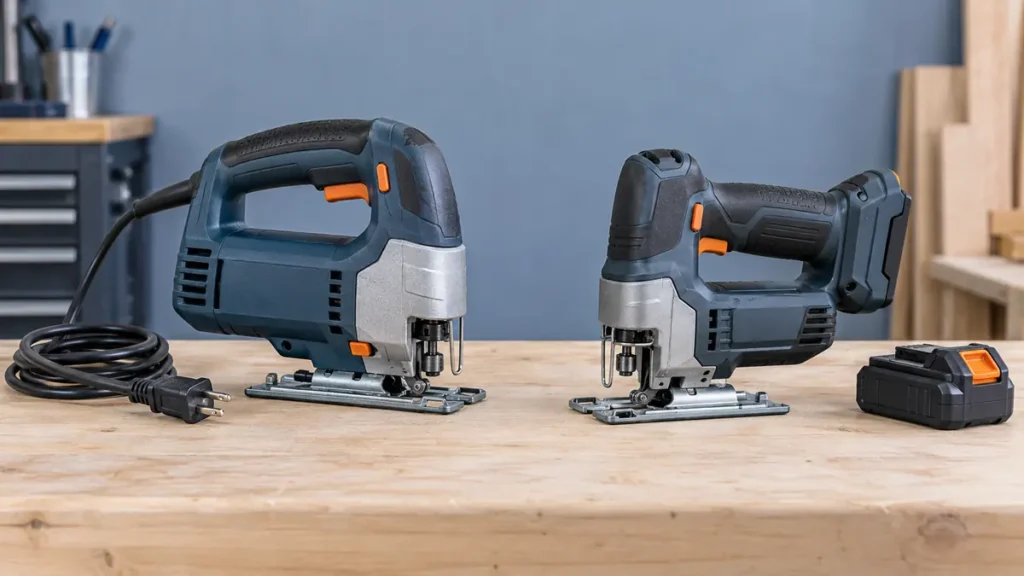
Choose a corded jigsaw when most cutting happens near a reliable outlet and you want a straightforward setup without batteries. Choose cordless when moving between work areas, turning around installed pieces or avoiding a trailing power cable matters more. Either can make accurate fitting cuts with a suitable blade, stable support and controlled feed. If your work stays at a bench, compare corded jigsaws for a fixed bench first. The important question is how power reaches the cut, rather than which power source sounds more advanced.
Compare the Whole Working Arrangement
A corded saw needs an appropriate supply and a cable route that stays clear of the blade. A cordless saw needs a charged, compatible battery and somewhere sensible to recharge it. Extraction may add a hose to either tool, so cordless does not always mean a completely untethered cutting setup.
| Situation | Corded consideration | Cordless consideration |
|---|---|---|
| Bench near an outlet | Easy access to continuous supply | Charger and spare-pack storage still needed |
| Several rooms or outdoor work | Cable length and routing can become awkward | Moving the tool is simpler; plan charging access |
| Curves in a small workpiece | Keep the cable from catching the corner | Check battery clearance through the turn |
| Work connected to extraction | Route cable and hose together without binding | Hose still affects movement and balance |
| Infrequent projects | No battery to charge before the first cut | Check pack condition before starting the project |
These are workflow comparisons. They do not establish that every corded model outcuts every cordless model, or the reverse.
Count Repositioning, Not Just Cutting Time
A project with several short notches in different rooms can involve more moving and arranging equipment than actual blade time. Cordless power may simplify those moves, provided charged packs are available. At a permanent bench, the same advantage can be much smaller because the outlet, support and extraction are already in place. Identify the activity that interrupts the work before deciding which supply is more convenient.
Map a typical session from storage to cleanup. Include retrieving a charger, finding a suitable outlet, bringing out an extension cord and moving the extractor. You do not need a stopwatch or an invented productivity percentage. A simple sequence reveals whether the power source removes an actual inconvenience or merely changes which equipment you carry.
Plan Cable and Hose Travel Before Cutting
With the saw disconnected or its battery removed, place it at the start and move it through the intended route without engaging the blade in the work. Check for a clamp, bench edge or corner that could snag the trailing equipment. Leave enough movement for the whole cut, including your final position.
Do not solve a short cable by pulling a connection taut. Use the extension-cord requirements in the saw’s manual and protect connections from the conditions at the worksite. Keep both cable and hose away from the underside of the work, where the moving blade projects. On a cordless tool, repeat the same route check with the battery you will actually use. A larger pack can change rear clearance even when the bare tool fits comfortably.
Check the End of the Route Too
A cable can travel freely across the first half of a board and then catch behind a support as the saw reaches the far edge. Curves make this less obvious because the tool changes direction while the connection remains behind it. Check the final position and the direction in which you will lift the stopped saw away. Do not make the last part of the cut dependent on pulling a tight cable around a corner.
A hose can create the same problem on a cordless tool. Its weight and stiffness may tug at the body even though no power cable is present. Arrange a supported route that leaves the shoe free to follow the intended path. The connection should remain secure without relying on excessive tension, and the route should not introduce a trip hazard around your working position.
Compare Batteries Using the Job, Not a Runtime Guess
Runtime depends on the tool, battery, material, blade, speed, feed and length of each cut. A pack that suits short trim notches may be inconvenient for repeated thick cuts. A second compatible battery can reduce charging interruptions, but it also adds equipment to buy, store and maintain.
Start with cordless jigsaw options that match the batteries you own. Then check the exact tool model against the battery and charger compatibility information. The guide to battery-platform and voltage differences explains why matching a voltage number alone is insufficient. Do not assume a higher amp-hour label makes a saw cut faster. Capacity, battery construction and the tool’s electrical requirements interact. Choose from the combinations the manufacturer approves, then decide whether the size and expected workload justify a larger pack.
Plan for Interruptions without Inventing Runtime
For occasional fitting cuts, checking the pack before the session may be sufficient. For repeated work, decide what happens when charging is needed: can another approved pack be used, can a different task proceed, or does the entire job stop? This practical fallback is more useful than borrowing a cuts-per-charge figure from a different blade, battery or material.
Repeated thermal or overload shutdowns are not a reason to keep restarting the saw into the same resistant cut. Stop and inspect the application, blade condition and permitted operating arrangement. A corded replacement does not automatically correct excessive feed, just as a larger battery does not automatically correct unsuitable teeth. Follow the tool’s instructions for cooling, restart and service when a problem persists.
Account for Equipment Already in the Workshop
A bare cordless tool can be a sensible addition to an established battery system. For someone starting from nothing, the relevant comparison is a working kit against a working corded setup. Include the charger and battery on one side, and any required extension cable on the other. Add appropriate blades and work support to both. A useful purchase note has three columns: equipment owned, equipment missing and parts that are model-specific. This prevents buying a second charger unnecessarily or overlooking the dust adapter needed for either saw.
Compare Entry Cost and Ongoing Use Separately
The initial purchase and the long-term arrangement are related but different. Existing approved batteries can make a bare cordless tool convenient today. Starting a second platform adds chargers, storage and replacement considerations. A corded saw avoids that particular equipment requirement, while retaining its own cable and electrical-supply needs. Record the equipment rather than assuming one category is always the cheaper system.
Also consider how rarely the saw may be used. A battery-powered tool needs a suitable pack ready when the project begins; a corded tool needs a safe accessible supply. Neither should be stored carelessly or returned to service with damaged components. Choose the arrangement you can maintain reliably, especially when the saw is used only for occasional household repairs.
Make the Choice with a Short Route Test
Choose corded if outlet access is convenient, the cable can travel freely and charging adds little benefit to your work. Choose cordless if movement is central to the job and you can support the platform with suitable batteries. If both fit, give more weight to grip, shoe stability and the controls you will use every cut. Return to the jigsaw selection checklist to compare those features. Changing the power source will not correct an unsuitable blade, unsupported sheet or feed pressure that bends the blade away from the line.
