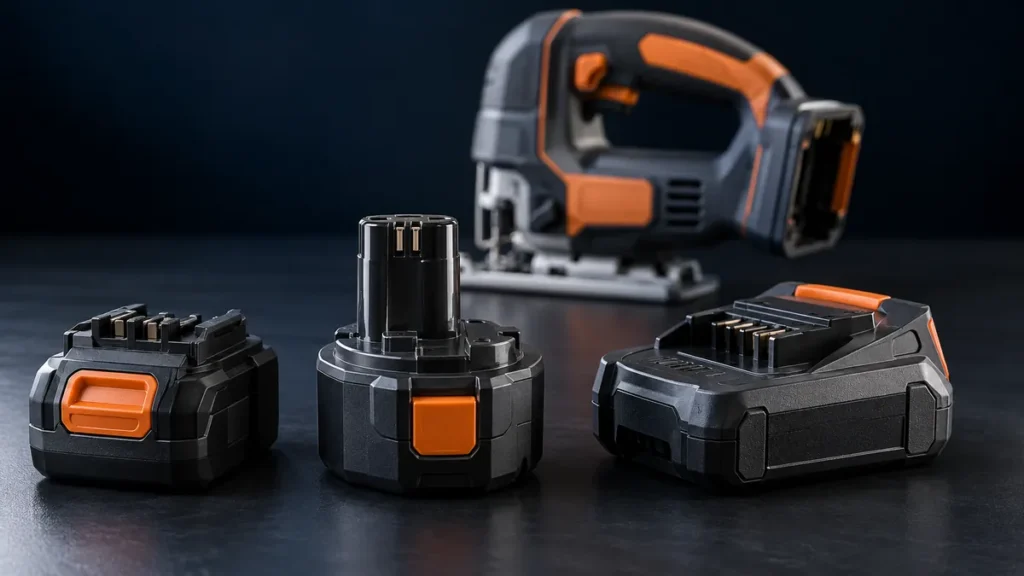
The practical choice between 12V, 18V and 20V MAX jigsaws is about the battery system, the complete tool’s size and the work it is designed to handle. Voltage labels alone do not predict cut quality or establish that one saw is more capable than another. In particular, DEWALT identifies its 20V MAX system as 18V nominal, so those two numbers cannot be treated as a straightforward power ranking. For a smaller setup used on fitting cuts and lighter projects, compare 12V jigsaws with the battery installed. Compact handling is useful only if the tool still suits the material and required cutting capacity.
Read the Label Before Comparing Numbers
A battery can be described by its maximum initial voltage or its nominal voltage. These describe different conditions. DEWALT’s 20V MAX labeling refers to maximum initial voltage measured without a workload; the stated nominal voltage is 18V. That naming convention does not make a DEWALT battery interchangeable with another brand’s 18V pack. “12V” also needs the manufacturer’s own definition. Avoid converting every platform name into a presumed universal specification. Use the exact model’s manual and battery compatibility list rather than a generic conversion rule.
| Label or specification | What it tells you | What it does not establish |
|---|---|---|
| Voltage family | Part of the manufacturer’s platform identification | Cross-brand interchangeability |
| Amp-hour capacity | A battery capacity rating within the stated conditions | Guaranteed cuts per charge |
| Bare-tool weight | Weight before some or all power accessories | Ready-to-cut handling |
| Rated wood or metal capacity | A model-specific application limit | Identical performance in every material |
| Stroke rate | Blade cycles per minute | Cutting speed through your particular workpiece |
Capacity and Energy Describe Different Things
Amp-hours describe charge capacity, while watt-hours express stored energy using voltage as part of the calculation. These quantities help describe a battery, but neither supplies a universal cutting-runtime result. Even two packs with apparently comparable labels can be used in tools with different motors, electronics and working conditions. Read the manufacturer’s stated ratings rather than inventing a conversion between model names.
For a purchasing comparison, first establish that the packs are approved for the tools being considered. Then compare size, weight, charging requirements and the workload you need to support. Do not multiply a marketing maximum-voltage label into an assumed energy specification when the maker already supplies an applicable rating. The practical goal is to compare supported configurations, not to turn labels into a performance league table.
Start with an Exact Platform Match
Bosch 12V Max and Bosch 18V are separate families. Makita CXT and LXT are separate systems. Milwaukee M12 and M18 are also separate. A shared brand name does not allow packs to move freely between these families. Use brand-specific battery compatibility to check the tool, pack and charger as a set. Do not rely on a product photograph that shows a similar-looking connector, or on the word “compatible” without an exact list of supported models.
If you already own an approved 18V setup, compare 18V jigsaw options within that system before starting a second battery family. If your workshop uses DEWALT’s corresponding platform, browse 20V MAX jigsaws by grip, controls and package contents rather than by the apparent numerical difference.
Build a Three-Model Compatibility Check
Record the jigsaw model, battery model and charger model together. Check the relevant official compatibility information for all three. A pack can belong to the right family while requiring attention to a particular tool generation, size restriction or charger arrangement. The exact combination is more reliable than a retailer’s broad phrase such as “fits 18V tools.”
Keep optional adapters outside the decision unless the manufacturer expressly supports the arrangement. Changing the physical connector does not establish that electrical protection, communication or charging requirements have been preserved. Starting a second approved platform can be less convenient, but it is a different decision from improvising a connection that the tool maker does not authorize.
Compare Working Size, Not Just Body Size
The battery can extend behind the saw, change the balance and interfere with nearby walls or fixtures. A compact pack may make a saw easier to turn, while a larger approved pack may better suit repeated cutting. The right compromise depends on your work and the manufacturer’s permitted combinations.
When evaluating weight, record whether a quoted figure is tool-only or includes a particular pack. A bare-tool figure beside a battery-equipped figure is not a fair comparison. If you can handle the tool before buying, try the same battery configuration you expect to use.
Account for the Whole Turning Envelope
A tool turns through a larger area than the blade alone. The handle, pack and hose connection all sweep around the cut. For an installed opening, check whether that envelope fits beside a wall, cabinet side or raised fitting. A compact saw body can lose much of its clearance advantage when paired with a long pack.
Compare the setup in the orientation required for the job. A clear route on a flat loose board may not remain clear in a confined installation. Do not solve insufficient access by abandoning stable shoe contact or holding a small workpiece beside the moving blade. If the supported route is not possible, change the cutting sequence or choose an appropriate alternative method.
Capacity Comes from the Complete Saw
Motor design, electronics, stroke, blade guidance and the blade itself all contribute to the cutting result. A compact saw can be well suited to trim and thin sheet work without being the right choice for repeated deep cuts. A full-size saw can offer useful capacity while being unnecessarily bulky for small installed openings. The distinction between brushless and brushed motor differences is another part of the choice, but it does not override the material and thickness limits in the manual.
Keep Platform Choice Separate from Cut Quality
Two saws on the same battery family can have different stroke mechanisms, blade support and control layouts. Conversely, two saws with different voltage labels may both handle a particular fitting cut adequately. Compare the material-specific capacity and the features that affect the task rather than treating the battery family as a complete description of the tool.
For a visible edge, the blade’s tooth geometry, support and feed still need attention. For repeated thick cuts, check reach and deflection as well as the tool’s rated capacity. A larger platform may offer configurations better suited to that workload, but the individual saw and blade must establish that suitability. This keeps a sensible platform decision from becoming an unsupported claim about every model in the category.
Make a Platform Decision in the Right Order
Write down the cut, check the tool’s application rating, identify an approved battery, and then compare the complete weight and clearance. Consider how you will recharge and store the packs. If buying into a platform creates more equipment than the work justifies, compare corded and cordless working setups before committing. Choose the system that supports the job and the rest of your workshop. A familiar, compatible setup with a suitable blade is more useful than a larger number on a battery label.
