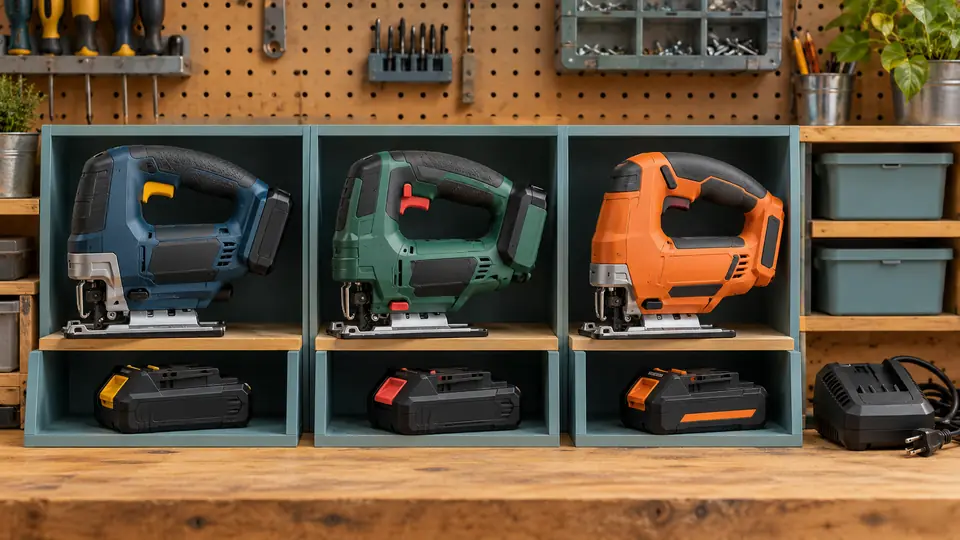
Choose a jigsaw battery platform by the exact batteries and charger you own, then compare the saws available within that system. A brand name by itself is not a compatibility specification. Bare tools, kits and aftermarket tools can look similar while requiring different power equipment or accessory connections. For example, our Bosch jigsaws comparison includes different power arrangements. Decide whether you need a corded tool, a 12V Max tool or an 18V tool before comparing the remaining features.
Make a Compatibility Record Before Shopping
Photograph the labels on your existing tool battery and charger. Record their model numbers, the platform name and the battery’s capacity. Use the candidate jigsaw’s manual to confirm the combination, including any restrictions associated with a particular attachment.
| Part of the setup | Match to confirm | Common assumption to avoid |
|---|---|---|
| Battery | Exact family and approved pack | All packs from one brand fit |
| Charger | Battery model and regional supply | Similar contacts mean compatibility |
| Blade | Supported shank and application | Every T-shank blade suits every cut |
| Dust adapter | Exact saw model and revision | One brand uses one universal port |
| Splinter insert or guide | Listed saw or base compatibility | A rail accessory is a jigsaw accessory |
| Kit contents | Exact package code | All listings include the pictured battery |
The explanation of battery-platform naming and working size is useful if the voltage labels are causing confusion. Keep the platform decision separate from grip and cut-quality decisions.
Keep Power and Mechanical Fit in Separate Columns
A battery interface and a dust-port interface answer different questions. A pack may power the saw correctly while a hose adapter still fails to fit the collection tube. Likewise, a blade can fit the clamp but be unsuitable for the material. Separating these matches prevents the word “compatible” from being treated as a blanket approval for the whole setup.
Use one line for each required connection: battery to tool, battery to charger, blade to clamp, blade to workpiece, attachment to saw and hose to attachment. Record the exact model or part number beside each line. This is especially helpful when a product page shows several package versions or an accessory appears in photographs without being included in the box.
DEWALT: Compare the Tool and Package Separately
A listing such as DCS334B identifies a tool-only package; the product page specifies that its battery and charger are separate. The DCS334 and DCS335 also have different handle layouts. Buying within a familiar system therefore still requires a choice about handling and package contents. Compare DEWALT jigsaws using the exact model and included equipment. Check blade-shank requirements and extraction accessories independently; a compatible battery does not make every mechanical accessory interchangeable.
Makita: Distinguish CXT from LXT
Makita’s 12V max CXT and 18V LXT names identify separate battery systems. A charger with provision for more than one family does not mean the batteries fit the same tool. Do not shorten the compatibility check to “Makita battery.” Our Makita jigsaws guide also includes corded choices, which do not require joining either cordless platform. When comparing them, check the dust connection by saw model: a through-body hose connection and a separate nozzle arrangement are different setups.
Compare Bare Tools with Complete Packages
A tool-only listing can make sense when the correct power equipment is already available. A kit can be more practical when starting a platform or when the included pack suits the intended work. Compare the actual contents rather than assuming a case, charger or second battery accompanies every version of a familiar model.
Keep regional supply requirements in view for chargers and corded equipment. A similar product name offered in a different market may not describe the same electrical package. The correct decision is based on the exact listing and official documentation for the supplied equipment. Do not infer that a plug change alone resolves every difference in the electrical specification.
Milwaukee: M12 and M18 Solve Different Setup Needs
Milwaukee M12 and M18 tools use their corresponding battery families. Compare the working size with an approved pack installed and consider where the switch sits in your normal grip. Handle layout and battery bulk can matter as much as the body dimensions. Use the Milwaukee jigsaws comparison to narrow the models, then check attachment restrictions in the manual. For example, an approved battery for operating a saw may still be too large for a particular dust attachment arrangement.
RYOBI: Check the ONE+ Listing and Kit Contents
A RYOBI ONE+ jigsaw listing may be a bare tool or a kit. Look for the stated pack and charger rather than inferring them from a promotional image. A model’s brushless motor, orbital controls and lighting should also be confirmed individually. Compare RYOBI jigsaw packages against the equipment already in your workshop. Starting with the right package avoids buying a redundant charger or receiving a saw you cannot power on arrival.
Festool: Plan the Base and Extraction System
For Festool, consider how the jigsaw will connect to the rest of the workshop. Base accessories, splinter protection, extraction and storage can influence the complete setup. A Basic package should not be assumed to contain every accessory pictured elsewhere in the range. Review Festool jigsaw configurations with a list of the exact bases and attachments required for your work. Match each accessory to the saw family, not just the manufacturer.
Identify the Attachment Chain Before Committing
A specialized workshop arrangement can involve several parts between saw and guide or between saw and extractor. Identify whether the chosen guide needs a separate base, whether a splinter insert fits that base and whether the intended cutting angle changes the arrangement. An accessory that is compatible with the saw in one configuration may have additional conditions in another.
Write the chain in the order the components connect, then mark which parts are supplied. This makes an omitted base or adapter visible before purchase. It also prevents two accessories with similar purposes from being treated as interchangeable. A guide-rail strip and an insert fitted around a jigsaw blade can both reduce surface damage in their intended systems, but they do not occupy the same place or mount in the same way.
SKIL: Separate Corded Tools from Cordless Systems
SKIL offers different power arrangements. A corded jigsaw does not require a battery platform, while a cordless model needs its specified battery and charger. Similar styling is not proof that two cordless products share power equipment. Use SKIL jigsaws to compare the actual models and package contents. Check the name on both tool and battery before assuming your existing equipment applies.
Treat Aftermarket Compatibility as a Separate Purchase Decision
An aftermarket tool advertised to accept a brand’s batteries is not necessarily a tool made by that brand. Confirm the manufacturer, approved power arrangement, support and warranty separately. Do not assume a physical fit provides the protections of an approved system. The most useful shortlist has one row per complete setup: saw, battery, charger, blade, dust fitting and any required base accessory. Choose among those working combinations, rather than among brand names alone.
Check Support Before Expanding a Platform
Compatibility is easier to manage when replacement parts, manuals and the responsible manufacturer are identifiable. Check who supports the saw, battery and charger individually. A seller’s broad statement about a battery family does not establish that the original battery manufacturer warrants the aftermarket tool or approves its electrical arrangement.
Keep photographs of the labels and the relevant official compatibility information with the purchase record. If a tool or pack changes later, repeat the check rather than relying on memory of the brand name. A small platform inventory is also useful when several people share a workshop: it makes the approved combinations clear without encouraging trial-and-error insertion of similar-looking packs.
