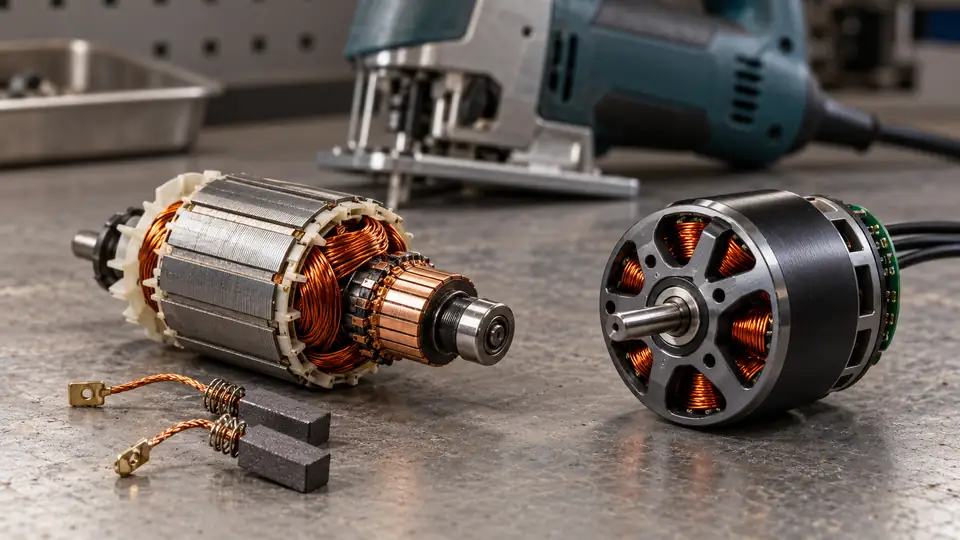
A brushless jigsaw uses electronic motor control instead of the brush-and-commutator arrangement in a conventional brushed motor. That can improve efficiency and removes carbon brushes as a wear item. It does not automatically produce a straighter cut, eliminate blade deflection or make every brushless model the better purchase. Compare brushless jigsaws when frequent cordless work, control features or an upgrade within your battery system makes the technology useful. For occasional projects, a well-matched brushed saw can still be a practical choice.
What Changes Inside the Tool?
In a brushed motor, carbon brushes make electrical contact with the rotating commutator. The brushes wear with use and may require service where the tool provides for replacement. Brushless designs use electronic switching instead. They still have bearings, a gearbox, a blade mechanism and electronic components that can wear or fail. The useful buying question is not whether one motor has fewer service items in theory. It is whether the complete saw offers the handling, features and support your work needs.
| Question | Motor design can influence | Check separately |
|---|---|---|
| How much work fits on a charge? | Electrical efficiency | Battery, material, blade and cutting conditions |
| How does the saw start and respond? | Electronic control possibilities | The actual trigger, dial and low-speed behavior |
| Will the cut remain square? | Available drive under load | Blade stiffness, guidance, shoe setting and feed |
| What maintenance is involved? | Brush wear in a brushed design | Manual, service parts and repair access |
| Is an upgrade worthwhile? | Potential efficiency and feature gains | Whole-tool cost and the job being repeated |
Brushless Does Not Mean Maintenance-Free
Removing carbon brushes from the motor design removes that particular wear item. The rest of the jigsaw still contains a moving blade mechanism, guides, a clamp, bearings and controls. Dust accumulation, a damaged shoe or a worn guide can affect use regardless of how the motor is switched electrically. Follow the maintenance instructions for the complete tool rather than assuming the motor label removes all service needs.
Where a brushed model provides for brush servicing, use its approved parts and procedure. Do not open the tool merely because a general article mentions replaceable brushes. If the manual directs the owner to a service center, that is the appropriate route. An electronics fault in a brushless saw likewise calls for the specified service process, not improvised changes to the control system.
Read Runtime Comparisons with Their Conditions
A manufacturer’s comparison between two named saws is evidence about that stated comparison. It is not a universal percentage improvement for every brushless tool. DEWALT, for example, describes the DCS334’s runtime benefit relative to its DCS331. That does not provide a guaranteed number of cuts in your timber or with your battery.
Runtime changes with blade condition, stock thickness, feed pressure, orbital setting and the battery used. A dull blade can turn a reasonable setup into a slow, hot cut. Before upgrading solely for runtime, check whether the current blade and settings suit the material. When browsing cordless jigsaws, compare package contents and approved batteries along with motor type. A bare brushless saw and a complete brushed kit solve different purchasing needs.
Compare Like-for-Like Work Before Drawing Conclusions
A useful comparison keeps the material, thickness, blade, battery and cut pattern in view. If several of those change at once, the motor type alone cannot explain the result. A manufacturer may provide a named comparison under specified conditions, but that does not establish an identical improvement for your next project.
Think about where interruptions occur in the actual work. A saw used for short scattered notches may spend more time being positioned than cutting. A saw making repeated longer cuts may place greater demands on the power arrangement. Decide whether a runtime improvement addresses a real constraint, and consider blade condition and charging plans before attributing every interruption to a brushed motor.
Separate Motor Technology from Blade Control
The motor drives the mechanism, but the blade has to remain aligned through the work. A narrow scrolling blade is designed to turn; a wider, stiffer blade is generally more appropriate when the cut calls for resistance to sideways movement. Neither becomes interchangeable simply because the saw has an efficient motor.
Shoe stability, guide condition and the operator’s feed matter too. Forcing the saw around a tight curve can bend the blade underneath the board while the top appears close to the line. Replacing the motor category does not remove that geometry. A light helps you see. Orbital action changes the cutting motion. Electronic speed control governs operation. These features may appear on brushless models, but they should each be checked in the exact saw’s specifications rather than inferred from the motor label.
Diagnose the Cut Before Blaming the Motor
Inspect the finished edge from above and below. If the top follows the line while the bottom slopes, the blade may be deflecting even though the motor maintains its cutting action. If the whole saw is being pushed off the layout, look at guidance, work support and the effort being applied. If the edge chips, inspect tooth direction and surface support.
These observations help identify which feature an upgrade would need to improve. Better blade guidance can be relevant to a deflection problem, but it does not make every blade equally stiff. More convenient speed control can help a delicate start, but it does not change an inappropriate tooth pattern. Treat each component as part of a system rather than attaching every outcome to motor construction.
When Does the Upgrade Make Sense?
Consider brushless when the saw is used repeatedly, charging interruptions matter, or the newer model also fixes a handling or adjustment problem. Consider keeping a functioning brushed tool when it already handles occasional projects well and the blades, support and controls are suitable. If the difficulty is bulk, compare working size and battery platform before deciding that motor technology is the answer. A smaller approved battery or a different grip layout may address the problem more directly.
Keep a Serviceable Saw When It Still Fits the Work
A functioning brushed jigsaw does not become unsuitable because a newer range uses brushless motors. If it completes the required cuts within its limits, accepts appropriate blades and remains comfortable to control, the most useful improvement may be elsewhere in the setup. Better support or a material-specific blade can address a concrete problem without replacing the entire tool.
An upgrade becomes easier to justify when several useful changes arrive together: a preferred grip, a suitable extraction connection, more accessible adjustments or a better match to an established battery system. Write down those gains separately. You can then assess the complete tool on its merits without inventing a fixed efficiency percentage or assuming the newest motor design improves every aspect of the cut.
Use a Practical Upgrade Checklist
- Name the problem: runtime, switch access, weight, adjustment or cut quality.
- Check whether blade condition or work support is causing it.
- Compare the complete candidate setup, including its battery.
- Identify the improvement you will use on normal projects.
- Confirm service support and accessory availability for the exact model.
Use the broader guide to choosing a saw for the project if several factors remain unresolved. Motor design is a useful specification once the application is clear; it should not be the entire buying decision.
