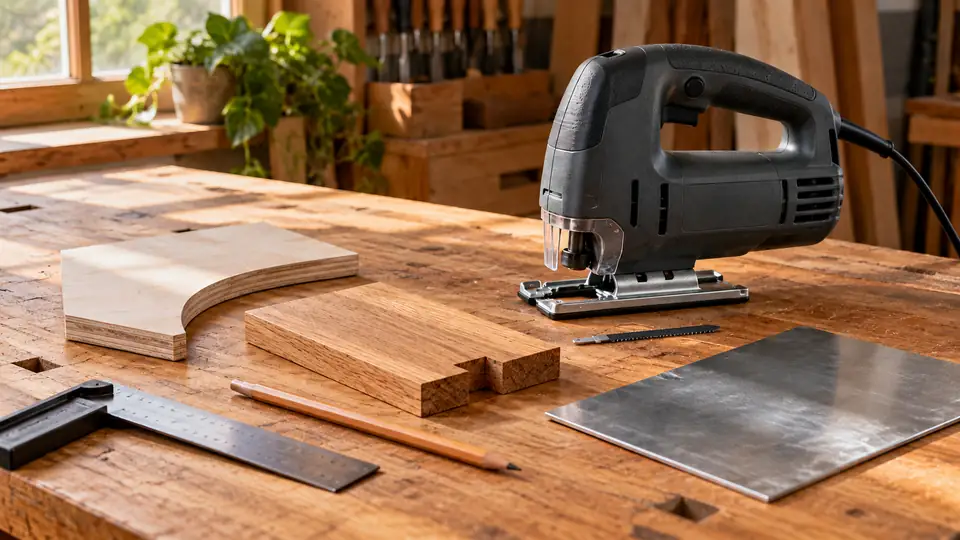
A good jigsaw choice starts with the cuts you need to make, the space around the work and the way the complete tool feels in your hand. Choose the blade for the material, then look for a saw that gives you comfortable control, adequate cutting capacity and a practical power supply. A higher voltage label or a longer feature list cannot make that decision for you. For shelves, repair work and occasional fitting cuts, start with our jigsaws for home projects and use the checklist below to narrow the choices around your actual work.
Start with Three Projects, Not a Specification Sheet
Write down your next three jobs. “Cut a curve in a shelf,” “notch flooring around a pipe” and “trim a thin metal panel” are useful descriptions. “Buy a powerful saw” is not. Record the material, thickness, shape and visible face for each job. These four details reveal whether you need a general wood blade, a narrow scrolling blade or a material-specific cutting edge.
| Your typical work | Features to prioritize | What to check before buying |
|---|---|---|
| Occasional wood cutouts | Comfortable grip, variable speed, stable shoe | Can you see the line with the shoe supported? |
| Repeated trim fitting | Accessible controls, predictable low-speed response | Can you operate the switch without changing your grip? |
| Thick wooden curves | Suitable rated capacity, blade support and clearance | Will a correctly rated blade reach through the full stroke? |
| Coated boards and flooring | No-mar shoe cover, compatible splinter insert | Is the insert included, optional or unavailable? |
| Installed work away from a bench | Manageable battery-equipped size and balance | Can the tool turn without striking the surrounding structure? |
A jigsaw is especially useful for curves, notches and openings. For repeated long straight cuts, compare jigsaw versus circular-saw tasks before putting the entire tool budget into a jigsaw.
Turn the Project into a Cutting Requirement
Consider a shelf with one straight end and a curved front. The curved edge is a reasonable jigsaw task, but it does not mean the jigsaw should also become the default tool for every long straight edge. Record which cut determines the finished fit, how much material can be removed during sanding and whether both faces remain visible. This separates the tool’s essential requirements from features that merely sound convenient.
For a cabinet opening, access may decide the purchase before maximum capacity does. Measure the space available for the saw body, battery and hose, not just the opening itself. Include the route into and out of the cut. A saw that reaches the starting point but cannot complete the turn is an awkward match even when its specification comfortably covers the board thickness.
Separate Home Use from Repeated Workshop Work
An occasional project rewards simple setup: an easy-to-lock shoe, clear blade installation and controls you understand. A workshop that changes materials throughout the day may benefit more from quick adjustments, spare parts availability, effective blade guidance and a dust connection that stays attached. The distinction is workload, not the label on the owner. If the saw will make repeated fitting cuts or join an extraction system, compare professional jigsaw options around those needs. Paying for a feature you use every session makes more sense than paying for an impressive maximum setting you rarely select.
Check Grip, Size and Working Weight Separately
A short body helps in confined spaces. A low working weight can reduce the effort of repositioning the saw. These are different advantages. A compact tool can become noticeably bulkier with a large battery, while a relatively long corded saw may feel balanced on a supported board. Look at compact jigsaws when surrounding clearance is the problem. Look at lightweight jigsaws when repeated handling is the problem. Compare the same weight basis: bare tool against bare tool, or ready-to-cut setup against ready-to-cut setup. For handle choice, think about switch access, hand size and your normal cutting posture. The comparison of barrel-grip versus D-handle handling explains why a low grip is not automatically the easiest grip for every user.
Judge Balance on Supported Work
Much of a normal cut happens with the shoe carrying the tool on the workpiece. Handling therefore includes more than lifting the saw off a shelf. Think about the pressure needed to keep the shoe stable, the reach to the switch and the movement needed through a curve. A comfortable lifting grip can still become awkward when your wrist turns around a small opening.
If you can handle a display tool, evaluate it unpowered with an approved battery configuration and a representative working posture. Keep clear of any installed blade. Compare visibility from where you will actually stand, rather than leaning over an unsupported tool to get an artificial view. The objective is a manageable working arrangement, not a universal winner for every hand size.
Put Useful Controls Ahead of Extras
Variable speed lets you adapt the cutting action to the blade and material. An orbital selector changes the blade’s cutting motion; it is useful when the material and finish permit it. A square, securely locked shoe gives you a reliable reference surface. A light and blower can improve visibility, but neither guides the blade mechanically.
Before buying, locate the blade release, bevel lock and speed control in the product photographs or manual. Check whether adjustments need a separate wrench. A tool-free control is convenient only if you can lock it securely and verify the setting afterward.
Compare Controls in Their Working Positions
Imagine changing from a straight cut to a bevel. Identify the control that unlocks the shoe, the reference used to set the angle and the action that locks it again. A quick lever saves time only if the shoe remains secure after adjustment. Check whether the dust attachment, splinter insert or no-mar cover is still permitted in that arrangement; accessories can have different limitations from the bare saw.
Low-speed control also deserves a closer look than the maximum stroke-rate number. Some saws combine a trigger and dial, while others use a switch with a separate speed setting. Consider whether you can start, maintain the intended pace and stop comfortably with your normal grip. These are control-layout questions that a larger motor specification cannot answer.
Compare Complete Setups
For cordless tools, include a compatible battery and charger. For either power source, include the right blades, clamps, work support and any model-specific dust adapter. If funds are limited, our budget jigsaws provide a starting point for a simpler setup without sacrificing the blade and support the project needs. Use this final purchase check:
- The manual permits the material and thickness you intend to cut.
- The saw accepts the blade shank you plan to buy.
- The complete tool fits your grip and available working space.
- Required batteries, inserts and dust parts are identified by model.
- You have a way to support the work and keep the blade’s path clear.
Once the equipment is selected, follow our guide to using a jigsaw safely and effectively for setup and the first practice cut. Choose the setup that solves your projects with the fewest awkward compromises.
Prioritize the Missing Part of the System
Before replacing a serviceable saw, inspect what currently prevents an acceptable cut. If a coated board chips, the blade and face support may need attention. If the underside wanders, blade geometry and feed pressure may be responsible. If the tool cannot turn beside a wall, body size may be the real limit. Assigning the problem correctly prevents a new tool from inheriting an unchanged setup problem.
Keep a written shortlist with one row per complete configuration. Record the saw, approved battery if applicable, required blade, dust parts and useful surface-protection accessories. Cross out equipment already owned. Comparing these configurations makes a bare tool and a kit understandable on the same basis, while keeping optional accessories from crowding out the equipment needed for the first project.
