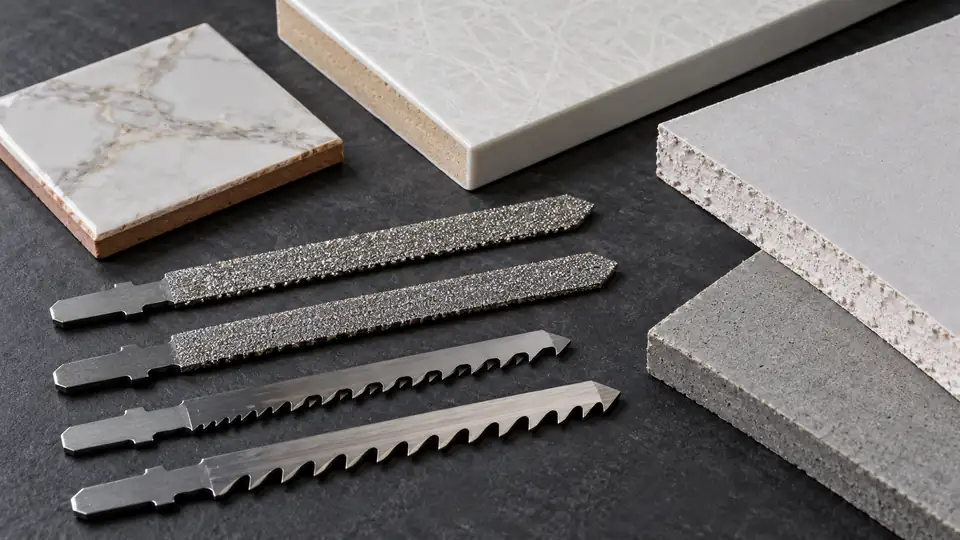
Choose a jigsaw blade for tile, fiberglass, drywall or fiber cement only when the blade’s rating, the saw’s permitted uses and the material manufacturer’s cutting method all agree. These materials do not form one universal “specialty blade” category. A carbide or diamond edge can suit a named application without making every jigsaw appropriate for that work. For an approved ceramic-tile job, compare jigsaw blades for ceramic tile against the tile type and thickness. Do not transfer a ceramic rating to porcelain, stone or another harder product without an explicit match.
Use a Three-Gate Material Check
First identify the product. Then check whether the tool and cutting method are permitted. Finally choose the exact blade and dust-control arrangement. This order prevents buying an apparently suitable cutting edge for a method the board or saw manufacturer does not allow.
| Material | Blade detail to verify | Separate decision before cutting |
|---|---|---|
| Ceramic tile | Named tile type, grit and thickness range | Whether the tile and saw permit the method |
| Fiberglass laminate | Explicit composite or fiberglass rating | Laminate construction and dust controls |
| Drywall / plasterboard | Exact board application | Saw restrictions and whether a simpler approved tool suits the cut |
| Fiber cement | Explicit fiber-cement rating | Board-maker method and silica-dust controls |
| Porcelain, quartz or stone | Dedicated material and tool system | Do not infer suitability from a ceramic jigsaw blade |
For an unidentified installed panel, establish what it contains before cutting. A fresh blade is not a solution to unknown material or hidden services.
Start with the Product, Not the Blade Rack
Record the full material name and product code, then find its fabrication instructions. The broad term “board” can describe gypsum, cement-based material, resin composite or a layered assembly. Those products may need different tools even when their thicknesses look similar. A blade package naming one of them does not establish permission to cut all the others.
Next check the saw manual’s intended uses and restrictions. Only then compare the blade’s material rating, shank and working range. Keep the dust-control method alongside those choices. If one of the three gates fails, selecting a harder blade does not complete the setup. Use the material maker’s approved alternative rather than trying to resolve a method restriction with cutting-edge construction alone.
Grit and Carbide Teeth Do Different Jobs
A grit edge removes material by abrasion. A carbide-toothed or carbide-strip blade has a defined tooth pattern. The two can differ in feed, finish and intended substrate. “Carbide” describes a cutting-edge material, not an all-materials instruction. Read the specific product’s application list and thickness range. Avoid choosing a specialty blade merely because it is the hardest-looking option in a mixed set.
Read Every Material in a Layered Panel
A composite part can contain a hard face, fiber reinforcement and a different core. The cutting edge may encounter all of them. Establish whether the blade’s rating covers that actual construction, and whether the manufacturer permits cutting it in the planned location. Do not assume that a rating for a thin laminate covers a thick structural assembly.
The expected edge matters too. A concealed opening can have different requirements from an exposed edge or a critical fitted joint. Assess chipping, delamination and support using the product’s instructions. Where a trial is appropriate, reproduce the real thickness and layer arrangement rather than testing a different scrap that happens to share one ingredient.
Ceramic Tile: Small Shapes Still Need Support
Where the method is approved, a jigsaw can serve a different role from a tile saw used for repeated straight cuts. Support the piece so it cannot chatter, and avoid forcing a turn tighter than the blade can make. The tile surface and glaze may need their own handling precautions.
Do not add water around an ordinary electrical jigsaw to imitate a wet tile saw. The tool and process must be designed for any wet method. If the tile type is outside the blade’s rating, choose the appropriate cutting system instead.
Fiberglass: Match the Laminate, Not Just the Word
A thin fiberglass sheet, a thick molded part and a sandwich panel can require different blade geometry and support. Core layers, gelcoat and access to the rear face affect the task. Compare fiberglass jigsaw blades using the actual laminate and thickness. Plan dust collection, protective equipment and cleanup from the material’s safety information. Do not use an ordinary wood setup merely because the piece is easy to clamp. Keep the shoe clean and test a representative offcut if available. A damaged surface layer or edge delamination calls for a setup correction before the finished part is cut.
Plan the Cut and Cleanup Before Making Dust
Identify the permitted cutting location, collection method and protective equipment from the material information and tool instructions. Support the piece without putting clamps or fixtures in the underside blade route. Keep a large cutout controlled as it separates, and avoid forcing a narrow blade through a turn that the laminate and blade cannot accommodate.
After the cut, allow the tool to stop and disconnect power before inspection or adjustment. Handle the edge and debris using the precautions for the actual composite. Do not transfer a wood-dust cleanup routine automatically to a fiber-containing material. If the edge begins separating into layers, stop and reassess the blade, support and method before continuing through the finished part.
Drywall: Check the Saw’s Instructions First
A blade sold for plasterboard does not override restrictions in a jigsaw manual concerning gypsum or abrasive dust. For ordinary board openings, the board maker’s approved hand tools or dedicated cutting methods may be the more practical route. Use jigsaw blades for drywall only for a tool-and-material combination that permits the application. On installed walls, identify concealed wiring, pipes and other services before planning the cut; visible markings alone cannot establish what is behind the board.
Fiber Cement: Start with the Board Maker’s Method
James Hardie publishes product-specific cutting and dust-control guidance, including lower-dust methods for applicable products. Use the instructions for the exact board rather than treating every cement-containing panel alike. If those instructions and your saw permit a jigsaw, compare fiber-cement jigsaw blades for the named product and thickness. A connected vacuum hose alone does not demonstrate adequate silica control. Determine the required cutting location, collection, protective equipment and cleanup method before work. The guide to the tool-side extraction connection helps with mechanical fit; it does not replace the material’s dust-control requirements.
Distinguish a Blade Application from an Approved Workflow
A manufacturer may sell a blade for fiber cement while a particular board installation guide favors scoring, shears or a specified saw arrangement. These statements can address different products and operations rather than contradict each other. Match the guidance to the exact board, thickness, cut shape and working conditions instead of combining isolated recommendations into a universal procedure.
This distinction also applies to dust. A port connection demonstrates a mechanical route for collection; it does not establish exposure control for a particular silica-containing task. Use the current product and workplace guidance to select the full method. If the necessary conditions cannot be met, change the process before starting rather than adding an unverified vacuum adapter and assuming the problem is solved.
Record the Approved Combination
Keep the product name, saw model, blade code and permitted method together. If one of those changes, recheck the combination. That small record is more useful than a universal specialty-blade rule and prevents a successful cut in one board from becoming an unsuitable method for another.
