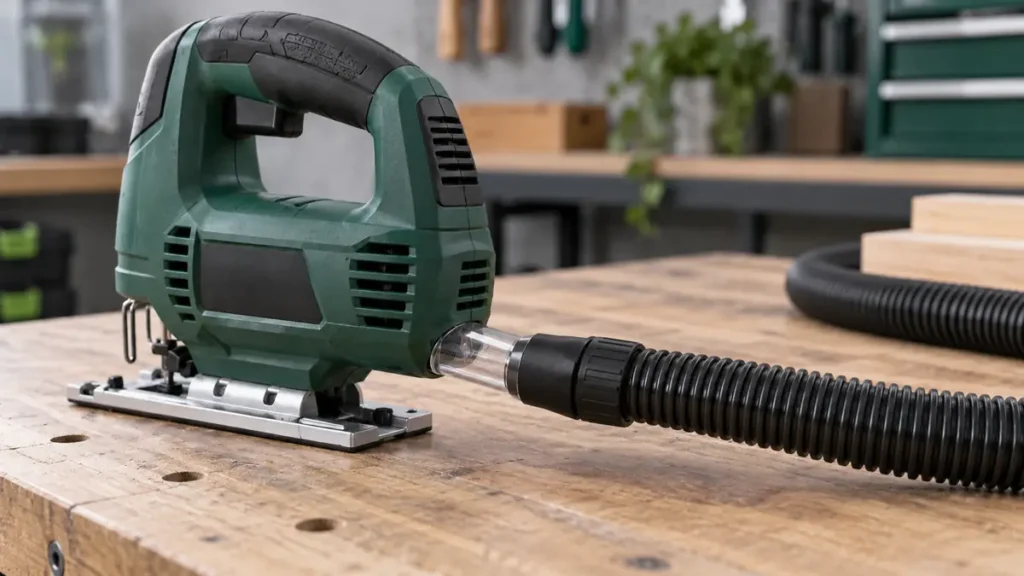
A jigsaw dust-extraction setup needs three compatible connections: the saw’s collection fitting, the hose interface and an extractor suitable for the material. A blower only moves debris away from the cutting line; it does not collect it. Before buying adapters, identify the exact saw model and the parts needed at its shoe or body. Compare jigsaws that support dust extraction by the complete connection arrangement. An advertised dust port can still require an optional hood, tube or model-specific fitting.
Draw the Connection Chain First
Write the setup as: saw → hood or tube → hose connection → extractor. Mark each part as included, already owned or missing. This separates a tool-side compatibility problem from a hose-diameter problem.
| Connection stage | What to confirm | Why it matters |
|---|---|---|
| Collection point | Correct hood, tube or built-in port | A hose alone cannot replace a missing collector |
| Tool-side fitting | Exact saw model and attachment | Similar saws may use different parts |
| Hose interface | Approved diameter and adapter arrangement | A loose fit can leak or pull away |
| Extractor | Suitable collection and filtration for the material | Visible cleanliness does not measure exposure |
| Moving setup | Clear travel through the whole cut | Hose tension can steer the tool |
Follow the manual’s instructions for the blower setting and dust cover when extracting. Do not tape over cooling vents or improvise a sealed enclosure around the saw.
Distinguish a Hose Adapter from a Collector
A reducer or cuff changes how two connections meet. It does not necessarily provide the hood or tube that gathers debris at the saw. If the tool-side collector is missing, buying a hose with a convenient diameter may leave the most important part of the chain unresolved. Start at the saw and work outward rather than starting with the vacuum nozzle in hand.
Read the included-parts list for the exact package. The same saw body can be sold with different accessories, and an accessory photograph can show a complete arrangement assembled from optional parts. Record the missing components by part number. This prevents ordering two hose reducers while still lacking the model-specific tube that attaches to the saw.
Bosch: JS470 and JS572 Use Different Kits
Bosch lists the JA1007 dust kit for the JS470E and JS470EB. It includes a clear hood, tube and VAC024 hose adapter. The JS572 family uses the JA1012 arrangement. These are not one universal Bosch jigsaw fitting. Check the listed hose connections for the selected kit. Buying an adapter with the right nominal diameter does not establish that it replaces the required tool-side tube. Keep a record of both the saw model and the attachment part number.
Makita: Direct Connection and Separate Nozzle Arrangements
Makita’s dust-management information lists a compatible 192108-A hose arrangement for the JV0600K. Its catalog distinguishes through-body connections on models such as the JV0600K and 4329K from the 417853-4 nozzle used with specified other jigsaws, including the 4350FCT and certain XVJ models. Do not order the nozzle simply because it appears beside a similar-looking Makita saw. Check the current model-specific dust solution, including the hose and extractor end of the setup. A kit name and a saw-body model may differ, so reconcile them before ordering.
Check Battery and Attachment Clearance
A dust tube can occupy space near a cordless saw’s battery. The Milwaukee 2737B instructions, for example, restrict use of its dust collection attachment with batteries larger than 5.0 Ah. That is an attachment-clearance issue as well as a battery-selection issue. Check the manual for the exact revision you own and use an approved combination. Do not trim an attachment or force it around an oversized pack. A battery that operates the saw is not automatically compatible with every accessory fitted to it.
Recheck the Setup After Changing a Pack or Base
A mechanical restriction can appear even when the electrical combination remains approved. A larger pack may occupy the space a dust tube needs, and an alternate base may change how an attachment sits near the cutting area. Use the instructions for the assembled configuration rather than relying only on the tool’s general battery-family information.
After any permitted change, disconnect power and inspect the complete arrangement. Confirm that the battery locks normally, the tube remains secured and the attachment does not interfere with controls or the intended shoe position. Do not treat contact between components as something to overcome by force. Choose an approved configuration or remove the incompatible option as the manufacturer directs.
Route the Hose without Adding Steering Force
With power disconnected, move the saw through the planned cut. Leave enough hose for the final position and keep it clear of clamps, corners and the blade underneath. Support its weight where appropriate without restricting movement or placing a loop in the cutting path. For a curve, check the entire turn. A hose that feels free at the start can tighten against a bench edge halfway through. Reposition the setup before cutting rather than pulling the tool against that resistance.
Diagnose Poor Pickup Before Buying Another Adapter
If visible debris suddenly increases, stop and check the basic connection chain after the blade has stopped. A loose cuff, displaced hood, blocked passage or extractor needing attention can change the result. Disconnect power as required before clearing a blockage or moving parts near the blade. Follow the extractor’s instructions for filters, containers and maintenance.
Also check whether the work itself has changed the collection geometry. An edge cut or opening can expose paths that differ from a cut across a fully supported panel. Do not infer a fixed collection efficiency from appearance, and do not respond by covering ventilation openings. Correct the approved mechanical arrangement and material controls rather than improvising a sealed saw enclosure.
Match the Collection System to the Material
Wood dust, plastic chips, metal debris and mineral-containing dust do not share identical collection requirements. Follow the material and extractor instructions. Do not assume that a household vacuum or a connected hose establishes adequate control for silica-containing materials, or collect hot metal debris in a system containing combustible dust. For ordinary board work, coordinate extraction with plywood cut support and dust planning so the supports do not obstruct the blade or collector. Disconnect power before clearing a blockage or adjusting a fitting.
Keep Cleanup Part of the Dust Plan
Dust control includes where debris goes after the cut. Follow the material and extractor instructions for emptying, filter handling and cleanup. A tidy-looking bench does not establish that fine airborne dust has been adequately controlled, while blowing settled dust around can create a different exposure problem. Choose a cleanup method suitable for the material rather than relying on the saw’s blower.
Keep collection tasks separated where the equipment instructions require it. Metal particles, wood dust and mineral-containing dust can create different hazards, and a hose that fits does not settle those questions. Establish the permitted material, extractor arrangement and protective equipment before starting. For a material with specific workplace controls, use the applicable guidance rather than treating this mechanical connection guide as a compliance assessment.
Judge the System as Part of the Saw Purchase
If extraction is central to your work, include all the required parts when comparing tools. Use the complete jigsaw selection checklist to weigh that setup against grip, control and cutting tasks. A practical final check is simple: every part is identified, the hose remains attached, the saw can complete the route freely and the extractor is suitable for the material. Improving the view of the line is helpful; controlling dust requires the whole chain.
