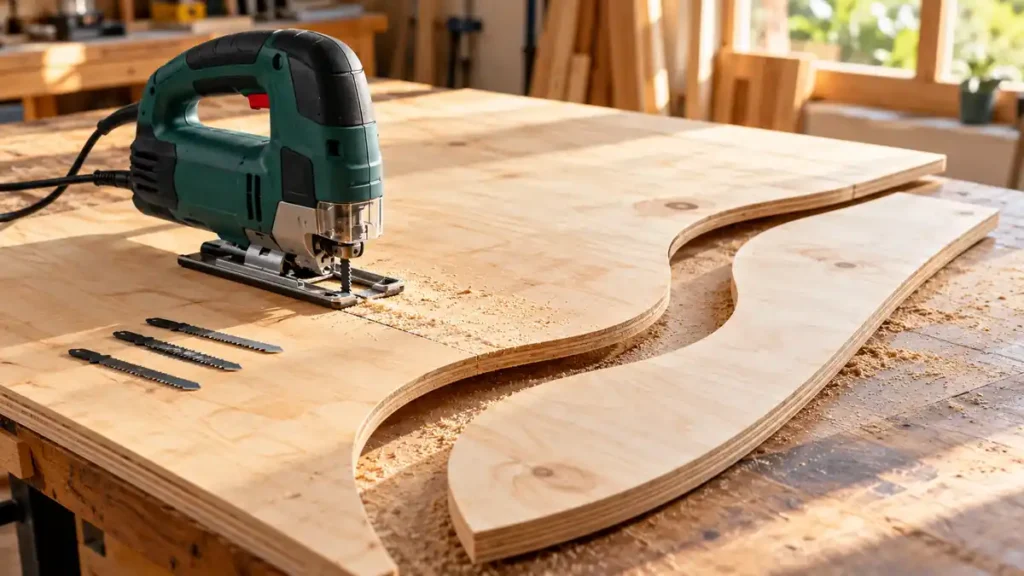
A curved cut can look simple on a pencil line and turn stubborn the moment the blade enters the wood. The jigsaw has to follow the arc without wandering, while the operator manages speed, blade choice, orbital action, and pressure. That is why shoppers seeking the best jigsaws for cutting curves often need more than a high maximum speed. A controllable trigger, useful speed adjustment, visible cut line, stable shoe, and a blade suited to the material all matter.
Common mistakes include choosing a blade meant for fast straight cuts, running aggressive orbital action through a delicate curve, or assuming that every jigsaw handles tight turns equally well. Cordless models add another decision because battery compatibility can limit the purchase, while corded tools are better suited to a fixed workbench with continuous power. The selections below include dedicated curve-cutting controls, variable-speed tools, compact cordless options, and a more refined corded model for buyers who want a steadier woodworking setup.
Different users will value different features. A homeowner shaping plywood may prefer a manageable corded tool with simple controls, while someone cutting furniture parts away from an outlet may prioritize a battery platform and built-in light. The BOSCH JS470E is the strongest overall match in this group because its variable-speed control, four orbital settings, T-shank clamp, and documented low-vibration design support controlled curve work without tying the buyer to a battery system.
Quick Answer
The BOSCH JS470E is the best overall choice for buyers who want a corded jigsaw with broad control over speed, orbital action, blade changes, and handling. The BLACK+DECKER BDEJS600C is especially appealing for straightforward curved cuts because it includes four curve settings and a wire-guarded adjustable shoe. For cordless work, the Milwaukee-compatible brushless jigsaw offers seven speed levels, four orbital settings, and 45-degree bevel adjustment, although it is a bare tool.
Best Jigsaws for Cutting Curves Comparison Table
| Product | Best For | Power And Speed | Curve-Relevant Features |
|---|---|---|---|
| BOSCH JS470E | Overall curve work | 7.0-amp, up to 3,100 SPM | Variable speed, 4 orbital settings, T-shank clamp |
| BLACK+DECKER BDEJS600C | Simple rounded cuts | 5-amp, up to 3,000 SPM | 4 curve settings, adjustable shoe |
| Milwaukee-Compatible Brushless Jigsaw | Milwaukee battery users | 18V battery platform, up to 3,500 RPM | 7 speeds, 4 orbital settings, LED light |
| DEMIMA DeWalt-Compatible Jigsaw | DeWalt battery users | DeWalt 20V battery, up to 3,200 RPM | 7 speeds, 3 orbital settings, LED light |
| VEVOR 6.5-Amp Jigsaw | Versatile DIY cutting | 6.5-amp, up to 3,000 SPM | 6 speeds, 4 orbital settings, LED light |
| Winmitool 5.5-Amp Jigsaw | Home project kits | 5.5-amp, up to 3,000 SPM | 6 speeds, 4 orbital settings, case |
| CAMXTOOL DeWalt-Compatible Jigsaw | Battery-sharing DIYers | DeWalt 20V battery, up to 2,800 RPM | 6 speeds, 4 orbital settings, LED light |
| DEMIMA Milwaukee-Compatible Jigsaw | Compact cordless projects | Milwaukee 18V battery, up to 3,200 RPM | 7 speeds, 3 orbital settings, LED light |
| Hammerhead HAJS048 | Basic corded curve cuts | 4.8-amp, up to 3,000 SPM | Variable speed, 4-stage orbital action |
The detailed reviews explain how each tool’s controls, power source, blade system, and included equipment affect curved cutting.
1. BOSCH Top-Handle Jig Saw JS470E | Best Overall

The BOSCH JS470E earns the top position because it gives curve-cutting work several useful layers of control. Its 7.0-amp motor reaches up to 3,100 SPM, while the variable-speed dial sets the maximum and the accelerator trigger controls the operating speed. That arrangement is useful for easing into a marked arc rather than immediately sending the blade at full speed. Four orbital settings also let the operator choose between a more controlled stroke and a more aggressive cut.
Handling details matter just as much on a curved line. The top-handle design has soft-grip areas, an ambidextrous lock-on button, and a die-cast foot with a steel insert. The listing also identifies an internal precision-machined plunging system and low-vibration design. A multidirectional T-shank clamp, tool-free blade change, blade ejection lever, anti-splinter insert, and non-marring overshoe round out a useful woodworking setup.
Pros
- 7.0-amp corded motor with speed up to 3,100 SPM
- Variable-speed dial and accelerator trigger provide layered control
- Four orbital settings cover controlled and faster cutting modes
- Multidirectional T-shank clamp supports quick blade changes
- Includes an anti-splinter insert, overshoe, blade, wrench, and case
Cons
- Corded operation limits movement away from an outlet
- Top-handle construction may be less appealing to buyers who prefer a compact cordless form
This is the most balanced pick for furniture shaping, plywood cutouts, trim work, and repeated workshop projects where consistent access to power is easy. It is less suitable for someone who already owns only a particular cordless battery system or needs to work in a remote area. Buyers who choose it are paying for a broader control package and documented handling features rather than maximum portability.
To buy this product, click here.
2. BLACK+DECKER BDEJS600C | Best for Dedicated Curve Control

A tool marketed with a specific curve-control system has a clear advantage for shoppers whose main project involves rounded cutouts. The BDEJS600C uses four curve settings intended to provide more control over curved work, alongside a 5-amp motor capable of up to 3,000 SPM. Its 3/4-inch orbital action can support faster material removal, but a careful operator should select a less aggressive setting when edge quality and steering matter more than speed.
The adjustable shoe and wire guard are practical features for following a visible line across plywood or a workpiece marked for a craft project. Bevel cuts extend to 45 degrees, which adds flexibility for angled edges, although beveling a curve demands more attention to workpiece support and blade selection. Since this is a corded top-handle tool, it suits a garage bench or home workshop better than a job site where a trailing cord becomes inconvenient.
Pros
- Four documented curve-control settings
- Variable-speed motor reaches up to 3,000 SPM
- Adjustable shoe includes a wire guard for line visibility
- Supports bevel cuts up to 45 degrees
- Simple corded format avoids battery and charger requirements
Cons
- Only a 5-amp motor is specified
- Corded use requires outlet access and cord management
This is a sensible choice for homeowners cutting rounded shelves, signs, panels, or occasional furniture parts. The curve settings make its intended use unusually clear, but buyers seeking a heavier workshop tool may prefer the BOSCH’s higher motor rating and broader control package. Keep the cut steady, use a narrow curve-suitable blade where appropriate, and avoid treating the highest orbital setting as the default for every arc.
To buy this product, click here.
3. Milwaukee-Compatible Brushless Cordless Jigsaw | Best for Milwaukee Battery Users

For a buyer already invested in Milwaukee 18V batteries, this cordless jigsaw removes the cord from curved cutouts, sink openings, trim work, and furniture shaping. The listing identifies a brushless motor, seven speed levels, and a maximum speed of 3,500 RPM. Those controls give the operator room to slow down for a delicate entry or raise the speed for a broader cut, although the correct setting still depends on the blade and workpiece.
Four orbital modes create another distinction from simpler cordless options. The base supports bevel adjustment from 0 to 45 degrees in both directions, with preset positions listed at 0, 15, and 30 degrees plus a 45-degree stop. A front LED can illuminate a dim cut line, while the rubber-wrapped grip and compact frame are useful around cabinets or other restricted spaces. The product is a bare tool, so the compatible Milwaukee battery and charger are separate requirements.
Pros
- Documented compatibility with Milwaukee 18V battery packs
- Brushless motor with speed up to 3,500 RPM
- Seven speed levels and four orbital modes
- Dual-side bevel adjustment up to 45 degrees
- LED light, tool-free blade change, and safety lock
Cons
- Battery and charger are not included
- Compatibility is limited to the specified Milwaukee battery platform
This model makes the most sense for existing Milwaukee battery users who value portability more than a complete kit. It can be a poor fit for someone starting from scratch because the battery system adds a separate purchasing requirement. Its strongest advantage is freedom of movement around a large panel or a built-in cabinet, where a power cord can snag on corners and interrupt a smooth curve.
To buy this product, click here.
4. DEMIMA DeWalt-Compatible Cordless Jigsaw | Best for Seven-Speed Cordless Control

This DEMIMA model targets users with DeWalt 20V batteries and offers a portable setup for straight, curved, and circular cuts. The listing specifies seven speed levels, a maximum speed of 3,200 RPM, and three orbital motions. That combination gives more adjustment than a basic single-speed saw, which matters when a tight curve calls for a calmer feed and a clean wood blade rather than an aggressive, fast-cutting configuration.
Its listed capacities are 80 mm in wood, 8 mm in steel, and 20 mm in PVC pipe. Those figures describe published maximums for the relevant materials, not a promise of perfect control or edge quality at those thicknesses. The tool also includes a front LED, rubber handle, safety lock, tool-free T-shaped blade change, and blades for wood and metal. Battery and charger requirements remain separate, and compatibility should be checked against the exact DeWalt battery series listed for the tool.
Pros
- Uses the specified DeWalt 20V battery platform
- Seven speed levels support varied cutting tasks
- Three orbital motions provide control over cutting action
- Supports 45-degree bevel adjustment
- Includes wood and metal blades, wrench, and manual
Cons
- Battery and charger are not included
- Three orbital motions offer fewer choices than four-setting models in this roundup
Choose this jigsaw if battery sharing is already part of your workshop routine and you want a cordless tool with a broad speed range. It is less compelling for a corded-workbench user who does not own DeWalt batteries. The included blade assortment is convenient for starting a project, but a tight curve may still call for a separate blade selected for its width and tooth design.
To buy this product, click here.
5. VEVOR 6.5-Amp Corded Jig Saw | Best for Versatile DIY Cutting

The VEVOR combines a 6.5-amp corded motor with six variable-speed settings and four orbital positions. Its product information specifically lists straight, curved, circular, and bevel cutting from 0 to 45 degrees, so it is aimed at the mixed-use DIYer who may move from a rounded shelf cutout to a straight panel edge in the same afternoon. The 3,000 SPM maximum is useful context, but it does not by itself determine how smoothly a curve will track.
Six included blades and tool-free blade changes make the package convenient at the start of a project. The important detail is to match each blade to its material and geometry rather than choosing by count alone. For a curve, a narrower wood blade may steer more readily than a broad fast-cut blade, while orbital action should be selected with the desired edge quality in mind. The LED is helpful in shadowed areas, though lighting does not replace a clearly marked line or secure workpiece support.
Pros
- 6.5-amp corded motor reaches up to 3,000 SPM
- Six speed settings provide useful adjustment
- Four orbital settings support different cutting approaches
- Supports 0 to 45-degree bevel cuts
- Includes six blades and tool-free blade changes
Cons
- Corded operation limits mobility around large or fixed installations
- Product information does not specify a dedicated curve-control system
This is a practical general-purpose pick for a home workshop where curves are one task among many. It gives more speed adjustment than some basic tools and includes a useful starter selection of blades. Buyers who regularly cut tight radii or prioritize the most specialized curve guidance should look toward the BLACK+DECKER’s documented curve settings or the BOSCH’s broader control design.
To buy this product, click here.
6. Winmitool 5.5-Amp Corded Jig Saw | Best Complete Home Project Kit

The Winmitool is built around a useful set of controls for a first workshop tool: six speeds, four orbital settings, tool-free blade changes, and bevel positions at 0, 15, 30, and 45 degrees. Its 5.5-amp motor is listed at up to 3,000 SPM. For curved work, the ability to reduce speed and choose a less aggressive orbital mode can help the operator stay closer to a marked line, particularly in plywood or softer boards.
This kit also includes four replacement blades, a scale ruler, safety goggles, gloves, a manual, an Allen wrench, and a carrying case. The rear dust port can connect to a vacuum hose, although the hose is not included. A parallel guide is supplied for straighter work, which is useful when a project combines curved cutouts with straight sections. The published wood capacity reaches 2-9/16 inches, but that maximum should not be read as a guarantee of clean, easily controlled curves at that thickness.
Pros
- 5.5-amp motor with speed up to 3,000 SPM
- Six variable-speed levels and four orbital settings
- Bevel positions include 0, 15, 30, and 45 degrees
- Rear dust port and parallel guide add workshop utility
- Includes blades, case, ruler, goggles, gloves, and wrench
Cons
- Vacuum hose is not included with the dust port
- Included accessories add convenience but do not replace task-specific curve blades
This model suits a new DIY setup where one box needs to cover furniture repairs, shelves, trim, and occasional curved designs. It may be more equipment than an experienced woodworker needs if a preferred blade collection and storage system are already available. The case and accessories are the main distinction here, while the tool’s curve performance will still depend on blade choice and careful feed pressure.
To buy this product, click here.
7. CAMXTOOL DeWalt-Compatible Cordless Jigsaw | Best for Battery-Sharing DIYers

CAMXTOOL takes a straightforward battery-sharing approach. The tool is listed as compatible with DeWalt 20V Max batteries and includes six variable-speed levels, four orbital settings, an LED, and a guide ruler. Its maximum speed is listed at 2,800 RPM, lower than several other tools here, but maximum speed should be weighed against control. For a curve around a sink opening or a furniture panel, a manageable setting can matter more than chasing the highest number.
The package includes seven T-shank blades, with separate wood and metal options, plus a dust blower port and tool-free blade release. That assortment gives a new user several starting points, though the product information does not identify every blade’s tooth geometry in detail. The 45-degree bevel range works in both directions, and the guide ruler is more useful for straight layout work than for tight curves. As a bare tool, it requires a compatible battery and charger.
Pros
- Compatible with the specified DeWalt 20V Max battery family
- Six speed levels and four orbital settings
- 45-degree bevel adjustment in both directions
- Includes seven T-shank blades for wood and metal
- LED light, guide ruler, and dust blower port are included
Cons
- Battery and charger are not included
- Maximum listed speed is 2,800 RPM
CAMXTOOL is a reasonable fit for a DeWalt battery owner who wants a cordless jigsaw for occasional curved cutouts and general repairs. It is less attractive for someone who needs a complete ready-to-run package or regularly cuts thick stock at a fast pace. The seven-blade assortment is useful, but buyers should confirm that the included blade shape suits the radius and material before starting a visible cut.
To buy this product, click here.
8. DEMIMA Milwaukee-Compatible Cordless Jigsaw | Best for Compact Milwaukee-Platform Work

This DEMIMA model shares the Milwaukee 18V battery requirement with another cordless selection in the roundup but uses a different listing and specification set. It offers seven speed levels, a maximum of 3,200 RPM, three orbital motions, and 45-degree bevel adjustment. The combination is aimed at users who want a compact battery-powered tool for circle cuts, trim work, and curved panels without bringing a cord across the work area.
The package includes short and long wood blades, metal blades, a wrench, and a manual. An LED helps illuminate the blade area, while the rubber handle and safety lock address basic handling and startup control. The listed capacities reach 80 mm in wood, 8 mm in steel, and 20 mm in PVC pipe. Those figures cover several materials, yet the correct blade remains decisive. A metal blade that fits the clamp is not automatically the right choice for a tight wood curve.
Pros
- Compatible with the specified Milwaukee 18V battery platform
- Seven speed levels reach up to 3,200 RPM
- Includes three orbital motions and 45-degree bevel adjustment
- Includes short, long, wood, and metal blades
- LED light and tool-free blade change support portable work
Cons
- Battery and charger are not included
- Three orbital motions provide less adjustment than four-mode models
This version is best for Milwaukee-platform users who want a supplied blade assortment and a portable tool for varied household or workshop cuts. It may be unnecessary for someone who already owns a higher-control cordless jigsaw or works beside a permanent outlet. The tool offers useful flexibility, but the product data does not document a specialized curve-control mechanism, so blade selection and operator technique remain central.
To buy this product, click here.
9. Hammerhead HAJS048 4.8-Amp Jig Saw | Best for Basic Corded Curve Projects

The Hammerhead keeps the controls familiar and the setup uncomplicated. Its 4.8-amp corded motor reaches up to 3,000 SPM, with variable-speed adjustment and four-stage orbital action. That gives a beginner a way to slow down for a marked curve or select a more aggressive stroke for rougher work. The product also lists a brake function, though the available information does not provide independent details about stopping time or cut quality.
A metal base plate adjusts for bevel cuts up to 45 degrees, and the dust port can connect to a vacuum. Tool-free T-shank blade changes make it easier to switch between the two included wood blades and other compatible options. This is a basic tool rather than a specialized curve machine, so shoppers cutting small radii should plan to choose a suitable narrow blade instead of relying solely on the included blades.
Pros
- Variable-speed 4.8-amp corded motor
- Maximum listed speed of 3,000 SPM
- Four-stage orbital function
- 45-degree bevel adjustment
- Dust port and tool-free T-shank blade changes
Cons
- Only two wood blades are included
- Lower motor rating than several corded alternatives in this group
The Hammerhead is a sensible match for occasional curves in thinner wood, craft panels, and home repair work. It is less suited to a buyer who wants a broad accessory package, dedicated curve settings, or a cordless battery platform. Its value lies in providing the core controls without a complicated setup, but the operator will need to supply the precision through correct blade selection and a controlled feed.
To buy this product, click here.
Buying Guide
Match the Tool to the Shape of the Curve
A broad, gentle arc through plywood places different demands on a jigsaw than a tight circle in a small furniture part. Dedicated curve settings, such as those listed for the BLACK+DECKER, can be useful for shoppers who expect rounded cuts regularly. Other tools rely on variable speed, orbital adjustment, and the operator’s blade choice. A narrow blade generally gives the operator more room to steer through a tight turn than a wide blade intended for long straight cuts, but the product details do not establish a universal minimum radius for any of these tools.
Follow the technique for cutting curves with a jigsaw when the layout needs relief cuts and a controlled turn.
Use Variable Speed as a Control, Not a Race
Maximum speed figures range from 2,800 RPM on the CAMXTOOL to 3,500 RPM on the Milwaukee-compatible model. Those numbers provide a reference for the available motor control, but they do not prove that one tool will cut every curve faster or cleaner. Slowing the blade can make it easier to follow a pencil line, especially in a thin or delicate workpiece. Start with the material and blade guidance, then adjust speed to the cut rather than automatically choosing the top setting.
Understand Orbital Action
Orbital action changes how the blade moves through the work. Higher settings can support faster material removal, while lower settings are generally more appropriate for controlled work and edge quality. The products here offer three or four orbital options, except where the listing uses different wording. A curve cut usually rewards restraint, particularly near a tight turn or an exposed edge. The right setting also depends on the material, blade, and desired finish.
Check the Battery Platform Before Buying Cordless
The cordless options are platform-specific. The DEMIMA and CAMXTOOL models listed here require the specified DeWalt battery families, while the other cordless models require Milwaukee 18V batteries. The tools are listed without batteries and chargers. A battery from another manufacturer or a different platform should not be assumed compatible because the voltage label looks similar. Buyers who already own the matching batteries can gain portability, while first-time cordless buyers need to account for the separate power-source requirements.
Choose the Correct Blade Interface and Geometry
Most of the selected tools describe tool-free T-shank blade changes. That does not make every T-shank blade equally suitable for curves. Blade width, tooth design, length, and material recommendation all affect the cut. A blade made for fast straight cutting may resist a tight turn, while a blade intended for curves may sacrifice some straight-line speed. Confirm the shank type, then choose a blade for the workpiece and radius rather than relying only on the blade count in a kit.
Think About Visibility and Dust Management
An LED can brighten the cutting area on the cordless models and the VEVOR, while the BLACK+DECKER lists a wire guard intended to support line visibility. The Winmitool, Hammerhead, and CAMXTOOL include dust-related features or ports, but a dust port does not automatically include a vacuum hose or remove every airborne particle. A clear layout line, stable workpiece, and suitable protective equipment remain important in a real workshop.
Separate Published Capacity From Practical Curve Work
Some products list maximum cutting capacities, including the Winmitool’s stated wood capacity and the DEMIMA models’ published material figures. These specifications describe listed limits, not guaranteed accuracy, squareness, or edge quality at every thickness. Thick material increases the chance of blade deflection and makes a tight curve harder to control. Match the blade’s usable length to the workpiece and treat maximum capacity as a boundary rather than a target.
Best Jigsaws for Cutting Curves FAQ
What makes a jigsaw suitable for cutting curves?
Useful characteristics include variable-speed control, manageable orbital settings, clear blade visibility, a stable shoe, and compatibility with blades intended for curved work. A dedicated curve-control feature can also help, as shown by the BLACK+DECKER. No feature eliminates the need for a suitable blade and steady workpiece support.
Is a higher maximum speed better for curved cuts?
Not automatically. A higher maximum can provide more cutting headroom, but a controlled lower speed may be easier to steer through a tight radius. The Milwaukee-compatible tool lists up to 3,500 RPM, while the CAMXTOOL lists up to 2,800 RPM. The best setting depends on the material, blade, curve, and desired edge.
Should orbital action be used for every curve?
No. Orbital action can increase material removal, but an aggressive setting may make a delicate curve harder to follow or affect the edge. Start with a lower setting for controlled work, then adjust only if the material and blade guidance support a faster stroke.
Are cordless jigsaws as suitable for curves as corded models?
Either power source can work for curves when the tool accepts a suitable blade and provides adequate control. Cordless models are convenient around large panels, cabinets, and outdoor work, while corded models avoid battery limitations during extended projects. The cordless selections here are tool-only, so the required DeWalt or Milwaukee battery must be available separately.
Do all of these jigsaws accept the same blades?
The listed tools describe T-shank blade systems, but compatibility should still be checked against the exact model and blade. Physical fit does not establish that a blade is appropriate for a particular material or curve. Blade length, width, tooth design, and intended application remain important after confirming the shank interface.
Can a jigsaw cut a perfect circle without an accessory?
A jigsaw can cut a circular opening when the workpiece is marked accurately and the operator guides the tool steadily, but the product details do not document a dedicated circle-cutting guide for these selections. A guide or template may improve repeatability, provided it is compatible with the jigsaw’s shoe and does not interfere with the blade path.
Are the listed cutting capacities suitable for curved cuts at maximum thickness?
Maximum published capacities should not be treated as a promise of clean or precise curves. Thick material can increase blade deflection and make turning more difficult. Use a blade with suitable working length, support the workpiece securely, and choose a gentler curve or thinner stock when control and edge quality matter.
Final Verdict
The BOSCH JS470E is the best overall choice among these nine products for buyers who want a corded jigsaw with a broad set of Controls. Its 7.0-amp motor, variable-speed dial, trigger control, four orbital settings, T-shank clamp, and included anti-splinter accessories create a balanced setup for workshop curve cutting. The BLACK+DECKER BDEJS600C is the more direct alternative for shoppers drawn to dedicated curve settings and a simpler home-project format.
Cordless buyers should choose by battery platform first. The Milwaukee-compatible brushless jigsaw offers the highest listed speed and four orbital settings, while the DeWalt-compatible DEMIMA adds seven speeds and a useful supplied blade group. The Winmitool is appealing as a complete corded home kit, and the Hammerhead keeps occasional projects straightforward. Whichever tool you select, pair it with a blade intended for the workpiece and curve, use orbital action conservatively, and treat published capacity as a limit rather than a performance guarantee.
