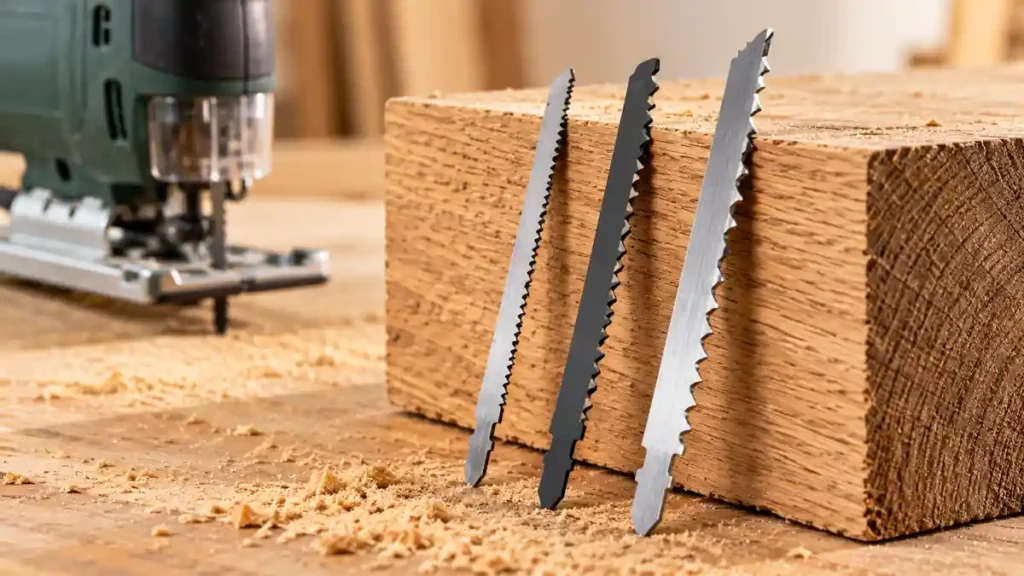
Thick wood exposes the weaknesses of an ordinary jigsaw blade quickly. A short fine-tooth blade can struggle to clear sawdust, a narrow blade can wander through a deep board, and an aggressive profile can leave a ragged edge that needs substantial sanding. The right choice depends on more than the blade count in a package. Working length, tooth spacing, shank style, blade material, and the intended wood application all matter.
For deep cuts in hardwood, plywood, chipboard, or thick panels, longer blades with relatively open tooth spacing are generally more practical than short scrolling blades. A 6-inch T344D blade, for example, has a listed 5-inch working length and a stated application range of 5 to 50 mm. Fine 20 TPI blades can be useful for veneers, laminates, and curved detail work, but they are a poor substitute for a long rough-cut blade through a thick timber. Compatibility matters too. Most selections below use a T-shank, while the excluded U-shank format is intended for tools with a different holder.
This comparison weighs documented blade length, tooth configuration, material, wood-cutting applications, and useful variety. Some picks are specialized for deep, fast cuts, while others earn their place as supporting options for hardwood finish work, curves, flush cuts, or mixed workshop use. The strongest match for genuinely thick wood is the Qjaiune T344D set because its long working length and 6 TPI profile are specifically documented for material up to 50 mm.
Quick Answer
Best Overall: Qjaiune T344D T-Shank Jigsaw Blades are the clearest match for deep wood cuts, with a 6-inch overall length, 5-inch working length, 6 TPI profile, and stated suitability for wood thicknesses from 5 to 50 mm.
Best for Finish Work: Diablo DJT308BFP5 Bi-Metal Blades are better suited to buyers who want a cleaner top and bottom surface on wood and can work within their shorter length.
Best Mixed Set: DEWALT DW3741C combines HCS and bi-metal blades in 6, 10, and 18 TPI options, giving a workshop several tooth profiles without narrowing the selection to one deep-cut blade.
Best Jigsaw Blades for Thick Wood Comparison Table
| Product | Best For | Blade Material | Tooth Profile or Length |
|---|---|---|---|
| Qjaiune T344D Blades | Deep wood cuts | High-carbon steel | 6 TPI, 5-inch working length |
| Diablo DJT308BFP5 | Clean wood surfaces | Bi-metal | 12 TPI, 4-5/8-inch length |
| DEWALT DW3741C | Workshop variety | HCS and bi-metal | 6, 10, and 18 TPI |
| Bosch TPW005 Pro-Wood Set | Hardwood and laminate | Not specified | Clean, reverse-tooth, and laminate profiles |
| Craluuur 30-Piece Set | Mixed wood-cutting tasks | HCS and HSS | Fast, clean, and curved wood profiles |
| Contractor 50-Piece Set | Broad replacement supply | Not specified | Assorted T-shank profiles |
| Leourae 54-Piece Set | Maximum blade variety | HCS and HSS | 9 blade types, including fast wood profiles |
| Romeda 10-Piece Set | Small mixed-material kit | SK5 high-carbon steel | Fast, clean, and basic wood profiles |
| T142HB Wood Blades | Flush and shaped cuts | High-carbon steel | Special-shaped body for wood work |
The detailed reviews below separate genuine deep-cut candidates from shorter blades that are better used for finish work, curves, or specialized woodworking.
1. Qjaiune T344D T-Shank Jigsaw Blades: Best Overall

The Qjaiune T344D set is the most direct fit for thick wood in this group. Each blade is listed at 6 inches overall with a 5-inch working length, and the stated application range reaches from 5 to 50 mm. That extra reach matters in a thick hardwood blank or a deep plywood panel, where a short blade may leave too little tooth engagement beneath the workpiece. The 6 TPI profile also points toward faster material removal rather than delicate scrolling.
Picture a jigsaw cutting through a 1-1/2-inch workpiece. A blade that barely extends below the board gives the shoe less room to remain supported and leaves the cutting edge working close to its limit. The Qjaiune’s documented length gives more clearance for that type of job, while its high-carbon steel construction is intended for hardwood, plywood, chipboard, particleboard, fiberboard, and PVC. The broad application list is useful, although the blade should still be matched to the actual material and feed rate rather than forced through every thick board at maximum speed.
Pros
- 5-inch working length is the strongest documented match for deep cuts in this selection.
- Listed application range extends to 50 mm material thickness.
- 6 TPI profile is suited to faster wood cutting than fine-tooth profiles.
- High-carbon steel construction is specified for hardwood and several wood-based panels.
- T-shank design supports quick installation on compatible jigsaws.
Cons
- Coarser teeth are less appropriate for fine, splinter-sensitive finish cuts.
- The set contains one blade type, so it offers little tooth-profile variety.
This is the blade to reach for when depth is the primary problem, such as trimming thick stock, cutting a deep opening, or separating a heavy plywood panel. It is less attractive for veneer, delicate laminate, and tight scrolling, where a shorter fine-tooth blade provides more control. Verify that the jigsaw accepts T-shank blades and allow sufficient blade clearance below the workpiece before cutting.
To buy this product, click here.
2. Diablo DJT308BFP5 Bi-Metal Jig Saw Blades: Best for Clean Thick-Wood Surfaces

Deep wood cutting is sometimes about edge quality as much as reach. The Diablo DJT308BFP5 uses a bi-metal construction and a 12 TPI profile, with a listed 4-5/8-inch blade length. Its distinctive selling point is a tooth arrangement intended to produce a fine finish on both the top and bottom of wood. That makes it a compelling choice for a thick panel that will remain visible on both faces, provided the blade length is adequate for the workpiece.
The opposing tooth direction is especially relevant for cabinet panels, furniture parts, and other pieces where tear-out on the underside would create extra cleanup. It is still a shorter blade than the Qjaiune, so the two products serve different priorities. A thick board near the upper end of a jigsaw’s practical range may call for the longer Qjaiune, while a moderately thick hardwood panel with visible faces may benefit more from the Diablo’s finish-oriented geometry.
Pros
- Bi-metal construction is specified for demanding wood applications.
- 12 TPI profile favors a finer cut than the 6 TPI deep-cut option.
- Opposing tooth design is intended to improve finish quality on both wood surfaces.
- 4-5/8-inch length provides more reach than many compact woodworking blades.
- T-shank design is compatible with jigsaws using that blade interface.
Cons
- Shorter working reach may limit its usefulness in very thick stock.
- The five-pack offers one wood-cutting profile rather than a range of options.
Choose this set for visible hardwood work, panels, and projects where reducing top and bottom splintering is a priority. Skip it as the first choice for very deep cuts that require the longest available working length or for rough demolition-style cutting. Its value lies in the balance between a substantial blade length and a cleaner, more controlled tooth arrangement.
To buy this product, click here.
3. DEWALT DW3741C Jigsaw Blades Set: Best for Workshop Variety

The DEWALT DW3741C takes a broader workshop approach. Its 10-piece T-shank set includes HCS and bi-metal blades in 6, 10, and 18 TPI configurations. The 6 TPI option is the most relevant to thick wood because its more open tooth spacing is intended for faster cutting, while the 10 and 18 TPI choices give the user a way to shift toward smoother or more controlled work.
That range is handy beside a workbench covered with different materials. A rough cut through thick construction wood may call for the coarse profile, while a thinner hardwood part or a cleaner edge may justify a finer one. The listing does not provide blade lengths or a specific maximum wood thickness, so this set cannot challenge the Qjaiune for documented deep-cut capacity. Its strength is flexibility, with both HCS and bi-metal options available for different cutting demands.
Pros
- Includes three documented tooth rates: 6, 10, and 18 TPI.
- Combines HCS and bi-metal blade construction.
- 6 TPI option gives the set a relevant profile for faster thick-wood cuts.
- T-shank interface suits compatible modern jigsaws.
- Mixed selection is useful for changing between rough and finer wood cuts.
Cons
- Blade working lengths are not specified in the product specifications.
- The set does not document a maximum wood thickness.
This is a sensible choice for a workshop that needs several cutting approaches rather than a single deep-cut specialist. It is less suitable for someone who already knows they need a long blade for 2-inch stock and wants documented reach before ordering. Check the individual blade markings and select the coarse profile for thick wood instead of treating every blade in the package as interchangeable.
To buy this product, click here.
4. Bosch TPW005 Pro-Wood Blade Set: Best for Hardwood and Laminate Combinations

The Bosch TPW005 is aimed at woodworkers who move between hardwood, laminate, and general wood panels. Its five-piece set includes a reverse-pitch clean-for-wood blade, a basic wood blade, a clean-for-wood blade, a laminate blade, and a clean-for-hardwood blade. This is a more application-specific assortment than a generic pack filled with repeated fast-cut profiles.
For thick wood, the clean-hardwood blade is the most relevant member of the set, but the product details do not state its length, TPI, or maximum cutting depth. That uncertainty matters. A fine hardwood blade may produce a better edge while still being unsuitable for a very deep board. The reverse-tooth option can make sense when the visible top face of a panel needs protection, while the laminate blade addresses a different abrasive surface rather than thick solid wood.
Pros
- Includes a blade specifically described for clean hardwood cuts.
- Reverse-tooth option targets cleaner top surfaces with reduced splintering.
- Laminate blade adds a distinct material-specific capability.
- Five blade types are more purposeful than a pack of near-identical blades.
- T-shank design is listed as compatible with more than 90% of current jigsaw makes and models.
Cons
- Blade length and maximum wood thickness are not specified.
- The set is better for varied finish work than clearly documented deep cutting.
Buy this set if your thick-wood projects also involve hardwood edging, laminate panels, or clean top surfaces. It is a weaker fit for a single deep rip through heavy timber, where the Qjaiune provides more useful length information. The main tradeoff is clear: Bosch offers a more deliberate mix of finish-oriented profiles, but less documented evidence for maximum depth.
To buy this product, click here.
5. Craluuur 30-Piece T-Shank Jigsaw Blade Set: Best for Mixed Wood-Cutting Profiles

Craluuur’s 30-piece set covers nine blade types, including T101AO, T101B, and T101BR for cleaner wood work, plus T144D, T244D, and T111C for faster wood cutting. That split is useful for a garage where one day brings a thick rough panel and the next brings a curved plywood template. The set also includes T118A and T118B metal profiles and T127D for aluminum, although those should remain separate from the wood-focused selection.
The product information identifies both HCS and HSS construction and says the shanks are clearly marked. That small organizational detail can save time when several similar-looking blades are sitting on the bench. Still, no blade length or maximum wood thickness is supplied. A buyer working with thick wood should identify the specific fast-cut blade and confirm that its usable length extends below the workpiece before relying on the assortment for a deep cut.
Pros
- Includes six documented wood-oriented blade types across clean, fast, and curved cutting tasks.
- HCS and HSS construction are identified for different blade applications.
- Printed blade markings make selection easier in a mixed set.
- Storage case keeps the 30 blades organized.
- Standard T-shank design suits compatible modern jigsaws.
Cons
- Blade lengths and maximum thick-wood capacities are not provided.
- Several blades are intended for metal or aluminum rather than wood.
This assortment fits a user who wants one case for general workshop work and understands that blade selection still matters. It is a useful companion to a dedicated long blade, rather than a guaranteed replacement for one. Choose the fastest appropriate wood profile for thick stock, keep metal blades separate, and avoid assuming that the largest count equals the greatest deep-cut capability.
To buy this product, click here.
6. 50-Piece Contractor T-Shank Jigsaw Blade Set: Best for Keeping Many Replacements on Hand
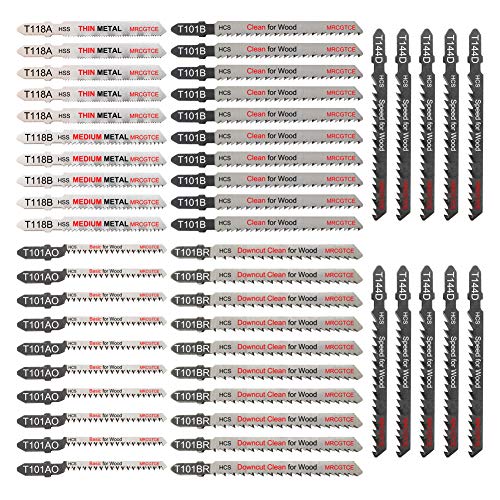
The contractor set is built around quantity and broad coverage. It includes T-shank blades identified for wood, plastic, and metal, with T101AO, T101B, T101BR, and T144D among the listed profiles. That gives it a useful place in a shared workshop, especially where blades disappear into toolboxes, get dulled on construction lumber, or need to be changed quickly during a project.
For thick wood, the T144D profile is the most relevant documented option because the set includes a faster-cutting wood blade type. The product specifications do not state the blade material, length, TPI, or maximum workpiece thickness, so it cannot provide the same depth-specific confidence as the Qjaiune. Think of it as a broad replenishment box. A homeowner cutting occasional thick plywood may appreciate the supply, while a cabinetmaker seeking a precise blade specification will likely want a more focused package.
Pros
- 50-piece quantity provides many replacements for active workshop use.
- Includes multiple documented wood profiles, including T144D.
- Also covers plastic and metal cutting applications.
- T-shank interface is suitable for compatible jigsaws.
- Storage case helps keep the assortment together.
Cons
- Blade material, length, TPI, and maximum wood thickness are not specified.
- Large assortment may include profiles that are unnecessary for a wood-only user.
Select this set for convenience and replacement depth, especially if several people share one jigsaw or the tool sees rough project work. Do not rank it ahead of a documented long blade simply because it contains more pieces. For a thick board, inspect the profile and usable length of the blade you select, then use the set’s general-purpose variety where its limits are acceptable.
To buy this product, click here.
7. Leourae 54-Piece T-Shank Jigsaw Blade Set: Best for Blade Variety

Leourae offers the broadest documented assortment in this comparison, with nine blade types and a reusable case. The wood selection includes T101AO for curved cuts, T101B for clean straight cuts, T101BR for reverse-tooth work, T144D for faster straight cuts, and T244D for curved wood cuts. The case also includes profiles for thin metal, general metal, and aluminum, making it a general-purpose blade cabinet rather than a thick-wood specialist.
The attraction is easy to picture: a project begins with a deep rough opening, shifts to a cleaner edge, then calls for a curve around a corner. Instead of stopping to order a different profile, the user has several labeled options in one case. However, the supplied description gives no blade lengths or wood thickness ratings. Buyers should check the individual blade markings and avoid treating T101AO or another short, fine profile as a substitute for a long, coarse blade in thick stock.
Pros
- 54-piece set includes nine distinct blade types.
- Wood selection covers fast straight, clean straight, reverse-tooth, and curved cuts.
- HCS and HSS materials are identified across the assortment.
- Blade types and intended uses are clearly marked.
- Reusable case supports organized storage and transport.
Cons
- Blade lengths and maximum wood thickness are not specified.
- Many pieces are intended for metal or aluminum rather than thick wood.
This set makes sense for a mixed-material workshop that values choice and organization. It is less convincing as the sole answer for deep hardwood cuts because the listing does not document a long working length. Keep a dedicated deep-cut blade nearby if your regular work involves thick panels, then use the Leourae assortment for the surrounding finish, curve, and material changes.
To buy this product, click here.
8. Romeda 10-Piece Assorted T-Shank Jigsaw Blade Set: Best Compact Mixed Set

The Romeda set keeps the assortment small while covering several common profiles. Its listed wood blades include T101AO, T101D, T101B, T101BR, T144D, T244D, T111D, and T111C, with T118A and T118B included for basic metal. The set is made from SK5 high-carbon steel according to the product specifications and uses a T-shank design for compatible jigsaws.
That combination can work well in a small home toolbox where space matters. The T144D and T244D profiles provide more relevant fast or curved wood options than a pack limited to fine scrolling blades, but the product data does not disclose blade length, TPI, or maximum cutting thickness. A thick-wood buyer should therefore treat this as a compact supporting kit and verify the selected blade’s reach before starting a deep cut.
Pros
- Compact 10-piece assortment covers several wood-cutting profiles.
- SK5 high-carbon steel construction is specified.
- Includes T144D and T244D options for faster or curved wood work.
- T-shank design supports quick changes on compatible jigsaws.
- Also includes two basic metal-cutting profiles for occasional mixed use.
Cons
- Blade length and maximum thick-wood capacity are not supplied.
- Only one blade is included for several of the listed profiles.
Choose Romeda when a small, varied kit is more useful than a large storage case. It suits occasional repairs, hobby projects, and a user who wants several starting points without carrying dozens of spare blades. For repeated deep cuts in hardwood, the Qjaiune remains a more defensible choice because its length and thickness range are explicitly documented.
To buy this product, click here.
9. T142HB T-Shank Wood-Cutting Blades: Best for Flush and Shaped Cuts
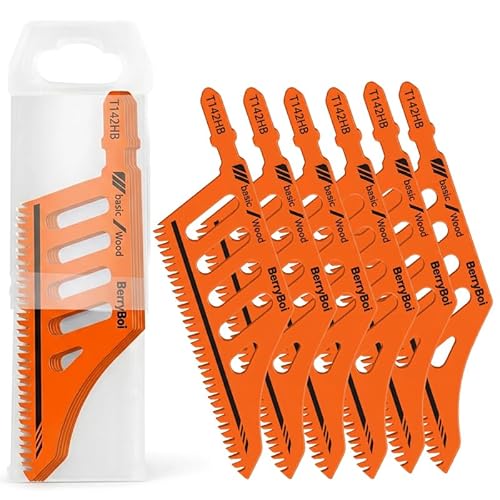
The T142HB set earns its place for a different reason than the long Qjaiune blade. Its special-shaped body is described for flush cuts, edge trimming, corner cuts, and shaped woodworking cuts. That can be handy after a thick panel has been installed or assembled and a protruding edge needs to be trimmed close to another surface. The blades use high-carbon steel and a black coating, with the listing describing compatibility with standard T-shank jigsaws.
This is a specialty woodworking option, not the strongest primary blade for cutting through a thick block from start to finish. The product specifications do not state the blade length, TPI, or maximum material thickness. Its value appears after the rough cut, when access, edge shape, or flush trimming matters more than maximum depth. A carpenter trimming fiberboard or a hobbyist shaping plywood may find that distinction useful, especially in corners where a conventional blade body is awkward.
Pros
- Special-shaped body is intended for flush, edge, corner, and curved cuts.
- High-carbon steel construction is specified.
- Black coating is described as supporting wear resistance and reduced friction.
- Suitable for wood, plastic, and fiberboard applications listed by the product.
- Standard T-shank interface allows quick changes on compatible tools.
Cons
- Blade length and maximum thick-wood thickness are not specified.
- Specialized shape makes it less suitable as a general deep-cut blade.
Buy this set as a companion for detailed woodworking, trimming, and shaped cuts rather than as your only thick-wood blade. It is particularly relevant when the cut must finish close to an edge or fit into a tight corner. A buyer who wants one blade for deep straight cuts should choose a longer coarse profile instead.
To buy this product, click here.
Buying Guide
Confirm the Required Shank Type
Every selected product here uses a T-shank, but that does not mean every jigsaw accepts it. Check the tool’s blade holder before ordering, especially with older machines or models that use a screw-mounted U-shank system. A blade can be perfectly suitable for thick wood and still be unusable if its mounting interface does not match the saw.
Prioritize Working Length for Deep Cuts
Blade length is one of the clearest distinctions in this category. The Qjaiune T344D is listed with a 5-inch working length and a 5 to 50 mm application range, giving it a documented advantage for deep material. A total blade length is less useful than the portion carrying teeth and extending beneath the workpiece. Leave enough clearance for the blade to move freely below the board without striking the support surface.
If the blade leans beneath the surface, check why a jigsaw blade bends rather than forcing the saw forward.
Match Tooth Spacing to the Wood
Coarse profiles such as the listed 6 TPI Qjaiune blade generally remove material more quickly than fine profiles, while 12, 18, or 20 TPI blades are more aligned with controlled or finish-oriented cuts. Tooth count alone does not guarantee a clean or fast result. Material thickness, wood species, feed pressure, blade length, and the jigsaw’s settings all influence the cut.
Separate Rough Cuts From Finish Cuts
A thick wood project often benefits from two blade types. Use a longer, more open profile to make the main cut, then switch to a finer or specialized blade for visible edges, curves, or flush trimming. The Diablo blade focuses on cleaner top and bottom surfaces, while the T142HB is aimed at shaped and flush work. Neither role should be confused with the other.
Evaluate Sets by Useful Variety
A 54-piece assortment looks impressive, but much of its content may be intended for metal, aluminum, plastic, or fine detail work. For thick wood, look for a meaningful coarse wood profile, sufficient length, and clear markings. A smaller set with a documented long blade can be more useful than a large box filled with short specialty blades.
Check the Actual Workpiece Thickness
Measure the wood, including any angle or curve that could increase the blade’s travel requirement. A blade listed for 50 mm material should still be used with appropriate support and clearance, and a published range does not promise a square cut or a particular edge finish. Thick stock can magnify blade deflection, so steady feed pressure and a supported workpiece remain important.
Check jigsaw capacity, blade reach and deflection before treating a longer blade as permission to cut beyond the saw’s capacity.
Best Jigsaw Blades for Thick Wood FAQ
What blade length is useful for thick wood?
A blade needs enough toothed working length to pass fully through the workpiece with room below it. The Qjaiune T344D is the clearest documented example here, with a 5-inch working length and a listed application range reaching 50 mm. Actual suitability also depends on the jigsaw, the blade holder, the cut geometry, and how securely the material is supported.
Are fine-tooth jigsaw blades suitable for thick hardwood?
They can be suitable for some finish-oriented cuts, but they are usually a less direct choice for removing material quickly from a thick board. The Bosch T101AO, for example, is a fine 20 TPI blade intended for clean curved and scrolling cuts, while the Qjaiune uses a 6 TPI profile for faster wood cutting. Choose according to the required edge quality and depth rather than assuming one tooth count works for every job.
Is a T-shank blade compatible with every jigsaw?
No. T-shank blades fit jigsaws designed for that interface, while some older tools use U-shank or another holder style. Confirm the blade clamp in the saw’s documentation or inspect the existing blade before purchasing. Physical fit and material suitability are separate questions, so a blade must match both the tool and the wood-cutting task.
Which blade is best for a 2-inch wood panel?
The Qjaiune T344D is the strongest documented match among these products because its listed application range reaches from 5 to 50 mm, which includes approximately 2 inches. The actual cut also depends on the blade’s usable length below the shoe, the wood type, and the saw’s control. Measure the panel and confirm that the blade extends sufficiently below it before cutting.
Are bi-metal blades useful for thick wood?
They can be useful when durability and a controlled wood cut are priorities. The Diablo DJT308BFP5 uses bi-metal construction, a 12 TPI profile, and a tooth arrangement intended to improve finish quality on both sides of wood. It has less documented reach than the Qjaiune, so it is better viewed as a clean-cut alternative for moderately thick material rather than an automatic replacement for a long deep-cut blade.
Should I choose a blade set or a single blade type?
A set is useful if your projects shift between rough cuts, clean edges, curves, laminate, plastic, and occasional metal. A focused blade type is easier to evaluate when thick wood is the main task. Large sets such as the Leourae and Craluuur packages provide several wood profiles, but their descriptions do not specify maximum thickness or blade length for every piece. A dedicated long blade may be the better foundation, with a varied set added for supporting work.
Can a thick-wood blade make a perfectly straight cut?
No blade guarantees a perfectly straight or square result. Thick material can increase resistance and encourage deflection, particularly if the blade is narrow, the workpiece is poorly supported, or the feed pressure is uneven. Use the correct blade length, support the wood close to the cut, keep the shoe flat, and treat published capacity as a specification rather than a promise of precision.
Final Verdict
The Qjaiune T344D is the Best Overall choice for thick wood because its documented 5-inch working length, 6 TPI profile, and stated range up to 50 mm address the central challenge directly. It is the most convincing option for deep cuts through hardwood, plywood, chipboard, and similar panels. The tradeoff is a narrower range of uses, with less emphasis on fine edges and detailed curves.
Choose the Diablo DJT308BFP5 for cleaner visible surfaces where its shorter length is sufficient, or select the DEWALT DW3741C if a workshop needs several tooth profiles in one T-shank set. The Bosch, Craluuur, Leourae, Romeda, contractor assortment, and T142HB each fill supporting roles, from hardwood finish work to flush trimming and mixed-material storage. Before ordering, match the shank to the jigsaw, measure the wood, and favor documented working length over an impressive piece count.
