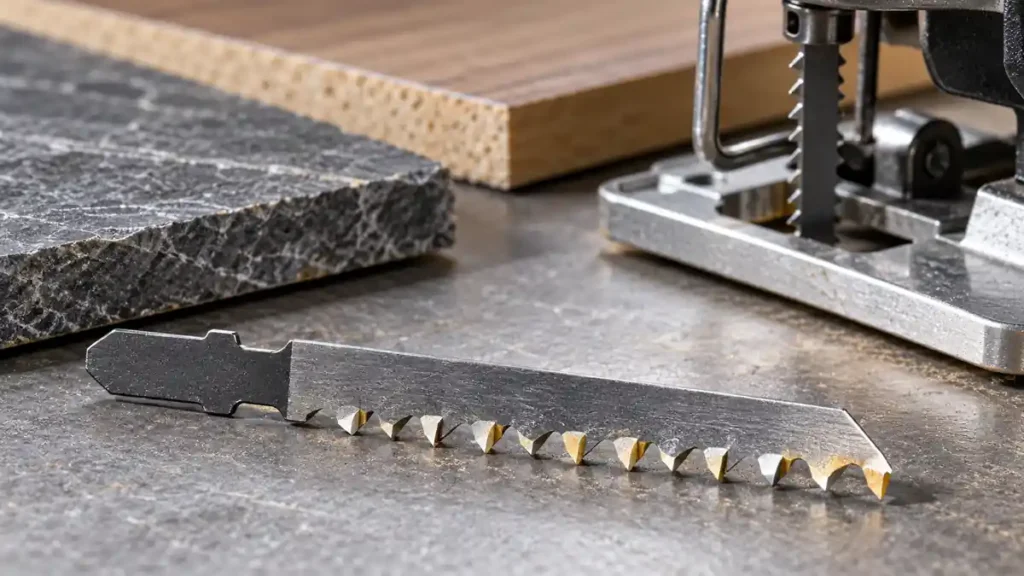
Carbide jigsaw blades are useful for abrasive and difficult materials, from laminate and composite decking to stainless steel and solid-surface countertops. Carbide teeth, carbide tips, and carbide grit behave differently, so the material rating matters as much as the construction.
These nine carbide products cover distinct cutting applications. The Bosch T128BHM3 is the laminate-focused starting point, while the T301CHM3 addresses solid-surface material and the T141HM1 serves fiber-and-plaster board. Choose the blade for the named material rather than assuming every carbide edge is interchangeable.
Quick Answer
Laminate and brittle sheets: BOSCH T128BHM3 3 Pc. 3.62 In. 14 TPI Carbide Teeth T-Shank Jig Saw Blades for Laminates. 14 TPI, 3.62 inches
Wood with nails or screws: BOSCH T367XHM3 5-7 TPI Carbide Edge T-Shank Jig Saw Blades for All-Purpose. 5-7 TPI, 5-3/16 inches
Ceramics, fiberglass, and glass: BOSCH T130RF1 1-Piece 3-1/4 In. 30 Grit Carbide Special for Ceramics. 3/64 to 5/8 inch materials
Best Carbide Jigsaw Blades Comparison Table
| Product | Best For | Specifications / Compatibility | Key Features |
|---|---|---|---|
| BOSCH T128BHM3 3 Pc. 3.62 In. 14 TPI Carbide Teeth T-Shank Jig Saw Blades for Laminates | Laminate and brittle sheets | Carbide teeth | 14 TPI, 3.62 inches |
| BOSCH T367XHM3 5-7 TPI Carbide Edge T-Shank Jig Saw Blades for All-Purpose | Wood with nails or screws | Carbide edge | 5-7 TPI, 5-3/16 inches |
| BOSCH T130RF1 1-Piece 3-1/4 In. 30 Grit Carbide Special for Ceramics | Ceramics, fiberglass, and glass | 30-grit carbide matrix | 3/64 to 5/8 inch materials |
| Bosch T118AHM3 3 Pc. 24 TPI Carbide Edge for Stainless Steel | Stainless steel | Carbide edge | 24 TPI, 3.25 inches |
| Bosch T108BHM3 3 Pc. 12 TPI Carbide Edge for Carbon Fiber | Carbon fiber and fiber-based materials | Carbide strip | 12 TPI, 3.625 inches |
| Diablo DJT144DHM 4-Inch 5-7 TPI Carbide Teeth Jig Saw Blade | Composite decking and PVC | TiCo high-density carbide | 5-7 TPI, 4 inches |
| BOSCH T301CHM3 Solid-Surface Blades | Best Carbide Solid-Surface Blade | T-shank blade | Bosch T301CHM3 carbide strip, 8 TPI |
| BOSCH T141HM1 4-Inch 6 TPI Carbide-Tipped Special for Fiber and Plaster | Fiber cement and plaster | Carbide-tipped teeth | 6 TPI, 4 inches |
| Diablo DJT128BHM 3-5/8-Inch 14 TPI Carbide Jig Saw Blade | Laminate finish cuts | Carbide teeth | 14 TPI, 3-5/8 inches |
1. BOSCH T128BHM3 3 Pc. 3.62 In. 14 TPI Carbide Teeth T-Shank Jig Saw Blades for Laminates — Laminate and brittle sheets

Laminate is unforgiving. A blade that cuts acceptably through ordinary lumber can chip the decorative surface or leave a ragged edge once it meets a hard, brittle layer. The T128BHM3 is aimed at that specific problem, with carbide teeth, a 14 TPI pattern, and a thin kerf intended to reduce material removal and heat buildup.
The three-blade package gives a little breathing room for a flooring, countertop, or cabinet project, while the 3.62-inch overall length keeps the design more specialized than a long general-purpose blade. Bosch describes the tooth design as suitable for clean cuts on both sides of the cutting surface. That makes this a strong choice for careful laminate work where edge appearance matters more than aggressive feed speed.
Pros
- Carbide teeth are intended for difficult laminate materials.
- Fine 14 TPI pattern suits cleaner, more controlled cuts.
- Thin kerf is intended to reduce heat and material removal.
- T-shank interface suits compatible jigsaws.
- Three-blade package is practical for a project with spare capacity.
Cons
- Its laminate-focused design is less suitable for fast coarse cuts.
- Compatibility still depends on the jigsaw accepting T-shank blades.
Choose this blade for laminate panels, flooring, or similar brittle sheet goods where a fine cutting pattern is useful. It is less compelling for thick wood, nail-embedded lumber, or materials that call for a coarse progressive tooth profile. Keep the workpiece supported and avoid forcing the saw, since a specialized clean-cut blade still depends on steady feed control.
To buy this product, click here.
2. BOSCH T367XHM3 5-7 TPI Carbide Edge T-Shank Jig Saw Blades for All-Purpose — Wood with nails or screws

Renovation lumber has a habit of hiding surprises. A cut that begins in wood can suddenly meet a screw, nail, or other embedded fastener, which is where a conventional wood blade may lose its edge. The T367XHM3 addresses that use case with a carbide edge, a progressive 5-7 TPI tooth pattern, and heat-optimized construction.
Its 5-3/16-inch length gives the blade more reach than the laminate-focused options here. The progressive tooth arrangement combines smaller and larger teeth, while the exaggerated tip is intended to help with plunge cuts. Bosch also describes the tooth geometry as compatible with the pendulum movement of a jigsaw, so this is the selection to examine for rougher structural work rather than delicate finish cuts.
Pros
- Carbide edge is intended for wood containing nails and screws.
- Progressive 5-7 TPI pattern supports faster general-purpose cuts.
- Heat-optimized construction is intended for demanding work.
- Exaggerated tip supports plunge-cut applications.
- Three-blade format provides replacement blades for larger projects.
Cons
- Coarser teeth are a weaker match for fine laminate edges.
- Its longer blade may be unnecessary for thin sheet materials.
This is a sensible carbide choice for remodeling, reclaimed boards, and wood where hidden fasteners are possible. It does not turn a jigsaw into a metal-cutting tool, and the listed application remains centered on wood with nails or screws. Buyers doing finish carpentry or thin laminate work should choose a finer blade instead.
To buy this product, click here.
3. BOSCH T130RF1 1-Piece 3-1/4 In. 30 Grit Carbide Special for Ceramics — Ceramics, fiberglass, and glass

The T130RF1 is the oddball in the best possible way. Instead of conventional pointed teeth, it uses a 30-grit carbide matrix bonded to the blade edge. That file-like cutting action is intended for ceramics, fiberglass, and glass, materials where a regular toothed blade can be a poor match.
Bosch lists a 3/64-inch to 5/8-inch material range, along with a 3-1/4-inch overall length and 2-5/16-inch working length. Those dimensions matter because the blade is specialized and relatively short. The listing describes it for fine straight or curved cuts, but the one-piece package and narrow material focus make it a task blade rather than a general workshop staple.
Pros
- 30-grit carbide matrix is intended for ceramics, fiberglass, and glass.
- File-effect edge supports straight and curved cutting applications.
- Documented material range covers thin specialty workpieces.
- Compact 3-1/4-inch blade length suits controlled applications.
- T-shank format fits compatible jigsaws.
Cons
- Single-blade package offers no spare for a demanding project.
- Its specialty edge is unsuitable for ordinary wood-cutting tasks.
Buy this one when the material itself makes ordinary jigsaw blades a poor choice. It has a clear role in tile, fiberglass, and glass-related work, but it should not be selected simply because it contains carbide. Confirm the jigsaw’s T-shank compatibility and follow material-specific cutting practices before starting.
To buy this product, click here.
4. Bosch T118AHM3 3 Pc. 24 TPI Carbide Edge for Stainless Steel — Stainless steel

Stainless steel demands a more deliberate blade choice than ordinary sheet metal. The T118AHM3 uses a carbide edge and 24 TPI configuration for this specialty application, with a 3-1/4-inch blade length that favors controlled work over deep cuts. Its thin kerf is intended to reduce heat and material extraction.
The three-piece package is useful when a metal project may require replacement blades, while the listed flexibility is intended to reduce frequent blade changes. Bosch also describes the design as resistant to heat buildup. That does not remove the need for appropriate feed pressure and workpiece support, but it does explain why this blade belongs in a carbide shortlist for stainless steel rather than a general wood assortment.
Pros
- Carbide edge is specifically intended for stainless steel.
- 24 TPI suits a controlled metal-cutting approach.
- Thin kerf is intended to reduce heat and material removal.
- Three blades provide useful replacements.
- Compact length suits many thin specialty-metal applications.
Cons
- It is specialized for stainless steel rather than broad mixed-material use.
- The short blade length limits its usefulness on thicker workpieces.
This blade is the clearest choice here for stainless steel, especially when a fine metal-cutting pattern is more useful than a coarse general-purpose profile. It is a poor substitute for wood, laminate, or deep-cutting blades. Check the workpiece thickness and the jigsaw’s T-shank holder before purchasing.
To buy this product, click here.
5. Bosch T108BHM3 3 Pc. 12 TPI Carbide Edge for Carbon Fiber — Carbon fiber and fiber-based materials
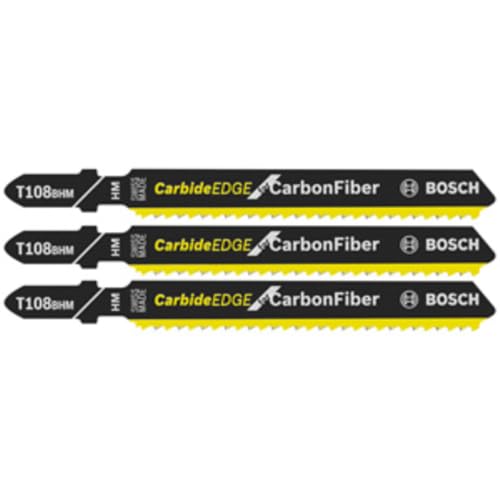
Carbon fiber and other fiber-based materials can be abrasive, dusty, and difficult to cut cleanly with a conventional blade. The T108BHM3 uses a carbide strip, side-set and ground teeth, and a 12 TPI profile. Bosch lists it for carbon fiber and fiber-based materials, with a straight-cut emphasis and a 3-5/8-inch blade length.
The three-blade package makes more sense here than a single specialty blade because abrasive materials can place unusual demands on an edge. Still, this is not a universal composite blade. Its documented focus is fiber-based material, so a buyer cutting laminate, PVC, or stainless steel should choose a product whose application matches that workpiece.
Pros
- Carbide strip is intended for abrasive fiber-based materials.
- Designed specifically around carbon fiber cutting.
- 12 TPI profile suits a balance of control and material removal.
- Side-set and ground teeth are features.
- Three-blade package offers replacements for specialty work.
Cons
- Its straight-cut focus may not suit tight curved work.
- Carbon fiber specialization limits its usefulness for general projects.
Consider this blade for carbon fiber panels and related fiber materials where ordinary teeth may wear quickly. Because the listing does not establish universal suitability for every composite, avoid treating it as a catch-all solution. Appropriate dust management and workpiece support remain part of the cutting setup.
To buy this product, click here.
6. Diablo DJT144DHM 4-Inch 5-7 TPI Carbide Teeth Jig Saw Blade — Composite decking and PVC
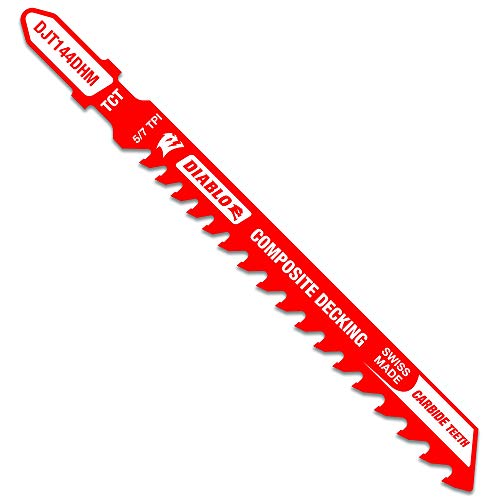
Composite decking sits in an awkward middle ground. It looks like lumber, but its plastic content can soften or melt when friction and heat climb. The DJT144DHM is aimed at composite decking, wood, PVC, and other demanding materials with a coarse 5-7 TPI carbide tooth pattern and a non-stick Perma-SHIELD coating.
The 4-inch length is long enough for many general-purpose cuts without moving into an oversized format. Diablo also describes an impact-resistant carbide-to-blade connection and an optimized design intended to reduce heat.
Pros
- Carbide teeth are intended for composite decking and PVC.
- 5-7 TPI profile favors faster, more aggressive cuts.
- Non-stick coating is intended to reduce heat and friction.
- Four-inch length offers useful reach for general work.
- T-shank design is listed for compatible corded and cordless jigsaws.
Cons
- Coarse teeth are less appropriate for fine laminate finish cuts.
- Material suitability should be checked rather than extended to every plastic.
This is the better fit for a deck board, PVC trim, or pressure-treated wood project where a fine 14 TPI edge would slow progress. Buyers cutting thin decorative laminate should move toward the Bosch T128BHM3 or Diablo DJT128BHM instead. The T-shank interface still needs to match the jigsaw before use.
To buy this product, click here.
7. BOSCH T301CHM3 Solid-Surface Blades — Best Carbide Solid-Surface Blade

The T301CHM3 is a three-pack of carbide-strip blades made for solid-surface countertop material. The 4-5/8-inch overall length and 8 TPI tooth layout provide a material-specific alternative to ordinary wood and laminate blades. Its solid-surfacing application includes the mineral-filled resin surfaces used for countertop openings. Choose it within the specified thickness range, keep the cutout supported, and feed steadily so the blade can clear the kerf. This blade is not a substitute for the different cutting equipment required by stone countertops.
Choose this blade for the named material and cutting style. Match the usable length to the workpiece and fit it only to a compatible blade clamp. A supported workpiece and controlled feed help the blade follow the marked line.
Pros
- Carbide-strip cutting edge
- Dedicated solid-surface application
- Three-blade pack
- T-shank for compatible saws
Cons
- Not a general stone-cutting blade
- Material and usable-length limits still apply
The BOSCH T301CHM3 Solid-Surface Blades is the best carbide solid-surface blade in this comparison. Its bosch t301chm3 carbide strip, 8 tpi make it worth considering when those features match your next project.
To buy this product, click here.
8. BOSCH T141HM1 4-Inch 6 TPI Carbide-Tipped Special for Fiber and Plaster — Fiber cement and plaster

Fiber cement, plasterboard, and fiberglass can quickly expose the limits of ordinary wood blades. The T141HM1 uses carbide-tipped teeth and a coarse 6 TPI arrangement for fast cuts in these construction and remodeling materials. Bosch lists it for cement board from 1-1/4 to 2-3/8 inches, fiberglass and plasterboard from 1/4 to 3/4 inch, plus related plaster applications.
That documented thickness range gives this blade a clear job-site identity. It is a four-inch, one-piece blade intended for coarse material removal, so it should not be confused with the fine laminate and stainless-steel options above. The single-blade package is a limitation for larger projects, but the specialized application can justify keeping one available for renovation work.
Pros
- Carbide-tipped teeth are intended for fiber and plaster materials.
- 6 TPI profile supports fast, coarse cutting.
- Documented applications include cement board and plasterboard.
- Four-inch length suits the listed construction tasks.
- T-shank design fits compatible jigsaws.
Cons
- One-piece package provides no replacement blade.
- Coarse profile is unsuitable for fine finish cuts.
This blade is the practical specialist for remodeling jobs involving fiber cement, plaster, or plasterboard. It is a poor choice for stainless steel, glass, or decorative laminate, where the edge design and tooth pattern are mismatched. Check the material thickness against the listed application before starting.
To buy this product, click here.
9. Diablo DJT128BHM 3-5/8-Inch 14 TPI Carbide Jig Saw Blade — Laminate finish cuts

The DJT128BHM takes a similar fine-cut approach to the Bosch T128BHM3, but its product information highlights bi-directional carbide teeth and a Perma-SHIELD non-stick coating. The 14 TPI pattern and 3-5/8-inch length place it firmly in the laminate category, where top and bottom edge appearance can matter during a flooring or countertop cut.
The coating is intended to reduce heat, friction, and pitch buildup, while the carbide tooth geometry is aimed at fast cutting in laminate. Those claims describe the design goal, not a guarantee of a flawless edge on every panel. Still, the combination gives this single-blade option a credible place for buyers who want a dedicated laminate blade from a different manufacturer.
Pros
- 14 TPI carbide tooth design suits laminate materials.
- Bi-directional teeth are intended to improve top and bottom finishes.
- Non-stick coating is intended to reduce heat and pitch buildup.
- 3-5/8-inch length closely suits laminate cutting applications.
- T-shank format works with compatible jigsaws.
Cons
- Single-blade package offers less reserve than a three-pack.
- Laminate specialization limits its usefulness on coarse materials.
This is a strong alternative for laminate flooring, decorative panels, and similar sheet goods when a fine carbide blade is the priority. The Bosch T128BHM3 is more convenient for buyers who want three blades, while the Diablo coating and bi-directional tooth description may appeal to those focused on heat and edge control. Neither should be treated as a general metal or masonry blade.
To buy this product, click here.
Buying Guide
Match the named material
Use a blade rated for the actual board, not just one that fits the clamp. Material-specific tooth construction matters in abrasive boards.
Use the guide to jigsaw blade materials and cutting-edge construction to separate the cutting-edge material from the blade’s stated application.
Check usable length
The blade must clear the full thickness throughout its stroke. Overall length and usable cutting length are different measurements.
Support the edge and waste
Clamp and support the material with clearance below the blade. A supported exit helps prevent the last section from breaking away.
Use the correct speed and feed
Follow the blade and saw recommendations. A suitable sharp blade and deliberate feed are more useful than forcing the teeth through the work.
Use the guide to blade ratings for abrasive board and tile materials to separate material ratings and tool-approved applications.
Frequently Asked Questions
Does T-shank fit every jigsaw?
No. It fits compatible T-shank clamps. Check an older or unusual saw before ordering.
Will any carbide blade cut this material?
No. Carbide construction alone does not define the application. Match the named material and thickness rating.
Can I use a longer blade to increase saw capacity?
No. Stay within the tool’s rated capacity and choose sufficient usable blade length for the workpiece.
Final Verdict
BOSCH T128BHM3 3 Pc. 3.62 In. 14 TPI Carbide Teeth T-Shank Jig Saw Blades for Laminates is the laminate and brittle sheets pick. 14 TPI, 3.62 inches
For wood with nails or screws, consider BOSCH T367XHM3 5-7 TPI Carbide Edge T-Shank Jig Saw Blades for All-Purpose. 5-7 TPI, 5-3/16 inches
