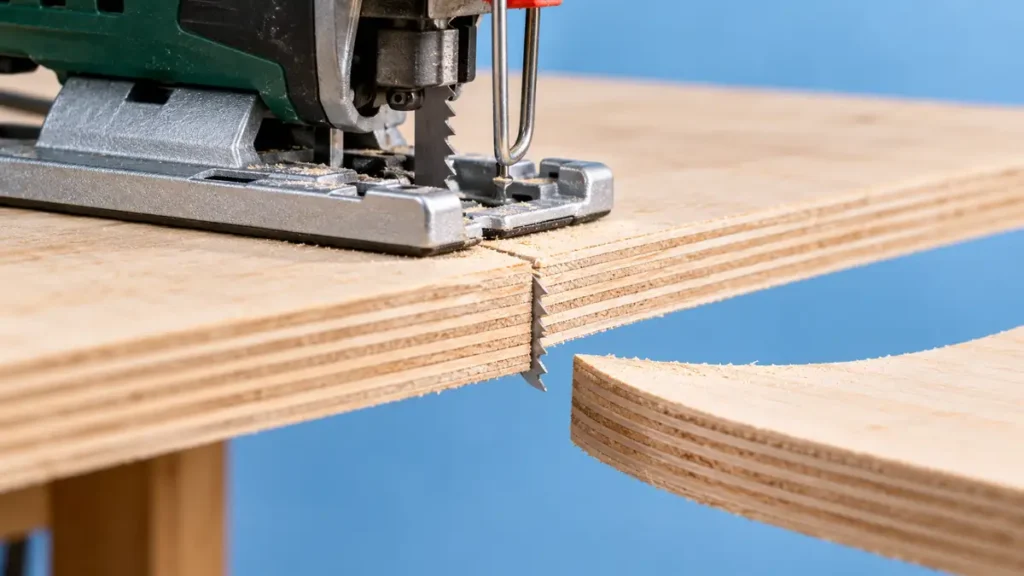
A plywood project can go from clean and crisp to fuzzy and splintered in a few seconds, especially near the exit side of a cut. The right jigsaw blade helps control that problem, but plywood varies widely. Thin cabinet panels, laminated sheets, construction plywood, and thick wood-core panels each place different demands on tooth geometry, blade length, and cutting speed. A blade that behaves neatly on a thin veneer may feel painfully slow in thick stock, while an aggressive blade can leave an edge that needs considerable sanding.
Blade compatibility is the first filter. Every selection below uses a T-shank design according to the product specifications, but that does not mean every older jigsaw accepts it. After shank type, look at the blade’s intended cut. Fine 20 TPI blades suit detailed curves and cleaner edges, while 6 TPI blades remove material quickly from thicker plywood. Reverse-tooth and opposing-tooth designs can help manage splintering on a visible face, while longer blades provide more reach but can be harder to control in thin sheet goods.
This comparison weighs those differences rather than treating a larger package as automatically better. Some picks focus on clean scroll work, some on thick plywood, and others offer a practical assortment for a mixed workshop. The Bosch T101AO is the strongest overall match for clean plywood curves and fine edge work, while the other selections fill useful gaps for speed, thickness, versatility, and blade variety.
Quick Answer
Best Overall: The BOSCH T101AO 5-Piece Clean for Wood Blades is the most focused choice for clean, curved plywood cuts. Its narrow body, pointed 20 TPI teeth, and stated plywood compatibility suit detailed work where edge quality matters.
Best for Thick Plywood: The 20-Pack T344D Long Jigsaw Blades uses a 6-inch blade with 6 TPI for fast cutting in wood-core plywood and thicker stock. Its long profile is better suited to depth than delicate scrolling.
Best Versatile Set: The Bosch TPW005 Pro-Wood Set includes several wood, hardwood, laminate, and reverse-tooth options, making it useful for a workshop that cuts more than one type of sheet material.
Best Jigsaw Blades for Plywood Comparison Table
| Product | Best For | Blade Material or Type | Tooth Design | Length or Count |
|---|---|---|---|---|
| BOSCH T101AO Clean for Wood | Clean curves and scrolling | Wood-cutting T-shank blade | 20 TPI pointed teeth | 3-1/4 inches, 5 pieces |
| Bosch TPW005 Pro-Wood Set | Mixed plywood and wood work | Assorted wood-cutting blades | Clean, reverse-tooth, hardwood, laminate | 5 pieces |
| BOSCH T101B100 | Repeated straight plywood cuts | High-carbon steel | 10 TPI variable pitch | 4 inches, 100 pieces |
| Diablo DJT308BFP5 | Fine top and bottom edges | Bi-metal | 12 TPI opposing-tooth design | 4-5/8 inches, 5 pieces |
| GINEPAN T101AO Set | Curved cuts and scrolling | High-carbon steel | 20 TPI pointed teeth | 3 inches, 20 pieces |
| T344D Long Blade Set | Thick wood-core plywood | Thick-gauge high-carbon steel | 6 TPI fast-cut profile | 6 inches, 20 pieces |
| Qjaiune T344D Set | Small supply for thick cuts | High-carbon steel | 6 TPI | 6 inches, 5 pieces |
| 50-Piece Contractor Set | General workshop variety | Assorted wood, plastic, and metal blades | Multiple profiles | 50 pieces |
| DEWALT DW3741C Set | Mixed wood and metal tasks | HCS and bi-metal | 6, 10, and 18 TPI | 10 pieces |
The detailed reviews below sort these blades by the plywood jobs they suit best, from fine curves and visible edges to fast cuts through thicker sheet material.
1. BOSCH T101AO 5-Piece Clean for Wood T-Shank Jig Saw Blades — Best Overall

The Bosch T101AO is the most specific match for plywood work that calls for a neat edge and controlled curves. Its 20 TPI pointed-tooth profile is intended for fine-finish cuts in plywood, hard and soft wood, MDF, laminates, and veneers. That combination points toward cabinet cutouts, small templates, craft panels, and curved shapes where a rough, aggressive tooth pattern would leave more cleanup behind.
The narrow blade body is useful for scrolling and curved work, while the 3-1/4-inch overall length keeps the blade compact. The listing identifies a T-shank interface and a design without a set-screw mounting hole, which suits jigsaws that use tool-free T-shank retention. A five-piece pack is modest, but it keeps the selection focused. If you are cutting a sink opening or shaping a plywood pattern, this is the sort of blade that prioritizes control over brute-force speed.
Pros
- Documented suitability for plywood, MDF, laminates, and wood.
- 20 TPI pointed teeth are intended for fine-finish cuts.
- Narrow blade body supports curved cuts and scrolling.
- Pointed teeth are intended to reduce splintering on both sides of the workpiece.
- T-shank design fits compatible jigsaws without a set-screw mounting hole.
Cons
- The five-piece pack offers less variety and reserve stock than larger sets.
- The fine 20 TPI profile is less suited to fast cutting through thick plywood.
This is the best starting point for visible plywood edges, tight curves, and smaller cutouts. It may feel slow if the job involves long straight cuts through thick construction panels, where a lower-TPI blade will clear material faster. Buyers should also confirm that their jigsaw accepts T-shank blades before ordering, since physical fit depends on the saw’s blade holder rather than the brand name alone.
To buy this product, click here.
2. Bosch TPW005 5-Piece T-Shank Jig Saw Blade Set for Pro-Wood — Best for Mixed Wood Projects

The TPW005 earns its place through useful variety rather than one specialized tooth pattern. The set includes a T101AO reverse-pitch clean-for-wood blade, a T101C basic wood blade, a T101BR clean-for-wood blade, a T101BIF laminate blade, and a T101BF clean-for-hardwood blade. For a workshop that moves between plywood, hardwood, laminate, and general wood, that spread is more practical than receiving five identical blades.
Plywood often creates two different problems in the same afternoon. A visible panel may need a cleaner top edge, while a rough construction piece may call for quicker material removal. The reverse-tooth option addresses top-surface splinter control, and the listed clean-for-hardwood blade is also specified for plywood and OSB. The T-shank design is listed as fitting more than 90 percent of current jigsaw makes and models, although the saw’s own holder should still be checked.
Pros
- Includes five distinct blade types for different wood-cutting situations.
- Contains a reverse-tooth blade for cleaner top surfaces.
- Includes a blade listed for clean cuts in hardwood, OSB, and plywood.
- Offers a laminate blade for abrasive sheet applications.
- T-shank design provides broad compatibility with many modern jigsaws.
Cons
- The set does not provide a large quantity of any one plywood blade.
- Different profiles require the user to choose the correct blade for each cut.
This set fits a buyer who would rather keep several cutting options in one small package than specialize immediately. It is especially useful for repair work, furniture projects, and remodeling jobs where the plywood may sit beside laminate or hardwood. A dedicated T101AO pack remains the cleaner choice for repeated fine scrolling, while this kit makes more sense for a varied bench drawer.
To buy this product, click here.
3. BOSCH T101B100 100-Pack T-Shank Jig Saw Blades — Best for Repeated Straight Cuts

The T101B100 is aimed at people who cut plywood often and want a consistent supply of a familiar wood blade. Its 10 TPI variable-pitch pattern is listed for clean cuts in hard and soft wood, plywood, plastics, OSB, and laminated particle board from 3/16 inch to 1-1/4 inches thick. That stated range covers many cabinet, shelving, trim, and general construction panels without pushing the blade into a specialty role.
At 4 inches overall with a 3-inch working length, this blade is shorter than the long T344D options in this guide. That compact format is easier to match with ordinary sheet thicknesses and is better aligned with straight or gently shaped work than deep cuts through thick stock. The 100-piece format is the real distinction. A busy workshop, school shop, or production-minded user can keep replacement blades close by instead of stretching one blade past the point where its edge feels useful.
Pros
- 10 TPI variable-pitch profile is listed for plywood and several wood-based panels.
- Documented working range covers materials from 3/16 inch to 1-1/4 inches thick.
- 4-inch overall length and 3-inch working length suit many routine sheet cuts.
- High-carbon steel construction is intended for wood materials.
- 100-piece quantity provides substantial replacement stock for repeated work.
Cons
- The pack offers one primary blade profile rather than several specialized options.
- Its listed dimensions are less appropriate for very thick plywood than 6-inch blades.
This choice makes sense for repeated straight cuts in plywood within the stated thickness range. It is a practical drawer staple for projects where blade consumption matters more than tight scrolling. Buyers working mainly on thin veneer or intricate curves should select a finer, narrower blade, while those cutting thick wood-core panels should look toward the longer 6 TPI selections.
To buy this product, click here.
4. Diablo DJT308BFP5 Bi-Metal Jig Saw Blades — Best for Fine Top and Bottom Edges

Some plywood cuts expose both faces, which makes ordinary tear-out control less forgiving. Diablo’s DJT308BFP5 addresses that situation with a listed tooth design that faces in opposite directions at each end of the blade. The product is described for ultra-fine top and bottom wood cutting, so it is a compelling option for panels where both surfaces need attention rather than only the face pressed against the saw shoe.
The 4-5/8-inch length and 12 TPI profile place this blade between the fine 20 TPI scrolling blades and the aggressive 6 TPI thick-stock blades. Its bi-metal construction and ultra-hardened cutting edge are intended for demanding wood applications. The listing also describes compatibility with combination and many U-shank cordless and corded jigsaws, but buyers should verify their particular holder because the product title identifies a T-shank design.
Pros
- Opposing tooth direction is intended to improve finish quality on the top and bottom surfaces.
- 12 TPI profile balances a fine edge with more cutting clearance than 20 TPI scrolling blades.
- Bi-metal construction is suited to demanding wood applications.
- 4-5/8-inch length offers more reach than compact 3-inch working profiles.
- Designed specifically for wood rather than a broad mixed-material assortment.
Cons
- The five-piece pack gives limited quantity for large production jobs.
- The blade’s specialized tooth design may be unnecessary for hidden or rough plywood cuts.
This blade is a strong fit for finished furniture panels, exposed plywood surfaces, and cuts where sanding both faces would be frustrating. It may be excessive for rough framing or concealed openings, where a standard wood blade can handle the work with less specialized geometry. Confirm the saw interface before purchase, especially if the tool is an older model or uses a different shank system.
To buy this product, click here.
5. GINEPAN T101AO 20-Piece T-Shank Jigsaw Blade Set — Best for Curved Cuts in Quantity

GINEPAN follows the same general fine-cut direction as the Bosch T101AO, but the package contains 20 T101AO blades. The product information identifies a 3-inch, 20 TPI profile for curved and scrolling cuts in plywood, MDF, laminated substrates, and hard or soft wood. That makes it relevant for users who repeatedly cut templates, rounded corners, decorative shapes, or small openings and prefer to keep spare blades available.
The listing describes high-carbon steel construction and a T-shank interface compatible with many current jigsaws from brands such as Bosch, DEWALT, BLACK+DECKER, Makita, SKIL, Ryobi, and others. Those brand references should be treated as a guide rather than a substitute for checking the saw’s manual or clamp. The supplied case has a relatively large gap for these small blades, so storage may be less tidy than the 20-piece count suggests.
Pros
- 20 TPI pointed-tooth profile is intended for fine curved and scrolling cuts.
- Product information specifically lists plywood compatibility.
- 20-piece quantity provides more replacements than a small five-pack.
- High-carbon steel construction is intended for repeated wood cutting.
- T-shank design suits many modern jigsaws that accept this interface.
Cons
- The supplied case may allow the small blades to move around or scatter.
- The narrow fine-cut design is less appropriate for fast cuts through thick plywood.
This set is a sensible choice for a craft bench or small furniture shop where curves appear often and replacement stock matters. The blade count is useful, but it should not be mistaken for a range of cutting profiles because the set centers on the T101AO format. Choose it over the Bosch five-pack for quantity, not for a different cutting purpose.
To buy this product, click here.
6. 20-Pack T344D Long T-Shank Jigsaw Blades — Best for Thick Plywood

Thick plywood changes the blade decision completely. A short fine-tooth blade may make a lovely edge in thin stock, but it is a poor match for a deep cut where the teeth struggle to clear material. This T344D set uses a 6-inch overall blade with 6 TPI and is listed for construction timber, softwood, chipboard, wood-core plywood, and fiberboard up to 100 mm thick. That intended application gives it the clearest role among the long-blade options.
The thick-gauge high-carbon steel construction is intended to provide wear tolerance for demanding cuts, while the coarse tooth spacing favors material removal over delicate scrolling. A long blade can reach through thicker panels, but its extra length also makes setup and feed control more important. It is better suited to broad openings, rough shaping, and straight cuts than to tiny interior curves where a narrow blade is easier to guide.
Pros
- 6-inch overall length is suited to deeper plywood cuts.
- 6 TPI profile is intended for quick cutting through thick wood materials.
- Product information specifically lists wood-core plywood.
- Thick-gauge high-carbon steel construction is intended for demanding use.
- 20-piece package includes a storage case for keeping long blades organized.
Cons
- Coarse 6 TPI teeth are a poor fit for fine scrolling and delicate edge work.
- The long profile may be more blade than needed for thin plywood panels.
Choose this set for thick plywood, chipboard, and construction-style work where reaching through the stock is the first challenge. It is the wrong direction for a small decorative cutout in cabinet-grade plywood, where the Bosch T101AO or GINEPAN set offers a more suitable tooth pattern. The stated 100 mm application limit should also be treated as a product-information guideline, not a guarantee of clean or square cuts at that thickness.
To buy this product, click here.
7. Qjaiune T344D 5-Piece Long T-Shank Jigsaw Blade Set — Best Small Pack for Thick Cuts

Qjaiune’s T344D set offers the same broad thick-material category as the larger 20-pack, but in a five-piece format. Each blade is listed at 6 inches overall with a 5-inch working length, 6 TPI, and a tooth spacing of 0.15 inch. The stated application range is 5 to 50 mm, covering a useful span for thicker plywood, hardwood, chipboard, particleboard, and fiberboard.
That smaller quantity suits a homeowner or occasional builder who needs long blades for a specific project without filling a drawer with spares. The high-carbon steel profile and T-shank attachment are intended for quick, stable cutting in compatible saws. Its product description also includes PVC among the materials, but plywood remains the stronger reason to select it. This is a straight-cut tool in spirit, with the reach and tooth spacing aimed at depth rather than intricate shapes.
Pros
- 6-inch total length and 5-inch working length suit deeper material.
- 6 TPI tooth profile is intended for fast cutting.
- Listed application range covers 5 to 50 mm material thickness.
- Product information specifically includes plywood, hardwood, and chipboard.
- Five-piece quantity suits occasional thick-stock projects.
Cons
- Coarse teeth are less suitable for smooth, detailed plywood curves.
- The product information does not provide several alternative tooth profiles in the pack.
This is a reasonable pick for someone preparing one thick plywood project, such as a workbench component, utility cabinet, or deep cutout. It saves the buyer from committing to a larger assortment while retaining the long reach that thin blades lack. For frequent construction work, the 20-pack offers more replacements, while fine furniture work calls for a shorter, denser tooth pattern.
To buy this product, click here.
8. 50-Piece Contractor T-Shank Jigsaw Blade Set — Best for Broad Workshop Variety
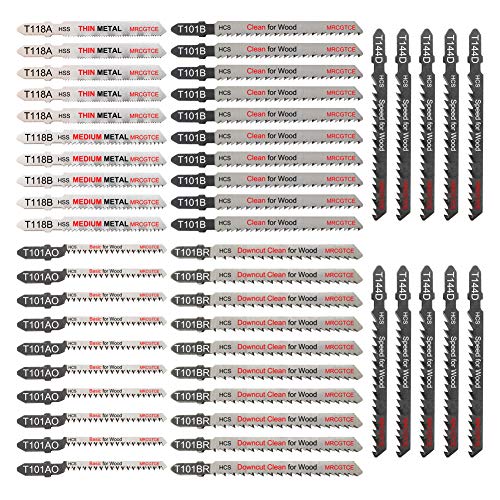
This contractor set is aimed at the workshop where plywood is one material among several. The assortment includes T118A, T118B, T101AO, T101B, T101BR, and T144D profiles for wood, plastic, and metal applications. That range can be convenient when a project moves from plywood to a plastic panel or a light metal component, and the included case keeps the different shapes together.
For plywood specifically, the T101AO, T101B, and T101BR selections are the most relevant. The presence of additional profiles is useful only if the owner understands the markings and chooses the blade according to the workpiece. A large count can create a false sense of precision, so this set should be viewed as a general replacement kit rather than a carefully curated plywood system. The T-shank interface still needs to match the jigsaw.
Pros
- 50-piece assortment provides substantial replacement stock.
- Includes several wood-cutting profiles relevant to plywood.
- Also covers listed plastic and metal-cutting applications.
- Storage case helps keep the assortment together.
- T-shank format suits compatible modern jigsaws.
Cons
- The assortment includes blades that may have no role in a plywood-only workshop.
- Check count of each individual blade type for the exact product configuration.
This set works best for a general-purpose tool drawer, rental-property maintenance, or a household that occasionally cuts different materials. It is less compelling for a woodworker who already knows the exact tooth profile needed and wants a consistent supply of one high-performing plywood blade. Buyers should read the markings before cutting, since metal and wood blades are not interchangeable simply because they share a T-shank.
To buy this product, click here.
9. DEWALT DW3741C 10-Piece T-Shank Jigsaw Blade Set — Best for Mixed Wood and Metal Work

The DEWALT DW3741C is a mixed-material assortment rather than a plywood specialist. Its 10-piece set includes HCS and bi-metal blades, with 6, 10, and 18 TPI options. That spread gives the buyer a way to switch between faster, more open teeth and finer profiles, while the wood and metal coverage may be useful during remodeling or repair work.
Plywood users should focus on the wood-oriented blades and select the tooth spacing that matches the panel thickness and desired finish. The product information does not identify every individual blade type or assign each TPI option to a particular material, so it would be inaccurate to treat the set as a complete plywood recipe. Its value lies in the range of profiles and the included case, especially for a tool box that serves several jobs.
Pros
- Includes both high-carbon steel and bi-metal blade construction.
- Offers 6, 10, and 18 TPI options for different cutting situations.
- Designed for a mix of wood and metal applications.
- T-shank interface suits compatible jigsaws.
- 10-piece format provides more variety than a single-profile pack.
Cons
- Check exact count of each blade profile for the exact product configuration.
- Mixed-material selection is less focused for plywood than dedicated wood sets.
Pick this set if your jigsaw handles repair work that may involve plywood one day and metal the next. It is less targeted than the Bosch wood selections, and the missing per-blade breakdown makes precise planning harder. Still, the combination of TPI options and blade materials gives it a useful place in a general tool case where versatility matters more than a single specialized edge finish.
To buy this product, click here.
Buying Guide
Confirm the T-Shank Interface
Every product selected here is described as T-shank, which is the first compatibility check. A T-shank blade is held by the jigsaw’s blade clamp, but the clamp design differs among tools and generations. Before buying a large pack, check the saw’s manual or the existing blade shape. A blade that looks close enough may still fail to lock securely, and a physically compatible blade can remain unsuitable if its cutting profile does not match the plywood job.
Match Tooth Density to the Plywood Cut
Tooth-per-inch figures help describe the cutting character, but they do not provide a universal quality ranking. The 20 TPI Bosch and GINEPAN blades are aimed at fine curved and scrolling work. Their dense teeth remove material more gradually and suit visible edges. The 10 TPI Bosch T101B100 is a broader straight-cut choice, while the 6 TPI T344D blades favor faster removal in thick plywood. The right selection depends on panel thickness, edge expectations, and whether the cut is straight or curved.
Choose Fine or Aggressive Geometry
Fine teeth are useful for a cabinet panel or a decorative cutout where a ragged edge creates extra sanding. Coarse teeth are more practical for a utility opening or thick wood-core plywood where the blade must clear material quickly. Reverse-tooth and opposing-tooth designs place extra emphasis on controlling the visible face. They can be valuable for finished panels, but they do not turn every cut into a guaranteed splinter-free result.
Check Blade Length Against Material Thickness
A blade needs enough usable length to pass through the workpiece without running out of cutting reach. The compact Bosch T101AO measures 3-1/4 inches overall, while the long T344D options measure about 6 inches overall and list applications for substantially thicker material. More length is not automatically better. Long blades can be unnecessary in thin plywood and may make small curves harder to manage, so match the blade to the panel rather than choosing the longest option by default.
Separate Plywood Specialists From Mixed Sets
A five-piece fine-wood pack and a 50-piece contractor assortment serve different buyers. Dedicated packs provide a clearer cutting purpose, while mixed sets add profiles for plastic, metal, laminate, or general wood. A large count can be convenient, but examine how many blades actually fit the plywood work you do. If nearly every project involves clean curves, a collection centered on T101AO blades may be more useful than a box filled with unrelated profiles.
Account for the Visible Face
Jigsaw teeth cut on the upward stroke, so the relationship between the saw shoe, blade direction, and visible face affects where splintering may appear. Product descriptions for reverse-tooth and opposing-tooth blades specifically address cleaner surfaces, but the workpiece still needs proper support and a suitable feed rate. For plywood that will remain exposed, consider the edge on both faces and use a sacrificial backing board or masking method when appropriate for the material and project.
For a visible veneer face, follow the steps for reducing splintering in plywood before deciding tooth direction and feed.
Do Not Treat Material Claims as Universal
A blade listed for plywood may also mention MDF, OSB, plastic, or hardwood, but those applications do not make it equally suitable for every material. Metal blades from an assortment should not be used for plywood simply because they fit the saw, and a coarse wood blade should not be selected for delicate veneer work solely because it is longer. Use the stated material application as the starting point, then match the tooth shape and dimensions to the actual cut.
Best Jigsaw Blades for Plywood FAQ
What Type of Jigsaw Blade Is Best for Plywood?
The best type depends on the plywood thickness and the desired cut. A fine 20 TPI blade such as the Bosch T101AO suits curved cuts and visible edges. A 10 TPI blade is more adaptable for routine straight cuts, while a 6 TPI long blade is better aligned with thick wood-core plywood and fast material removal.
Are T-Shank Blades Compatible With Every Jigsaw?
No. T-shank blades fit many modern jigsaws, but the tool must have a compatible T-shank holder. Older saws and some specialty models may use a different interface. Check the jigsaw documentation or compare the existing blade before purchasing.
Is a Higher TPI Better for Plywood?
Higher TPI generally points toward smaller, more closely spaced teeth and a finer cutting profile, but it is not automatically better. The Bosch T101AO uses 20 TPI for fine curves and scrolling, while the 6 TPI T344D blades are intended for faster cuts through thicker material. Plywood thickness and the required edge finish should guide the choice.
What Blade Should I Use for Thick Plywood?
A longer blade with a coarser tooth profile is usually the more relevant option among these products. The T344D selections measure about 6 inches overall, use 6 TPI, and are listed for wood-core plywood and material up to specified thickness ranges. They are intended for deeper, faster cuts rather than small decorative curves.
Can I Use a Metal-Cutting Jigsaw Blade on Plywood?
A blade’s ability to fit the saw does not make it appropriate for every material. Metal-cutting blades use tooth profiles intended for metal and are not the first choice for plywood. Select a blade whose product information specifically identifies wood or plywood, then match its tooth density and length to the cut.
Are Reverse-Tooth Blades Good for Plywood?
Reverse-tooth blades can be useful when the top face of plywood needs better splinter control. The Bosch TPW005 includes a reverse-pitch clean-for-wood blade, and its product information describes a cleaner top surface with reduced splintering. The result still depends on blade condition, support, feed pressure, and the plywood itself.
Should I Buy a Large Jigsaw Blade Set?
A large set makes sense if your work includes several materials or if you consume blades regularly. A focused five-piece pack may be more useful for someone who repeatedly cuts plywood with one specific profile. Review the actual blade types in the package rather than judging the set by its total count alone.
How Can I Reduce Plywood Splintering With a Jigsaw?
Start with a blade intended for clean wood or plywood cuts, then support the sheet close to the cut line and keep the workpiece secure. Fine-tooth, reverse-tooth, or opposing-tooth designs may help with the exposed face. Make a test cut on scrap plywood first, because veneer direction and the panel’s construction can change the result.
Final Verdict
The BOSCH T101AO is the best overall choice for plywood buyers who care about clean curves, fine edges, and controlled scrolling. Its 20 TPI pointed teeth, narrow body, compact dimensions, and stated plywood compatibility give it the clearest match for detailed work. The Bosch TPW005 is the more flexible alternative for a workshop that also cuts hardwood, laminate, OSB, and general wood, while the Bosch T101B100 is better suited to repeated straight cuts within its listed thickness range.
Thick plywood calls for a different approach. The 6-inch T344D sets trade fine control for reach and faster material removal, with the 20-piece version better suited to frequent construction work and the Qjaiune five-piece pack useful for occasional deep cuts. Diablo’s bi-metal blade is a specialized option for cleaner top and bottom surfaces, while the broader contractor and DEWALT assortments make sense for mixed-material tool kits. Confirm the T-shank fit, match TPI and blade length to the panel, and choose the product around the cut you actually make rather than the size of the package.
