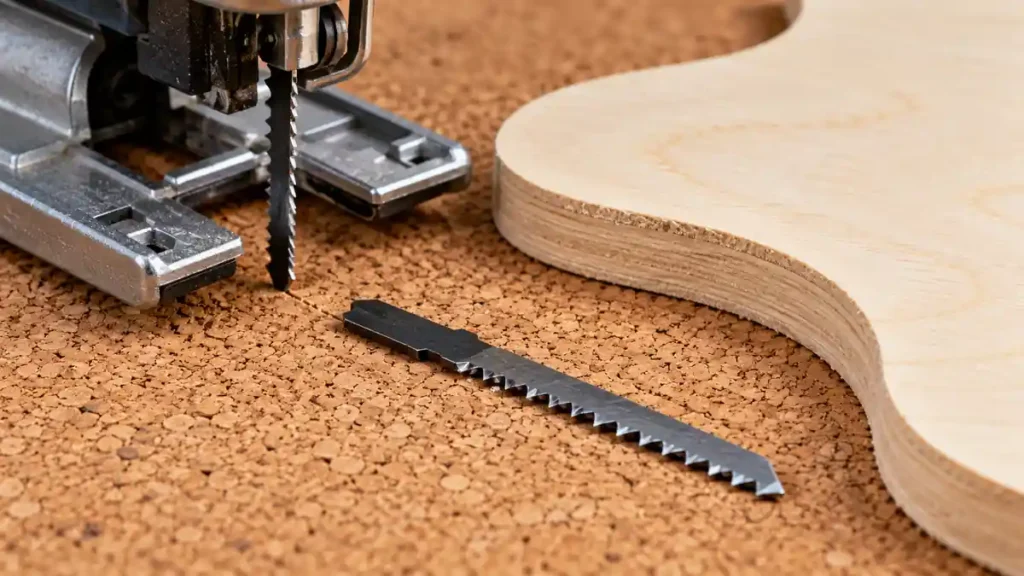
A jigsaw can turn a plywood template into a smooth arc, but the blade decides whether that arc feels controlled or becomes a jagged wrestling match. Curved cuts call for a different approach from long straight cuts. A narrow scrolling blade can follow tighter shapes, while a broader curve blade may offer more stability in thicker wood. Tooth count, blade length, shank style, and the material listed for the blade all affect the result.
A common mistake is choosing a large assortment based on blade count alone. Many sets contain plenty of straight-cut blades while offering only a few genuinely useful options for curves. Another mistake is overlooking compatibility. Most products below use a T-shank design, but a T-shank blade still needs to match the jigsaw’s clamp, and a blade that fits physically may remain poorly suited to the workpiece. High tooth counts can support cleaner cuts in thin wood and laminate, while coarser profiles can remove material faster in thicker stock.
This comparison focuses on documented curve-cutting designs, narrow profiles, scrolling applications, useful blade assortments, and material compatibility. Some selections suit fine plywood or laminate work, while others make more sense for a workshop that cuts several materials. The Bosch T101AO earns the strongest overall position for its clearly stated narrow profile, pointed teeth, and dedicated curved-cut application, while the Festool and Create Idea options offer more specialized alternatives.
Quick Answer
Best Overall: BOSCH T101AO is the clearest match for clean curved and scrolling cuts in wood, plywood, MDF, veneers, and laminates. Its narrow body and 20 TPI pointed-tooth profile are directly tied to the application.
Best Specialized Wood Option: Festool 204267 uses conically ground teeth and is specifically described for curve cuts in wood. Confirm the blade interface before ordering.
Best Dedicated Curve Assortment: Create Idea T244D focuses on curve cutting in softwood, hardwood, plywood, and composite wood, with a documented 6 TPI profile and 75 mm working length.
Best Jigsaw Blades for Curves Comparison Table
| Product | Best For | Curve-Cutting Focus | Shank or Set Type |
|---|---|---|---|
| BOSCH T101AO | Clean wood curves and scrolling | Narrow body, 20 TPI pointed teeth | T-shank, 5 pieces |
| Festool 204267 | Specialized wood curves | Conically ground teeth | 5-piece pack, compatibility to confirm |
| Create Idea T244D | Curves in thicker wood | 6 TPI, 75 mm working length | T-shank, 5 pieces |
| GINEPAN T101AO | Fine scrolling on wood and laminate | 20 TPI pointed teeth | T-shank, 20 pieces |
| Craluuur 30-Piece Set | Mixed materials and occasional curves | T101AO and T244D included | T-shank, 9 blade types |
| Leourae 54-Piece Set | Large workshop assortment | T101AO and T244D included | T-shank, 9 blade types |
| EZUVITA 25-Piece Set | Wood, plastic, metal, and aluminum | T101AO and T119BO curve blades | T-shank, 8 blade types |
| Contractor 50-Piece Set | General-purpose blade storage | T101AO included | T-shank, assorted types |
| DEWALT DW3741C | Mixed wood and metal work | 18 TPI option in assortment | T-shank, 10 pieces |
The detailed reviews explain which blades are genuinely shaped for turning cuts, which sets simply include a curve-capable option, and where compatibility or material limits deserve attention.
1. BOSCH T101AO 5-Piece Jigsaw Blades — Best Overall

A blade for curves should give the jigsaw room to turn instead of forcing a broad, straight-cut profile around a tight template. The Bosch T101AO is one of the clearest matches in this group because its listed design combines a narrow blade body with 20 TPI pointed teeth. Bosch describes it for curved cuts and scrolling in double-sided laminates, laminated substrates, MDF, hard and soft woods, plywood, and veneers. That application range fits the kind of detailed work where a clean edge matters more than rapid stock removal.
The pointed teeth are listed as a way to reduce splintering on both sides of the workpiece, which is useful for a decorative plywood shape or a laminate panel where both faces remain visible. Its T-shank mounting system eliminates the set-screw hole associated with some older blade designs, and the pack contains five blades. A five-piece pack is less flexible than a large assortment, but the contents are focused rather than padded with unrelated metal and fast-cut blades. For a scroll pattern on thin or moderate wood stock, that focus is a real advantage.
Pros
- Narrow blade body is specified for curved cuts and scrolling.
- 20 TPI pointed teeth support fine wood and laminate work.
- Listed for plywood, MDF, veneers, laminates, hardwood, and softwood.
- Pointed teeth are intended to reduce splintering on both sides.
- T-shank design suits compatible modern jigsaws.
Cons
- Five-blade pack offers less material variety than an assortment.
- The fine profile is less suited to fast, aggressive stock removal.
This is the strongest starting point for a reader whose project involves plywood letters, curved cabinet panels, laminate shapes, or scrolling patterns. It may be less suitable for someone who wants one box to cover metal, aluminum, plastic, and rapid straight cuts. Check that the jigsaw accepts T-shank blades, support the workpiece carefully, and let the narrow blade turn gradually rather than twisting it through the curve.
To buy this product, click here.
2. Festool 204267 Jigsaw Blade S 75/1,4 K/5 — Best Specialized Wood Curve Blade

The Festool 204267 takes a more specialized route than the mixed-material sets. Its supplied description identifies conically ground teeth and a specific purpose, curve cuts in wood. That is useful information for shoppers who would rather select a blade around one job than sort through a case containing metal and straight-cut profiles. Conical tooth grinding is presented as part of the clean-cut design, although the listing does not provide a measured edge-quality result or a guaranteed turning radius.
Its narrow application can be a virtue beside a workbench covered with hardwood templates and curved furniture parts. A five-pack gives a small supply for repeat projects without asking the user to identify a suitable blade from several nearly identical codes. The available information does not state the shank style, compatible jigsaw models, TPI, or working length, so the buyer needs to verify those details against the tool manual before purchase. That check matters more here than it would with a clearly labeled T-shank assortment.
Pros
- Specifically described for curve cuts in wood.
- Conically ground teeth are listed for clean cuts.
- Focused design avoids filling the pack with unrelated blade types.
- Five-piece format suits repeat woodworking projects.
- Made in Germany according to the product specifications.
Cons
- The supplied details do not identify the shank style or compatible jigsaw models.
- Its wood-focused design does not cover metal, aluminum, or plastic applications.
Choose this blade when the work centers on wood curves and the jigsaw compatibility is already known. It is a weaker choice for a first-time buyer who needs clear T-shank identification or a broad selection of tooth patterns. A quick check of the blade clamp and the workpiece thickness can prevent an otherwise frustrating mismatch.
To buy this product, click here.
3. Create Idea 20-Piece T244D Jigsaw Blades — Best for Thicker Wood Curves

The Create Idea set is built around the T244D profile rather than a fine scrolling blade. The specifications list a 100 mm blade length, 75 mm working length, 6 TPI, 1.2 mm cutting width, and HCS 65Mn construction. Its stated application is curve cutting in softwood, hardwood, plywood, and composite wood. That combination makes it more relevant to larger or thicker wooden shapes than a very fine 20 TPI blade intended for delicate laminate work.
Picture a curved shelf blank or a broad plywood side panel rather than a tiny fretwork pattern. A coarser 6 TPI profile can be a more practical match for removing wood through a substantial curve, while the longer working length gives the blade more reach. The listing describes reduced vibration and jumping. The title and product specifications identify a T-shank format, so it remains necessary to confirm the jigsaw clamp and choose a blade length appropriate to the workpiece.
Pros
- Designed specifically for curve cutting in wood.
- Documented 75 mm working length provides useful reach.
- 6 TPI profile suits softwood, hardwood, plywood, and composite wood.
- HCS 65Mn construction is clearly identified.
- 1.2 mm cutting width and 100 mm overall length are documented.
Cons
- Coarse teeth are less focused on fine scrolling and delicate laminate edges.
- The product details describe a five-pack despite the 20-piece wording in the product title, so pack details deserve careful checking.
This option makes sense for woodworkers cutting broader curves where reach and material removal matter. It may be excessive for thin veneer, small decorative cutouts, or projects that demand a very fine edge. The unusual pack wording is worth checking before checkout, and the blade should be matched to the thickness and type of wood rather than selected by TPI alone.
To buy this product, click here.
4. GINEPAN T101AO Jigsaw Blades — Best for Fine Scrolling in Quantity

GINEPAN’s set takes the same general T101AO route as the Bosch option, with a 20 TPI profile intended for curved and scrolling fine-finish cuts. The listed materials include double-sided laminates, laminated substrates, MDF, hard and soft woods, and plywood. Pointed teeth are described as helping reduce splintering on both sides, a useful characteristic for a panel that will be viewed from the front and back.
The main distinction is quantity. Twenty identical T101AO blades suit a maker who repeatedly cuts wood curves and prefers a dedicated supply rather than a mixed box. The listing describes high-carbon steel construction and compatibility with more than 95 percent of current jigsaws, naming brands such as Bosch, DEWALT, Makita, SKIL, Ryobi, and others. That broad claim should still be checked against the individual jigsaw manual. The supplied case has relatively generous gaps, and the small blades may scatter inside it, so storage is functional rather than especially refined.
Pros
- 20 T101AO blades provide a dedicated supply for repeated curve work.
- 20 TPI profile is aimed at fine wood and laminate cuts.
- Pointed teeth are intended to reduce splintering on both sides.
- T-shank design is listed for many current jigsaw brands.
- Storage case is included.
Cons
- All blades share one profile, so the set lacks metal and fast-cut options.
- The supplied case may allow the smaller blades to move around.
Choose GINEPAN for a workshop that burns through fine curve blades while working mainly with wood, plywood, MDF, or laminate. A homeowner cutting one occasional shape may prefer the more focused five-piece Bosch pack or a varied assortment. Buyers should verify T-shank compatibility and keep the case level during transport so the narrow blades remain organized.
To buy this product, click here.
5. Craluuur 30-Piece T-Shank Jigsaw Blades Set — Best Mixed-Material Assortment for Curves

Craluuur’s set is a practical middle ground for someone who needs curve blades but does not want a box dedicated to one wood profile. The assortment includes T101AO blades for clean wood curves, T101B and T101BR profiles for other clean-cut applications, T144D and T111C for faster wood cutting, T244D for curved wood work, T118A and T118B for basic metal cutting, and T127D for aluminum. The product information identifies nine types across HCS and HSS construction.
That range can be handy in a garage where a curved plywood cut might be followed by a plastic panel or a small metal project. The narrow scroll profiles are listed for improved control on plywood and laminate, while the reverse-cut design is intended to help reduce splintering in suitable applications. The tradeoff is selection effort. A case with nine codes is useful only if the user reads the shank markings and matches each blade to the material, thickness, and desired edge. Standard T-shank compatibility is stated, but a tool with a U-shank-only clamp will not accept it.
Pros
- Includes both T101AO and T244D profiles for curved wood work.
- Offers nine blade types across wood, metal, and aluminum applications.
- HCS and HSS construction is identified in the product information.
- Printed blade markings support quicker selection.
- Storage case is included.
Cons
- Only part of the assortment is dedicated to curve cutting.
- Users must sort through several profiles before each material change.
This set fits a flexible home workshop where curves are one recurring job among several. A furniture maker who wants a consistent fine edge may get more useful pieces from a dedicated T101AO pack. The Craluuur case earns its place through variety, but the buyer should treat each blade type as a separate tool rather than expecting every piece to perform equally on a curved cut.
To buy this product, click here.
6. Leourae 54-Piece T-Shank Jigsaw Blades Set — Best for a Broad Workshop Assortment

Leourae offers the largest assortment in this selection, with 54 pieces spread across nine types. For curved wood, the documented choices include ten T101AO blades and five T244D blades. T101B is listed for clean straight cuts, T101BR for reverse-tooth work, T144D for faster straight cutting, and several profiles cover thin metal, other metal work, and aluminum. That allocation gives curve-focused users more than a token single blade while preserving useful options for unrelated jobs.
The case also includes clearly printed model codes and cutting-use markings. That small detail matters when a workbench is busy and several narrow blades look similar at a glance. The set is explicitly for standard T-shank jigsaws and is stated as incompatible with tools that accept only U-shank blades. A new jigsaw owner should check the clamp before buying, then separate the T101AO and T244D blades for quick access instead of relying on the color or shape alone.
Pros
- Includes 15 documented blades intended for curved wood cuts.
- Nine blade types cover wood, metal, and aluminum tasks.
- Printed model codes make the assortment easier to identify.
- Standard T-shank interface is clearly stated.
- Reusable storage case is included.
Cons
- The large selection can be excessive for buyers who need one dedicated curve profile.
- It is unsuitable for jigsaws that accept only U-shank blades.
Leourae is a sensible workshop box for a user who cuts curves one day and sheet metal the next. Its value comes from the spread of useful profiles rather than from a claim that every blade is ideal for every curve. Buyers focused on fine laminate or repeat scrolling may prefer Bosch or GINEPAN, while mixed-material users will appreciate having T101AO and T244D options in the same case.
To buy this product, click here.
7. EZUVITA 25-Piece Jigsaw Blades Set — Best for Curves Across Several Materials
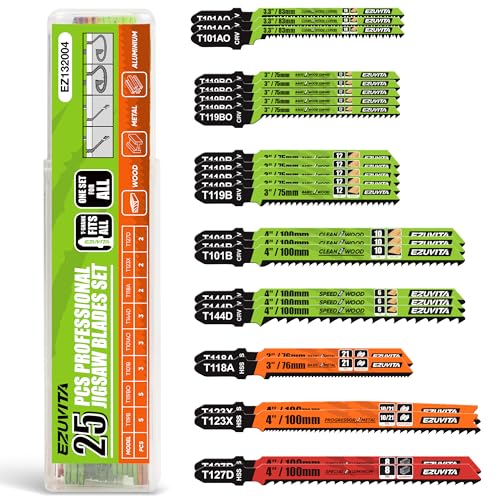
EZUVITA gives curve shoppers two relevant wood profiles in a broader eight-type assortment. The T101AO is listed for clean curved wood cuts, while the T119BO is identified for basic curve cutting in wood and plastic. The same case includes T101B for clean straight wood cuts, T144D for faster straight cuts, T118A for thin metal, T123X for thicker metal, and T127D for aluminum. That makes the set a useful choice for projects that shift between materials rather than stay in fine woodworking.
The product information identifies chrome vanadium steel for wood blades and high-speed steel for metal blades, with a T-shank design intended for common brands such as Bosch and DEWALT. The listed T101AO has an 18 TPI profile, while the T119BO is listed at 12 TPI. Those different tooth patterns illustrate why the set cannot be treated as nine interchangeable curve blades. A user cutting a tight plywood shape will likely reach for the finer option, while a plastic curve may call for a different profile and slower feed.
Pros
- Includes both T101AO and T119BO curve-cutting profiles.
- Offers documented options for wood, plastic, thin metal, thick metal, and aluminum.
- Lists distinct tooth counts for useful selection decisions.
- Uses separate wood and metal blade constructions according to the product details.
- Storage case supports organized transport.
Cons
- The set contains only a portion of blades aimed specifically at curves.
- Material and tooth-profile choices require careful sorting before cutting.
EZUVITA suits a general-purpose user who wants to cut curved wood and occasionally branch into plastic or metal. It is less compelling for someone seeking a pure scrolling pack, where Bosch T101AO or GINEPAN provides a more consistent profile. Before fitting a blade, read the marking, match it to the material, and check the T-shank clamp rather than choosing by blade length alone.
To buy this product, click here.
8. 50-Piece Contractor Jigsaw Blades Set — Best General-Purpose Case
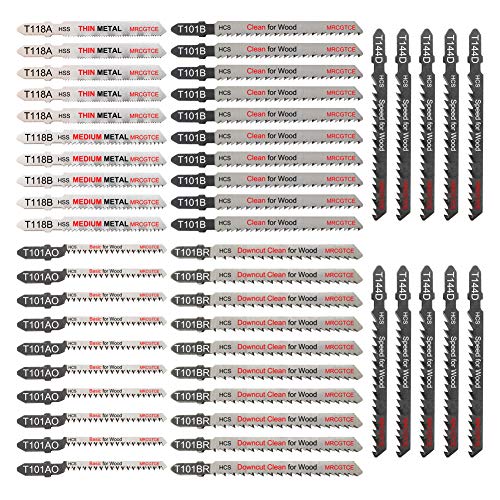
This contractor-style set covers several common blade codes, including T101AO, T101B, T101BR, T144D, T118A, and T118B. The T101AO is the relevant choice for curved wood work, while the other profiles support clean straight cuts, reverse-tooth applications, fast wood cuts, and basic metal work. That mix gives a general-purpose user a broad starting box, especially when a single weekend project can involve a curved wood panel followed by a straight trim cut.
The central limitation is specialization. The product title emphasizes 50 pieces, but the product specifications do not identify the quantity assigned to each blade type, the exact tooth counts, or the material construction for every profile. A large case can therefore look more curve-focused than it really is. Buyers should treat the included T101AO as the relevant curve option and use the other codes according to their stated applications. The T-shank format is identified, so tool compatibility remains a straightforward first check.
Pros
- Includes a T101AO profile for curved wood cuts.
- Offers T101B, T101BR, T144D, T118A, and T118B options.
- Covers wood, plastic, and metal applications according to the product title.
- Storage case is included.
- T-shank format suits compatible jigsaws.
Cons
- The product specifications do not show how many pieces belong to each blade type.
- The assortment is less focused on curves than dedicated T101AO or T244D packs.
This case works for a contractor or homeowner who values broad coverage and expects curved cuts to be one task among many. A buyer planning frequent scrolling work should choose a set with a clearly documented quantity of narrow curve blades. Check each model marking before use, since a T144D or metal blade may fit the same saw while being inappropriate for a delicate wood curve.
To buy this product, click here.
9. DEWALT DW3741C 10-Piece Jigsaw Blades Set — Best for Mixed Wood and Metal Work

The DEWALT DW3741C is a mixed-material set rather than a dedicated scrolling collection. Its product specifications list blades for wood and metal, a combination of bi-metal and HCS construction, and three tooth categories at 6, 10, and 18 TPI. The 18 TPI option is the most relevant for a cleaner, more controlled wood curve among the documented choices, while the coarser profiles support faster or heavier work where a tight scrolling radius is less important.
This range may suit a workshop that needs one compact case for general jigsaw duties. It does not provide the same direct curve-cutting documentation as Bosch, Festool, or Create Idea, and the product details do not identify each individual blade model or state which piece is shaped for scrolling. That uncertainty matters for a buyer whose main job is a curved edge. The T-shank format is clearly identified, but the user still needs to pair each tooth profile with the material and desired cut.
Pros
- Includes both bi-metal and HCS blade constructions.
- Three documented TPI categories provide different cutting approaches.
- Designed for wood and metal applications.
- T-shank format is identified.
- Storage case is included.
Cons
- Check a dedicated scrolling or narrow curve blade for the exact product configuration.
- The set offers less curve-specific detail than the top-ranked options.
Choose this set if wood curves are part of a wider maintenance or construction workload. It is a less precise match for someone buying specifically for intricate scrolling, where a named T101AO or T244D profile provides clearer guidance. Before cutting, identify the 18 TPI blade and confirm its shape and intended material from the packaging or markings.
To buy this product, click here.
Buying Guide
Confirm the Shank Type Before Comparing Tooth Profiles
A blade cannot help with a curve if it does not lock into the jigsaw. The products ranked here are primarily T-shank options, and several listings describe compatibility with modern jigsaws. That does not establish compatibility with every older tool. Check the blade clamp in the manual or on the saw before ordering, especially if the tool accepts U-shank blades only. A secure fit is the starting point for controlled turning, and no tooth pattern compensates for the wrong interface.
Choose a Narrow Profile for Tight Scrolling
Blade width affects how readily the blade can follow a curved line. Bosch T101AO and GINEPAN T101AO are clearly associated with narrow, fine-finish, scrolling work. These profiles are more suitable for a small decorative cutout than a broad straight-cut blade. A narrower blade still requires a gradual feed and careful control. Forcing the jigsaw sideways can bend the blade, widen the kerf, or pull the cut away from the marked line.
Match TPI to the Material and Cut Style
Higher tooth counts are often selected for cleaner cuts in thinner wood, laminate, and veneer, while coarser profiles can remove material more readily in thicker wood. These products illustrate the difference. Bosch and GINEPAN use 20 TPI T101AO profiles for fine curved work, while Create Idea identifies a 6 TPI T244D for curves in softwood, hardwood, plywood, and composite wood. Neither profile is universally superior. The workpiece thickness, wood type, desired edge, and cutting speed all matter.
Follow the technique for cutting curves with a jigsaw when the layout needs relief cuts and a controlled turn.
Separate Dedicated Curve Packs From General Assortments
A large case may contain only a few blades that genuinely suit curves. Leourae lists T101AO and T244D as curved-wood options, while Craluuur includes those profiles alongside straight-cut, metal, and aluminum blades. EZUVITA adds T101AO and T119BO curve choices to an eight-type selection. These assortments are useful when materials change, but a dedicated Bosch, GINEPAN, Festool, or Create Idea pack may offer more predictable results for repeated curved work.
Check Working Length Against the Workpiece
Blade length should leave enough usable teeth below the material without adding unnecessary flex. Create Idea provides a 100 mm overall length and 75 mm working length, which gives the buyer a clearer basis for matching the blade to thicker wood. The Bosch T101AO information lists a 3-inch blade length, while other products provide less detail. Do not transfer one blade’s length or capacity to another model, and do not assume an assortment’s longest blade is the best choice for a tight curve.
Match the Blade to the Material
Wood, laminate, plastic, aluminum, and steel require different tooth designs and blade constructions. A blade that physically fits the jigsaw is not automatically appropriate for every material. EZUVITA identifies separate wood and metal constructions, while Craluuur lists HCS and HSS types. DEWALT includes HCS and bi-metal blades. Use the profile named for the workpiece, support the material securely, and follow the jigsaw and blade maker’s operating guidance.
Think About Edge Visibility
For a decorative panel, both faces may matter. The pointed teeth listed for Bosch and GINEPAN are intended to reduce splintering on both sides of suitable workpieces. A reverse-tooth blade, such as the T101BR found in several assortments, may serve a different cutting situation. The presence of a reverse-tooth profile in a case does not make the entire set a clean-cut solution for every laminate or plywood project. Select the specific blade for the visible face and the material.
Best Jigsaw Blades for Curves FAQ
What type of jigsaw blade is best for tight curves?
A narrow scrolling blade is generally the most relevant choice for tight curves because its profile is intended to turn more readily than a broad straight-cut blade. The Bosch T101AO and GINEPAN T101AO are listed for curved and scrolling fine-finish cuts. The right choice still depends on the wood type, thickness, jigsaw clamp, and desired edge.
Are T-shank blades compatible with every jigsaw?
No. T-shank blades fit jigsaws designed to accept that interface, but some older tools use U-shank blades or another mounting system. Check the tool manual or blade clamp before ordering. A product listing’s broad compatibility statement should not replace model-specific confirmation.
Is a 20 TPI blade better for curves than a 6 TPI blade?
Neither is automatically better for every curve. The 20 TPI Bosch and GINEPAN profiles are aimed at fine curved and scrolling cuts in wood, laminate, MDF, and plywood. Create Idea’s 6 TPI T244D is described for curves in softwood, hardwood, plywood, and composite wood. A fine profile may suit thinner material and a cleaner edge, while a coarser profile may be more practical for thicker wood and faster material removal.
Can a metal-cutting jigsaw blade be used for curved wood cuts?
A metal blade should be selected for the metal application named by the manufacturer, not treated as a general curve blade. Metal profiles may have tooth patterns and construction intended for sheet metal or other metals. Use a wood curve blade for wood, such as a listed T101AO or T244D option, unless the product information specifically supports the intended material.
Are large jigsaw blade sets suitable for scrolling?
They can be, provided the case includes an appropriate narrow curve or scrolling profile. Leourae, Craluuur, and EZUVITA each list curve-capable blades within broader assortments. A large piece count does not mean every blade suits curves. Read the model code and choose the blade identified for curved wood, scrolling, or the specific material being cut.
What should I check before cutting a curved plywood shape?
Confirm the shank type, select a blade listed for plywood and curved work, and match its length to the material thickness. A narrow, fine-tooth profile can suit a detailed shape, while a broader or coarser profile may work better for a large curve. Secure the plywood, mark the line clearly, and guide the saw gradually without twisting the blade.
Does a longer blade make curved cuts better?
Length alone does not determine curve quality. A longer working length can provide reach for thicker material, as shown by the Create Idea specification of 75 mm working length, but blade width, tooth geometry, material, and rigidity remain important. The blade should be long enough for the workpiece and compatible with the jigsaw, without treating maximum length as a guarantee of cleaner or tighter curves.
Final Verdict
The BOSCH T101AO is the best overall choice for most readers searching for jigsaw blades for curves. Its documented narrow body, 20 TPI pointed teeth, T-shank design, and stated use for curved and scrolling cuts in wood, plywood, MDF, veneers, and laminates create the clearest match to the search intent. GINEPAN offers a similar fine-cut direction in a larger dedicated pack, while the Festool 204267 is a focused wood-curve option for buyers who can confirm the required blade interface.
For broader or thicker wooden shapes, the Create Idea T244D provides a different approach with a 6 TPI profile and 75 mm working length. Craluuur, Leourae, and EZUVITA make more sense for mixed-material workshops that need curve blades alongside straight-cut, metal, plastic, or aluminum options. The Contractor and DEWALT sets are general-purpose choices with less curve-specific detail. Before buying, verify the shank, match the tooth profile to the material and thickness, and choose a dedicated scrolling blade when the curve is tight or the finished edge will remain visible.
