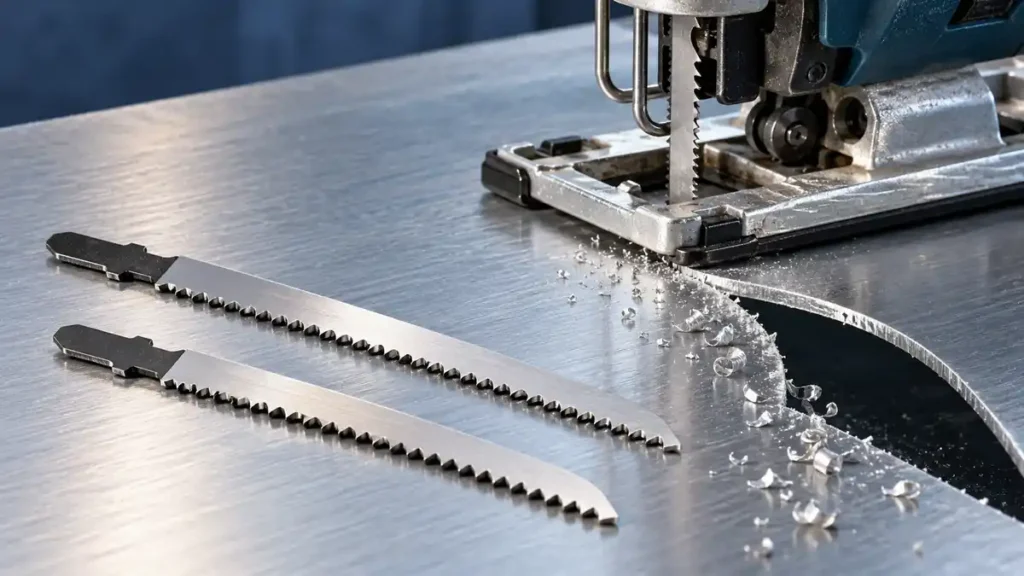
Aluminum can look deceptively easy to cut. It is softer than steel, yet a poorly matched jigsaw blade can load up with chips, chatter across a sheet, or leave an edge rough enough to require substantial cleanup. That is why shoppers looking for the best jigsaw blades for aluminum usually need a blade made for nonferrous metal rather than a general-purpose wood or thin-steel blade.
Tooth count, blade material, shank style, and workpiece thickness all matter. An 8 TPI aluminum blade is a practical fit for thicker aluminum and curved work, while a fine-tooth blade may make more sense for very thin sheet. Lubrication is also recommended in the product specifications for several metal-cutting options. A T-shank blade will suit many modern jigsaws, but a U-shank set requires a compatible older or U-shank tool. The right choice depends on whether you need dedicated aluminum blades, mixed-material coverage, curved cuts, or a larger selection for occasional projects.
The Bosch T127D earns the strongest overall position because its documented aluminum range covers material from 3/16 to 5/8 inch, and its HSS construction, 8 TPI tooth design, and four-inch length create a focused match for common aluminum-cutting work. The other selections serve different needs, including curved cuts, thin material, mixed workshops, and U-shank compatibility.
Quick Answer
The BOSCH T127D 5-Piece Aluminum Blades are the best overall choice for buyers who want a dedicated T-shank blade with a documented aluminum range of 3/16 to 5/8 inch. The BOSCH T227D Blades are the better pick for aluminum projects involving curved cuts. For a more durable construction, the LENOX Tools 1991592 uses bi-metal construction and is positioned for users who expect repeated metal-cutting work. Mixed-material workshops may prefer the 20-piece or 30-piece T-shank assortments, while the U-shank set is relevant only when the jigsaw accepts that interface.
Best Jigsaw Blades for Aluminum Comparison Table
| Product | Best For | Blade Material | Tooth Design |
|---|---|---|---|
| BOSCH T127D | Dedicated aluminum work | HSS | 8 TPI, straight cuts |
| BOSCH T227D | Curved aluminum cuts | HSS | 8 TPI, straight or curved cuts |
| Diablo DJT127D5 | Aluminum cutting with a T-shank | HSS edge | 8 TPI |
| LENOX Tools 1991592 | Repeated metal-cutting use | Bi-metal | Not specified |
| DEWALT DW3755H | Aluminum and fiberglass | HCS | 8 TPI |
| BOSCH T123X | Mixed-thickness nonferrous metal | HSS | 10 to 24 TPI progressive |
| 20-Piece T-Shank Set | Mixed workshop materials | HCS and HSS | Includes T127D aluminum blades |
| Craluuur 30-Piece Set | Broad blade variety | HCS and HSS | Includes T127D aluminum blades |
| 14-Piece U-Shank Set | U-shank jigsaws | HCS | 6 to 32 TPI assortment |
The detailed reviews below explain which blades are genuinely aimed at aluminum, which sets offer useful coverage, and where compatibility or material limits deserve attention.
1. BOSCH T127D 5-Piece Aluminum T-Shank Jig Saw Blades – Best Overall
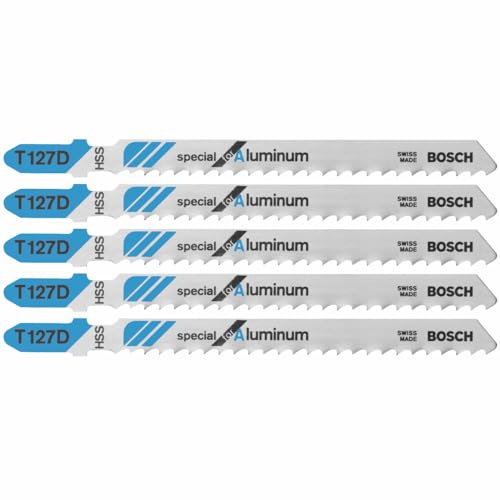
The Bosch T127D is the clearest match for the main search intent because the specifications specifically identify aluminum as a target material. Its recommended aluminum range runs from 3/16 to 5/8 inch, a useful span for brackets, panels, trim pieces, and other relatively substantial aluminum stock. The 8 TPI layout favors a faster, more open cut than a fine sheet-metal blade, so it makes more sense for thicker work than ultra-thin flashing.
Its high-speed steel construction is another practical fit for metal work, while the four-inch overall length and three-inch working length provide a compact blade format for a standard jigsaw. The listing recommends proper lubricant for cutting metal, a detail worth taking seriously because aluminum chips can pack around teeth during a dry cut. This is a focused five-piece package rather than a broad assortment, which keeps selection simple when the job is specifically aluminum.
Pros
- Documented for aluminum from 3/16 to 5/8 inch thick
- HSS construction is intended for metal-cutting use
- 8 TPI tooth design suits faster cuts in thicker aluminum
- Four-inch overall length with three-inch working length
- Five identical blades simplify replacement planning
Cons
- Focused on T-shank compatibility rather than U-shank tools
- The 8 TPI design is less specialized for very thin sheet than a fine-tooth blade
This is the strongest starting point for a buyer who wants one dedicated aluminum blade rather than a drawer full of unrelated teeth. It also covers fiberglass and plastic according to the product specifications, although aluminum remains its clearest purpose. Buyers cutting thin sheet or frequently changing between wood, steel, and plastic may prefer a set with more tooth patterns.
To buy this product, click here.
2. BOSCH T227D 5-Piece Aluminum T-Shank Jig Saw Blades – Best for Curved Cuts

The Bosch T227D shares much of the T127D’s core specification, including HSS construction, an 8 TPI tooth design, a four-inch overall length, and a three-inch working length. Its meaningful distinction is the documented ability to make straight or curved cuts. That makes it a more natural fit for rounded corners, cutouts, and shaped aluminum panels where a strictly straight-cut blade can feel restrictive.
The listed aluminum range is 3/16 to 5/8 inch, with additional suitability for fiberglass and plastic. Those material recommendations give the blade some flexibility around a workshop, but the tooth configuration still matters. A curved-cut designation does not remove the need to support the workpiece securely or guide the jigsaw steadily through the layout line. Lubricant is recommended for metal cutting, so a controlled feed and appropriate cutting fluid remain part of the setup.
Pros
- Documented for both straight and curved aluminum cuts
- Suitable for aluminum from 3/16 to 5/8 inch thick
- HSS construction supports the stated metal application
- 8 TPI profile offers a practical balance for thicker material
- Also listed for fiberglass and plastic applications
Cons
- Only fits jigsaws compatible with its T-shank interface
- Its 8 TPI profile is not the most specialized option for very thin sheet
Choose the T227D when your aluminum project includes arcs, rounded openings, or shaped components. It is a particularly sensible alternative to the T127D for a buyer who values documented curve-cutting suitability. For long, straight rip-like cuts, the two Bosch options are closer matches, so the T227D’s main advantage appears when the cut path bends.
To buy this product, click here.
3. Diablo DJT127D5 High-Speed Steel Aluminum Blades – Best for Documented Cutting Control

Diablo’s DJT127D5 takes a similar route to the dedicated Bosch aluminum blades, with a four-inch length, 8 TPI configuration, and a high-speed steel edge. The product information describes an optimized tooth design intended to support cutting speed and stability in aluminum. That language makes it a direct candidate for shoppers who want a purpose-specific T-shank blade rather than a general metal assortment.
The listing also presents the blade as suitable for corded and cordless jigsaws and describes compatibility with all combo and most U-shank jigsaws through its T-shank design. The actual fit still depends on the jigsaw’s blade holder, so buyers should check their tool before ordering. Its stated focus on straight cuts and curves gives it broader application language than a straight-only thin-sheet blade, while the HSS edge keeps the construction aligned with nonferrous metal cutting.
Pros
- Purpose-specific 8 TPI design for aluminum
- High-speed steel edge is suited to the listed metal application
- Four-inch blade length fits a familiar jigsaw format
- Product information describes use for straight and curved work
- Designed for corded and cordless jigsaws according to the listing
Cons
- The exact jigsaw fit should be checked rather than assumed from broad compatibility language
- The product details do not specify an aluminum thickness range
This Diablo pack is a good alternative for shoppers who want an aluminum-focused blade with a current-looking product design and a clearly stated 8 TPI profile. Bosch provides more specific thickness guidance, so the Diablo option suits buyers who can match the blade to their own material thickness and value the product’s stated tooth stability characteristics.
To buy this product, click here.
4. LENOX Tools 1991592 T-Shank Aluminum Cutting Blades – Best Bi-Metal Construction

Lenox approaches aluminum cutting with a different construction. The 1991592 uses bi-metal technology, which the product specifications describe as flexible and resistant to breaking. That distinction matters for buyers who expect repeated metal work and prefer a blade construction intended to tolerate flexing rather than a basic single-material blade.
The listing also identifies Power Blast technology and T2 technology as part of its durability and cutting design. These are manufacturer or seller claims, so they should be treated as design features rather than guaranteed results in every jigsaw or workpiece. The product is a four-inch T-shank blade in a five-pack, making it a dedicated replacement option for compatible tools. The product details do not state a precise aluminum thickness range or TPI, so material matching requires more judgment than with the Bosch options.
Pros
- Bi-metal construction is documented for flexibility and break resistance
- Intended for aluminum and other metal-cutting applications
- Four-inch T-shank format suits compatible modern jigsaws
- Five-pack provides replacement blades for recurring projects
- Power Blast and T2 features are identified in the product information
Cons
- The specifications do not state TPI
- No specific aluminum thickness range is provided in the available data
Lenox is the most compelling choice here for someone who prioritizes bi-metal construction over a clearly published tooth count. It is less straightforward for a first-time buyer because the missing TPI and thickness details make direct application matching harder. Check the workpiece and tool requirements carefully before selecting it for a particular aluminum cut.
To buy this product, click here.
5. DEWALT DW3755H Aluminum and Fiberglass Blades – Best for Aluminum and Fiberglass

The DEWALT DW3755H is a dedicated five-pack labeled for aluminum and fiberglass, giving it a useful two-material role for workshops that move between metal panels and fiberglass components. Its four-inch length and 8 TPI configuration place it in the same broad cutting category as the Bosch aluminum blades. The product specifications identify HCS construction, so buyers can see exactly how this model differs from the HSS and bi-metal options above.
HCS can be an appropriate fit for a general-purpose specialty blade, but the product data is less detailed than the Bosch listings. It does not provide an aluminum thickness range, working length, or expanded tooth geometry information. That leaves the DW3755H best suited to shoppers who already understand their jigsaw and material requirements, especially those who want a recognizable aluminum and fiberglass designation without needing a mixed assortment.
Pros
- Specifically labeled for aluminum and fiberglass
- 8 TPI configuration suits the listed application
- Four-inch blade format is compatible with suitable T-shank jigsaws
- Five blades provide replacements for recurring cuts
- Focused material designation is easier to sort than a general-purpose set
Cons
- The product details do not state a recommended aluminum thickness range
- HCS construction offers less specialized material information than the HSS and bi-metal alternatives
This DEWALT pack makes sense for a workshop where fiberglass appears alongside aluminum and where the user is comfortable choosing feed rate and workpiece thickness without a detailed manufacturer range. Buyers seeking the most specific documented guidance should move up to the Bosch T127D or T227D instead.
To buy this product, click here.
6. BOSCH T123X Progressor Metal T-Shank Blades – Best for Mixed-Thickness Nonferrous Metal

The Bosch T123X is broader than a dedicated 8 TPI aluminum blade. Its progressive 10 to 24 TPI tooth pattern is listed for varied metal thicknesses, including nonferrous metal from 5/64 to 3/4 inch. That published range makes it relevant to aluminum buyers whose projects move between thinner sheet, profiles, and thicker stock rather than staying within one material size.
The four-inch HSS blade has a three-inch working length and is also listed for thin metal, pipes, metal profiles, stainless steel, plastics, and fiberglass. That flexibility comes with a tradeoff. A progressive multi-material blade is harder to characterize as a single-purpose aluminum specialist, and the buyer must still match the tooth profile to the specific workpiece. For a mixed metal drawer, however, its range is more useful than a pack intended for one thickness alone.
Pros
- Documented for nonferrous metal from 5/64 to 3/4 inch
- Progressive 10 to 24 TPI pattern covers varied thicknesses
- HSS construction is intended for longer metal-blade service
- Four-inch length with three-inch working length
- Also listed for stainless steel, plastics, fiberglass, and metal profiles
Cons
- More general-purpose than a blade specifically labeled for aluminum
- Progressive teeth require careful material matching for the intended cut
Select the T123X when aluminum is one part of a wider metal-cutting workload. Its documented nonferrous range is the strongest reason to choose it over a fixed 8 TPI blade. For a simple aluminum-only project, the T127D remains easier to match, while the T123X earns its place through broader thickness and material coverage.
To buy this product, click here.
7. 20-Piece T-Shank Jigsaw Blade Set – Best Mixed-Material Set

This 20-piece set qualifies because it includes two T127D blades specifically identified for aluminum. The rest of the assortment covers wood and basic metal cutting through several T-shaped blade types, giving a mixed-material workshop a way to keep aluminum blades alongside everyday woodworking options. The set uses HCS and HSS construction, so the metal and wood blades are not presented as one identical material.
Its labeled storage case can be useful when a project moves from a plywood template to an aluminum component and then back to plastic or wood. The selection is also easier to manage because the product information describes printed blade identification and divided storage. The limitation is quantity. Only two blades are assigned to the aluminum application, so this is a broad starter assortment rather than a dedicated aluminum replacement pack.
Pros
- Includes T127D blades identified for aluminum
- Offers ten blade types across wood, metal, plastic, and aluminum work
- Standard T-shank design suits many compatible jigsaws
- HCS and HSS materials are used for different application groups
- Storage case and printed identification support quick blade selection
Cons
- Only two included blades are specifically designated for aluminum
- Mixed assortments require careful selection so wood blades are not used on metal
This set is a practical fit for a homeowner or general workshop that occasionally cuts aluminum but spends plenty of time on wood. Someone building a dedicated metal-cutting supply should choose a five-pack of aluminum blades instead, since the set’s aluminum coverage will be used up sooner.
To buy this product, click here.
8. Craluuur 30-Piece T-Shank Jigsaw Blade Set – Best Blade Variety

The Craluuur set includes two T127D aluminum blades among its 30 pieces, plus separate groups for clean wood cuts, faster wood cuts, and basic metal work. That makes it relevant for a workshop where aluminum is an occasional task rather than the main job. The larger count also provides more duplicates across the wood-oriented types, which may appeal to someone building a general jigsaw blade organizer from scratch.
The product specifications identify HCS and HSS construction, a T-shank interface, labeled shanks, and a storage box. The listing also describes fine-tooth and reverse-cut designs within the assortment, but those features apply to particular blade types rather than automatically to the two T127D aluminum blades. Treat the set as a collection of distinct tools, and check each shank marking before starting a metal cut.
Pros
- Includes T127D blades for aluminum
- 30-piece assortment covers wood, metal, plastic, and aluminum tasks
- HCS and HSS construction are represented
- Printed blade identification helps separate the different types
- Storage box keeps the assortment together between projects
Cons
- Only two blades are designated for aluminum
- The large assortment can be excessive for buyers seeking dedicated aluminum blades
Pick Craluuur when variety matters more than a deep supply of one aluminum blade type. It is particularly useful for a new jigsaw owner who cuts furniture parts, plastic, sheet material, and occasional aluminum. A metal-focused user will get more relevant replacements from one of the dedicated five-packs.
To buy this product, click here.
9. 14-Piece U-Shank Jigsaw Blade Set – Best for U-Shank Compatibility

This set earns a place for a specific reason: it serves U-shank jigsaws rather than the T-shank tools used by most of the dedicated aluminum options above. The assortment includes 6, 8, 10, 14, 18, 24, and 32 TPI configurations, and the product information identifies aluminum among its nonferrous-metal applications. That range gives a compatible U-shank tool more choices between faster cuts and finer metal work.
The U-shank interface is the deciding factor here. A T-shank jigsaw cannot automatically accept this set, and a physically similar blade should never be treated as interchangeable without checking the tool holder. The product information describes high-carbon steel construction and polished teeth for chip removal, but it does not provide an aluminum thickness range or identify a dedicated aluminum blade code. For an older compatible jigsaw, however, the set may solve a real availability problem.
Pros
- Designed for U-shank jigsaws
- Includes seven listed TPI options from 6 to 32 TPI
- Product information identifies aluminum among supported nonferrous metals
- High-carbon steel construction is documented
- Offers both faster and finer tooth configurations
Cons
- U-shank interface is unsuitable for a T-shank-only jigsaw
- No specific aluminum thickness range is provided
This is the right kind of specialist alternative for a buyer whose jigsaw requires U-shank blades. It should not be selected simply because the set contains many tooth counts. Check the tool’s blade clamp first, then choose a tooth pattern appropriate for the aluminum thickness and cut style.
To buy this product, click here.
Buying Guide
Confirm the Shank Type Before Comparing Tooth Design
A blade can be perfectly suited to aluminum and still be unusable in the wrong jigsaw. The Bosch, Diablo, DEWALT, Lenox, and mixed T-shank products in this roundup require a compatible T-shank holder. The 14-piece set at the end uses a U-shank interface. Check the existing blade, tool manual, or blade clamp before choosing a pack. Broad claims about compatibility should not replace matching the actual holder.
Match the Blade to Aluminum Thickness
The Bosch T127D and T227D provide the clearest documented range, from 3/16 to 5/8 inch aluminum. The Bosch T123X lists a wider nonferrous range from 5/64 to 3/4 inch and uses a progressive 10 to 24 TPI pattern. Products without a stated thickness range require more caution. Do not transfer a published aluminum range from one model to another, even when the blades look similar.
Use the guide to metal blade selection by alloy and thickness before choosing a tooth profile for the stock.
Understand 8 TPI Versus Fine-Tooth Options
The dedicated aluminum blades here primarily use 8 TPI, a relatively open tooth pattern suited to the thicker aluminum ranges identified in the product information. The Bosch T118G, which is not among the nine recommendations, uses 36 TPI for very thin sheet metal, showing why tooth count must match the application. A fine-tooth blade may suit thin material, while an open pattern can be more practical for thicker stock. The correct choice depends on the blade design and the manufacturer’s stated use, not TPI alone.
Compare HSS, HCS, and Bi-Metal Construction
HSS appears on the Bosch and Diablo aluminum-focused blades and the Bosch T123X. HCS appears on the DEWALT blade and within the mixed sets. Lenox uses bi-metal construction and describes it as flexible and resistant to breaking. These material labels help distinguish the products, but none proves a blade will last for a particular user or workpiece. Treat construction as one selection factor alongside tooth design, thickness guidance, and compatibility.
Choose Dedicated Packs or Mixed Assortments
A five-pack of dedicated aluminum blades gives more replacements for repeated aluminum work. A mixed set can be more useful for a garage where one afternoon involves plywood, plastic, and a small aluminum bracket. The 20-piece and 30-piece sets contain only two blades specifically identified for aluminum, so their total count should not be confused with aluminum-blade quantity.
Plan for Lubrication and Workpiece Control
The product specifications recommends proper lubricant for several metal-cutting blades. Follow the blade or tool maker’s operating guidance, support the aluminum securely, and avoid forcing the jigsaw through the cut. Lubrication does not turn an unsuitable blade into an aluminum blade, and it does not remove the need to match working length and tooth design to the workpiece.
Best Jigsaw Blades for Aluminum FAQ
What Type of Jigsaw Blade Is Best for Aluminum?
A blade specifically identified for aluminum or nonferrous metal is the safest starting point. In this roundup, the Bosch T127D and T227D have especially clear aluminum recommendations. Their 8 TPI HSS designs are listed for aluminum from 3/16 to 5/8 inch. Match the blade’s documented range to the material rather than relying on a generic wood or metal label.
Are T-Shank Blades Compatible With Every Jigsaw?
No. Many modern jigsaws use T-shank blades, but compatibility depends on the tool’s blade holder. U-shank tools require U-shank blades unless the manufacturer explicitly supports another interface. The U-shank set in this roundup should be treated as a separate compatibility choice from the T-shank Bosch, Diablo, DEWALT, and Lenox products.
Can a Wood-Cutting Jigsaw Blade Cut Aluminum?
A wood blade should not be selected for aluminum simply because it physically fits the jigsaw. Aluminum requires a blade whose material, tooth design, and published application support nonferrous metal cutting. The mixed sets include separate aluminum or metal blade types, so read the markings and do not grab a wood blade by mistake.
Is 8 TPI Suitable for Aluminum?
It can be suitable for the thicker aluminum applications identified by the product information for the Bosch T127D and T227D. Those blades are listed for 3/16 to 5/8 inch aluminum. Very thin sheet may call for a finer metal-cutting design, so the workpiece thickness and blade manufacturer’s guidance should control the choice.
Should Aluminum Be Cut With Lubricant?
The product specifications recommends proper lubricant when cutting metal for several listed blades. Follow the product guidance and use a cutting setup appropriate for aluminum. Lubricant may help manage heat and chip buildup, but it does not replace secure workpiece support, suitable eye protection, or the correct blade.
Are Blade Sets Better Than Dedicated Aluminum Blades?
That depends on the workshop. A dedicated five-pack is more useful for repeated aluminum jobs because every blade serves the same primary application. A 20-piece or 30-piece set may be more practical for a homeowner who also cuts wood, plastic, and basic metal. Check how many blades in the set are actually designated for aluminum before comparing the total piece count.
Can the Bosch T127D and T227D Cut Curves?
The T227D is specifically described for straight or curved cuts, making it the clearer choice for shaped aluminum work. The T127D is listed for fast, straight cuts. Both use an 8 TPI profile and share a documented aluminum range, but their stated cutting emphasis is different.
Final Verdict
The BOSCH T127D is the best overall pick for most buyers searching for jigsaw blades for aluminum. Its T-shank interface, HSS construction, 8 TPI design, four-inch length, and documented 3/16 to 5/8 inch aluminum range give it the strongest combination of clear application guidance and focused purpose. Choose the BOSCH T227D instead when curved cuts matter, or look at the LENOX 1991592 when bi-metal construction is the priority and the missing TPI and thickness details do not create a problem for your project.
The Bosch T123X is the more flexible choice for mixed-thickness nonferrous metal, while the 20-piece and Craluuur sets make sense for workshops that need wood and plastic blades alongside a small number of aluminum options. The DEWALT pack suits aluminum and fiberglass work, and the U-shank assortment is relevant only to tools built around that interface. Before ordering, confirm the shank type, identify the aluminum thickness, choose a suitable tooth pattern, and follow the product guidance for lubrication and cutting conditions.
