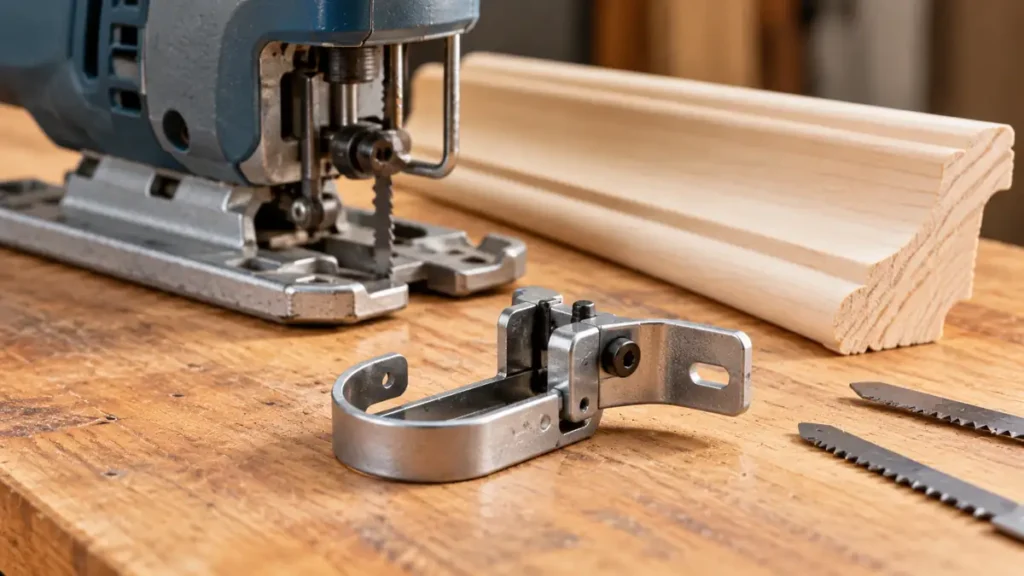
A coping foot gives a compatible jigsaw a different working posture for trim and crown molding cuts. Instead of guiding the saw in its usual upright position, the attachment supports coping work with the blade positioned for controlled curved cuts. That can be useful when a hand coping saw feels slow, awkward, or difficult to keep steady across repeated molding joints.
Compatibility deserves more attention than the word “universal” suggests. The listings commonly exclude Porter-Cable models and Bosch 1590 and 1591 jigsaws, while the Festool Carvex attachment is intended for a separate saw family. A variable-speed jigsaw, the correct blade, secure installation, and careful positioning all affect whether the accessory is appropriate for a particular job. A plated-steel body may help with longevity, but it does not guarantee a clean cut if the blade, saw, or mounting arrangement is unsuitable.
The Collins Tool Company Coping Foot stands out as the strongest documented choice because its listing identifies the original design, 14-gauge plated steel construction, broad compatibility restrictions, and a lifetime guarantee. The Festool-compatible option earns a separate place for Carvex owners, while the other selections offer similar general-purpose coping-foot functions with different documentation, dimensions, or positioning claims.
Quick Answer
Best Overall: Collins Tool Company Coping Foot is the clearest choice for buyers who want the most fully documented general-purpose option, including 14-gauge plated steel and a lifetime guarantee.
Best for Festool Carvex: Coping Foot Angle Saw is the specialized selection for the Festool Carvex line, with a design intended to let the blade turn, pitch, and bevel during a cut.
Best for Compact Storage: Horett Coping Foot Tool lists compact dimensions and a documented weight, making its physical size easier to assess before adding it to a small tool case.
Best Coping Foot for Jigsaws Comparison Table
| Product | Best For | Construction | Compatibility Notes |
|---|---|---|---|
| Collins Tool Company Coping Foot | Overall general-purpose use | 14-gauge plated steel | Most jigsaws, with listed exclusions |
| Coping Foot for Jigsaws | General woodworking | 14-gauge plated steel | Excludes listed Porter-Cable and Bosch models |
| Coping Foot Angle Saw | Festool Carvex owners | Not specified | Compatible with Festool Carvex line |
| Universal Heavy-Duty Steel Guide Rail | General-purpose coping work | Plated steel | Excludes Festool Carvex and listed models |
| LiebeWH Zero-Clearance Coping Foot | Template-free trim work | Plated steel | Most jigsaws, fit must be checked |
| Generic Universal Steel Coping Foot | Variable-speed saw users | Plated steel | Most jigsaws, exact model fit not specified |
| Coping Foot Tool | Repeated workshop use | Sturdy plated steel | Most variable-speed jigsaws |
| Horett Coping Foot Tool | Compact tool storage | Plated steel | Compatible jigsaw must be confirmed |
| UPQRSG Coping Foot | Simple general-purpose setup | Plated steel | Most jigsaws, variable speed recommended |
The detailed reviews below focus on fit restrictions, construction, installation, and the kind of coping work each attachment is positioned to support.
1. Collins Tool Company Coping Foot — Best Overall
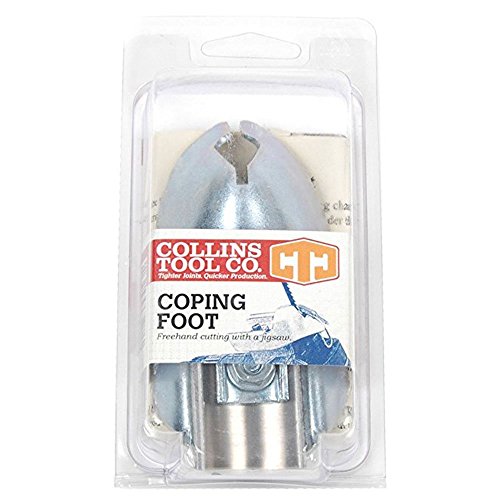
The Collins Tool Company Coping Foot earns the top position because its listing provides the clearest combination of intended function, construction, and support. It is built from 14-gauge plated steel and is intended to turn a compatible jigsaw into a coping machine without a separate jig or template. For a trim installer working through a stack of crown molding pieces, that direct setup can reduce the amount of improvised clamping and layout work around the bench.
Compatibility remains the first checkpoint. The listing names most jigsaws as compatible but specifically excludes Porter-Cable models and Bosch 1590 and 1591 saws. It also states that the attachment does not work with Festool Carvex, which has its own compatible version. Those exclusions are useful because they give buyers something concrete to compare against their existing saw rather than relying on a vague universal-fit label. The lifetime guarantee adds a meaningful support advantage, although it cannot overcome a model mismatch.
Pros
- 14-gauge plated-steel construction is specifically documented.
- Designed to convert a compatible jigsaw for coping work without a separate jig or template.
- Broad stated compatibility with clearly listed model exclusions.
- Lifetime guarantee is included in the product information.
- Strongest documentation among the general-purpose options in this group.
Cons
- Does not fit Porter-Cable models or Bosch 1590 and 1591 jigsaws.
- Not compatible with Festool Carvex, which requires a different attachment.
This is the most sensible starting point for a buyer with a conventional compatible jigsaw and regular trim work ahead. It suits users who value documented construction and a clear support policy over a generic listing with fewer details. Festool Carvex owners should skip it, and anyone with an excluded Bosch or Porter-Cable model should verify alternatives before ordering. A variable-speed saw and suitable blade are still required for controlled curved molding cuts.
To buy this product, click here.
2. Coping Foot for Jigsaws, High Efficiency Woodworking Tool — Best General-Purpose Alternative

This coping foot closely follows the classic general-purpose format. The product specifications identify a 14-gauge plated-steel body, dimensions of approximately 4.4 by 3.4 by 1.2 inches, and a design intended for most jigsaws. It is aimed at the woodworker who wants a dedicated attachment for crown molding and trim rather than building a custom guide around the saw base.
The listing also provides practical setup guidance. Installation and removal are described as taking a few minutes, with the foot requiring correct positioning and an appropriate blade before use. That detail matters in real trim work, where a small alignment error can make the blade wander along a cope profile. The product information says it is made in the United States, while the compatibility exclusions match the familiar restrictions for Porter-Cable and Bosch 1590 and 1591 models.
Pros
- 14-gauge plated steel is specified for the attachment body.
- Approximate product dimensions are supplied for storage planning.
- Fits most jigsaws according to the listing.
- Installation and removal are described as straightforward.
- Variable-speed saw use is identified for curved molding work.
Cons
- Porter-Cable and Bosch 1590 and 1591 jigsaws are excluded.
- Festool Carvex compatibility is not supported.
This is a useful alternative for a conventional jigsaw owner who wants the same basic coping-foot concept with dimensions and construction information clearly stated. It makes less sense for a buyer who needs a model-specific Festool accessory or has an excluded saw. Check the mounting arrangement before purchase, then use a suitable blade and moderate control rather than treating the attachment as a substitute for setup accuracy.
To buy this product, click here.
3. Coping Foot Angle Saw Compatible With Festool Carvex — Best for Festool Carvex

Festool Carvex owners need a different selection from the general-purpose attachments above. This product is specifically listed for the Festool Carvex line and is intended to let the user turn and pitch the blade while changing angles during a cut. That makes its role more specialized than a basic universal coping foot, particularly for complex crown molding profiles where the blade needs to approach the work from changing directions.
The listing describes a barrel-up operating position and claims that complex coping cuts can be made without a separate jig or template. The product information also says installation takes a few minutes. Those details may appeal to a trim carpenter who already owns a Carvex and wants an attachment that matches that platform, but buyers should still confirm the exact saw variant and mounting requirements before ordering. The product details do not provide material thickness limits, attachment dimensions, or blade specifications.
Pros
- Specifically listed for the Festool Carvex line.
- Supports turning and pitching the blade during a cut.
- Intended for complex crown molding coping work.
- Designed to operate without a separate jig or template.
- Quick installation is described in the product information.
Cons
- Its specialized compatibility limits usefulness for other jigsaw brands.
- Dimensions, construction material, and blade requirements are not specified.
This is the clear choice for Carvex users who need the dedicated accessory rather than trying to adapt a general-purpose foot that the other listings specifically exclude. It should be skipped by owners of ordinary D-handle or other non-Festool jigsaws unless compatibility is independently confirmed. Its angle-changing function is the central reason to choose it, while the limited specification detail calls for careful fit verification.
To buy this product, click here.
4. Coping Foot Universal Heavy-Duty Steel Guide Rail — Best for a Simple Steel Guide
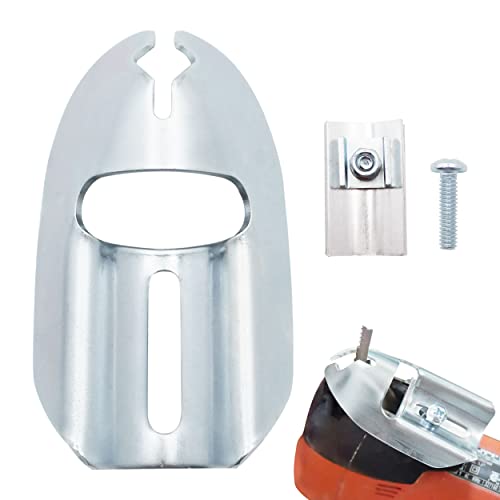
This option is described as a universal heavy-duty steel guide rail for most jigsaws. Its purpose is familiar: convert a compatible saw into a coping tool without adding a template or separate jig. The plated-steel construction gives the attachment a straightforward workshop profile, and the listing positions it for curved molding work with a variable-speed jigsaw.
The main advantage here is clarity around the basic job rather than a long list of specialized features. A user cutting several molding joints in a garage or trim station may prefer an attachment that focuses on the guide function and can be installed or removed as needed. Fit still comes first. The product excludes Porter-Cable, Bosch 1590 and 1591, and Festool Carvex models, so the “universal” description has practical boundaries.
Pros
- Designed specifically as a coping-foot guide rail.
- Plated-steel construction is documented.
- Fits most jigsaws according to the listing.
- Supports template-free coping work.
- Variable-speed operation is identified for curved moldings.
Cons
- Festool Carvex models are excluded.
- Porter-Cable and Bosch 1590 and 1591 jigsaws are also excluded.
This attachment suits a buyer who wants a direct, steel guide solution for a compatible conventional jigsaw. It is less suitable for a Carvex owner or anyone seeking documented dimensions, a guarantee, or a special angle-adjustment function. Compared with the Collins option, its listing provides less detail about support and construction gauge, so the appeal rests on its simple guide-rail role and stated compatibility range.
To buy this product, click here.
5. LiebeWH Coping Foot Jig Universal Heavy-Duty Steel Zero Clearance — Best for Template-Free Trim Work

The LiebeWH coping foot is presented as a heavy-duty steel, zero-clearance stabilizer for precision crown woodworking. The zero-clearance wording makes it attractive to users who want the attachment positioned closely around the cut area, while the listing also emphasizes template-free operation. Those features are relevant for someone laying out repeated trim joints on a workbench and wanting fewer temporary fixtures around each piece.
The product information describes plated steel, fine processing, and installation or removal in a few minutes. It also warns indirectly that the foot must be correctly positioned and paired with the right blade before it can work as intended. The listing says most jigsaws are supported and recommends a variable-speed saw for curved molding. It does not identify exact excluded saw models, so compatibility should be checked more carefully than with the Collins and first-ranked general-purpose options.
Pros
- Zero-clearance stabilizer design is stated in the product title.
- Plated-steel construction is documented.
- Intended for template-free crown woodworking.
- Fine processing and accurate manufacturing are claimed in the listing.
- Installation and removal are described as quick.
Cons
- Exact compatible and incompatible jigsaw models are not specified.
- The listing does not provide a construction gauge or product dimensions.
This product is worth a look for buyers drawn to the zero-clearance and stabilizer format, especially those working on trim where keeping the attachment correctly positioned is central to the task. It is less attractive for anyone who wants a clearly defined compatibility chart. Confirm the saw mounting arrangement before ordering, and treat the zero-clearance description as a design feature rather than a promise of perfect edge quality.
To buy this product, click here.
6. Generic Universal Steel Coping Foot — Best for Variable-Speed Saw Users

This generic coping foot focuses on the basic conversion from ordinary jigsaw to coping setup. The listing recommends a variable-speed saw for curved molding and identifies plated steel construction. It also describes quick installation after the correct vane or wing is positioned. That makes the attachment relevant to a DIY user who wants to experiment with coping crown molding without building a custom support from plywood or scrap stock.
The product information uses broad language about accurate engineering and long-term wear resistance, but it does not provide exact saw exclusions, dimensions, or a named manufacturer support policy. That leaves more responsibility with the buyer. Before a weekend trim project begins, compare the mounting area of the existing jigsaw with the product images and instructions, then test the setup on scrap molding so the blade orientation and support feel familiar.
Pros
- Plated-steel construction is listed.
- Variable-speed jigsaw use is recommended for curved molding.
- Intended to reduce the need for separate jigs and templates.
- Installation and removal are described as quick.
- Positioning with the correct vane or wing is addressed.
Cons
- Exact jigsaw exclusions are not provided.
- Dimensions and detailed mounting specifications are unavailable.
This is a reasonable choice for a buyer comfortable with checking fit and setting up an accessory through trial cuts. It is less suitable for a purchaser who needs a clearly documented model list or detailed dimensional information before ordering. The variable-speed recommendation is especially relevant here because coping involves curved molding cuts, where control matters more than simply running the saw at its highest setting.
To buy this product, click here.
7. Coping Foot Tool, Sturdy Steel Universal Foot Tool — Best for Repeated Workshop Use

This coping-foot tool is aimed at users who expect to install and remove the attachment across multiple projects. Its listing describes a sturdy plated-steel body, broad compatibility with variable-speed jigsaws, and setup in a few minutes without special tools. A trim carpenter moving from baseboard to crown molding may appreciate that removable format, since the accessory can stay separate from the saw when ordinary straight cuts are required.
The product description also emphasizes adjustment after installation and the need for the correct blade. That is a useful distinction from accessories that appear universal but provide little guidance about positioning. Exact saw models are not named, however, and the listing does not give dimensions or a specific construction gauge. Buyers should therefore treat compatibility as a claim to verify, especially if the jigsaw has an unusual baseplate, blade clamp, or handle arrangement.
Pros
- Sturdy plated-steel construction is specified.
- Designed for most variable-speed jigsaws according to the listing.
- Quick installation is described without special tools.
- Positioning can be adjusted after attachment.
- Suitable for repeated removal and installation between projects.
Cons
- Exact compatible jigsaw models are not identified.
- Product dimensions and mounting hardware details are not supplied.
This option fits a workshop routine where the coping foot is an occasional attachment rather than a permanent part of the saw. It may be skipped by buyers who need a named model list or a guarantee comparable to the Collins product. Its practical advantage is the installation format, while its main tradeoff is the limited technical detail available before purchase.
To buy this product, click here.
8. Horett Coping Foot Tool — Best Compact Design

The Horett attachment is the easiest selection in this group to assess from a storage perspective. Its listing gives approximate dimensions of 4.13 by 2.36 by 1.18 inches and a weight of about 4.37 ounces. Someone carrying a compact trim kit in a small tool case can use those figures to judge whether the accessory will fit beside blades, clamps, and measuring tools without taking up much room.
Its working purpose remains conventional: a plated-steel coping foot for compatible jigsaws, paired with a variable-speed saw and an appropriate blade for curved or trim cuts. The listing advises checking the saw and mounting requirements before use, which is particularly helpful because it does not provide a long list of exact compatible models. A stated 0.20-inch thread is also included, although buyers should confirm that this detail matches their intended mounting arrangement.
Pros
- Approximate dimensions are supplied for easier storage planning.
- Approximate weight of 4.37 ounces is documented.
- Plated-steel construction is listed.
- Variable-speed saw use is recommended for curved work.
- Quick installation and removal are described.
Cons
- Exact compatible jigsaw models are not listed.
- The stated 0.20-inch thread still requires mounting-fit verification.
This is a practical choice for a compact woodworking kit or a buyer who values physical size information. It should be passed over by anyone unwilling to verify mounting compatibility before purchase. The small footprint may make storage easier, but it does not replace the need for a correctly positioned foot, suitable blade, and controlled variable-speed operation.
To buy this product, click here.
9. UPQRSG Coping Foot — Best Straightforward Setup

The UPQRSG coping foot covers the core requirements without adding a specialized angle mechanism or platform-specific design. It is described as a plated-steel accessory for most jigsaws, with variable speed recommended for curved molding. For a homeowner preparing a small trim project, that straightforward format may be preferable to an attachment whose extra adjustments are unnecessary for a few cope joints.
The listing also describes quick installation, fine processing, and use without a separate jig or template. Those statements establish the intended application, but they do not provide exact dimensions, model exclusions, or a detailed blade specification. A buyer should therefore compare the accessory with the saw’s mounting arrangement and select a blade appropriate for the molding material rather than assuming the attachment itself determines cut quality.
Pros
- Plated-steel construction is identified.
- Designed for most jigsaws according to the product information.
- Variable-speed operation is recommended for curved moldings.
- Installation and removal are described as quick.
- Intended to work without a separate jig or template.
Cons
- Exact compatible and excluded jigsaw models are not specified.
- Dimensions, thread details, and blade requirements are not listed.
This product makes sense for a buyer seeking a basic coping-foot attachment and prepared to verify fit before ordering. It is less appropriate for a specialist who needs Festool Carvex compatibility, angle-changing control, or a documented guarantee. Its general design overlaps with several other selections, so the deciding factor should be the buyer’s confidence in the mounting fit and the intended frequency of use.
To buy this product, click here.
Buying Guide
Verify the Jigsaw Model Before Ordering
A coping foot is an interface accessory, so fit is more important than a broad universal claim. The Collins, first-ranked general-purpose, and heavy-duty guide-rail listings specifically exclude Porter-Cable models and Bosch 1590 and 1591 jigsaws. Several also exclude Festool Carvex. Compare the exact jigsaw model with the product information before placing an order, especially if the saw uses an unusual baseplate or blade arrangement.
Separate General-Purpose and Festool Carvex Designs
Most products in this roundup are aimed at conventional compatible jigsaws. The Festool Carvex selection is different and is listed for that line specifically. Its ability to turn and pitch the blade during a cut gives it a distinct purpose, but that feature does not make it a universal replacement for the other attachments. Carvex owners should begin with the dedicated model rather than adapting a general-purpose foot.
Use a Variable-Speed Jigsaw for Curved Molding
The listings repeatedly identify variable speed as a requirement or recommendation for curved molding work. Slowing the saw can give the operator more control while following a profile, particularly near a tight inside curve. A coping foot cannot correct for a saw that lacks suitable speed control or for a blade that is too aggressive for the material.
For the shaped-joint workflow, see the guide to coping molding with a jigsaw; any optional foot must match the saw.
Choose the Blade Separately
These accessories do not replace blade selection. The product descriptions refer to using the right blade, but they do not provide a universal tooth count, blade material, or length specification. Match the blade to the molding material and the shape of the cut. A narrow blade may help with a tight curve, while a broader blade may feel more stable on a larger profile. Confirm the blade fits the jigsaw’s clamp before attaching the coping foot.
Inspect Construction and Available Details
Plated steel appears throughout the candidate group, while the Collins and first-ranked general-purpose option specifically identify 14-gauge construction. The Horett model provides dimensions and approximate weight, which helps with storage planning. Other listings provide fewer measurements. More detail does not automatically prove better cutting, but it makes fit and ownership decisions easier.
Plan the Installation and Test Cut
Most listings describe installation or removal within a few minutes, yet correct positioning remains part of the setup. Before cutting a finished molding piece, secure scrap material and check the blade orientation, foot position, and saw control. This is especially useful when the accessory is new or the jigsaw model has not been used with a coping attachment before.
Best Coping Foot for Jigsaws FAQ
What Does a Coping Foot Do on a Jigsaw?
A coping foot changes how a compatible jigsaw is supported so it can be used for coping-style trim cuts. The listed products are intended to help cut curved molding profiles without a separate jig or template. The attachment does not automatically make every jigsaw suitable for this work, so the saw, blade, and mounting fit still need to be appropriate.
Will These Coping Feet Fit Every Jigsaw?
No. Several listings say they fit most jigsaws but identify exclusions. Porter-Cable models and Bosch 1590 and 1591 jigsaws are excluded by multiple general-purpose options. Festool Carvex also requires its dedicated coping-foot design. Check the exact saw model and mounting requirements rather than relying on the word universal.
Can I Use a Coping Foot With a Festool Carvex?
The dedicated Festool Carvex angle-saw accessory is the relevant selection here. The general-purpose Collins and several other listings state that they do not work with Festool Carvex. Confirm the exact Carvex version and mounting arrangement before purchase because the product specifications do not list every possible model detail.
Do I Need a Variable-Speed Jigsaw?
The product information recommends or requires a variable-speed jigsaw for curved molding work. Variable speed can help the operator control the blade while following a profile, particularly through changing curves. The accessory should not be treated as a substitute for suitable saw control.
What Blade Should I Use With a Coping Foot?
Use a blade that fits the jigsaw and matches the molding material and cut shape. The product details do not specify one universal blade type or tooth configuration for all nine accessories. A tighter curve may call for a blade suited to curved cutting, while the material may require a particular woodworking blade design. Follow the blade maker’s application guidance.
Does a Coping Foot Guarantee Clean or Accurate Cuts?
No. The listings describe these tools as accurate or suitable for coping. Cut quality also depends on blade choice, blade condition, saw speed, foot alignment, workpiece support, and operator control. Practice on scrap material before cutting finished trim.
Are These Attachments Permanent Jigsaw Parts?
Most are intended to be installed and removed as needed, with several listings describing removal within a few minutes. That allows one jigsaw to return to ordinary cutting tasks after the coping work is finished. Keep the mounting hardware together with the attachment so the setup is easier to repeat later.
Final Verdict
The Collins Tool Company Coping Foot is the Best Overall choice because its 14-gauge plated-steel construction, stated general-purpose compatibility, exclusions, and lifetime guarantee are documented more clearly than the alternatives. The Coping Foot for Jigsaws is a strong general-purpose alternative with similar 14-gauge construction and useful dimensional information. For Festool Carvex owners, the Coping Foot Angle Saw is the meaningful specialist option.
Buyers should match the attachment to the exact jigsaw before comparing steel construction or installation claims. A variable-speed saw, suitable blade, correct positioning, and a supported workpiece remain central to controlled coping cuts. If storage size matters, the Horett listing supplies useful dimensions and weight. If a model-specific guarantee matters, Collins has the clearest support information. The right choice is the one that fits the saw and the intended molding work, rather than the one with the broadest universal wording.
