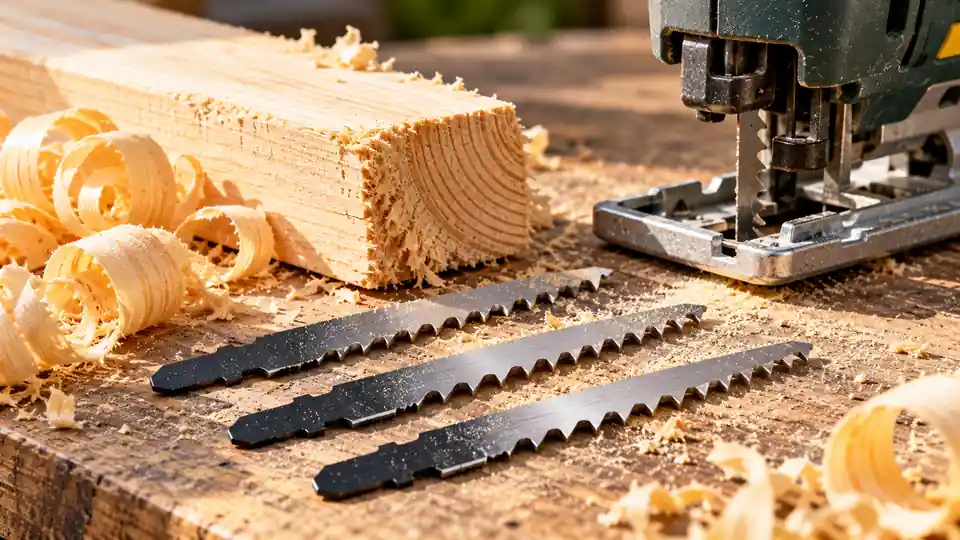
A fast cut through framing lumber, plywood, or a thick shelf blank depends on more than pushing the jigsaw harder. The blade has to match the material, the workpiece thickness, and the saw’s shank system. A coarse 6 TPI blade can move quickly through thick wood, while a finer blade is usually more appropriate for cleaner edges in thinner boards. Choosing the wrong profile can leave a rough edge, wander through the cut, or force you to stop repeatedly for blade changes.
Compatibility is the first checkpoint. Several selections below use a T-shank, while others use a U-shank, and those systems should not be treated as interchangeable without checking the jigsaw’s blade clamp. Blade length matters too. Long T744D and T344D blades are aimed at thicker stock, while shorter 4-inch blades are easier to control in ordinary sheet goods. Tooth count, blade material, intended cut direction, and whether the set includes useful specialty profiles all affect the result.
This comparison focuses on documented fast-cutting characteristics for wood, including coarse tooth profiles, usable blade lengths, wood-specific applications, and practical variety. Some sets are better for a mixed workshop, while others are more focused on straight cuts through thick timber. The selections below show where each blade set fits, along with the compatibility and cut-quality compromises that deserve attention before ordering.
Quick Answer
The EZARC T744D 7-Inch T-Shank Blades are the strongest overall match for fast wood cutting because their 6 TPI profile, long reach, and documented use with thick wood, beams, and planks directly fit the search intent. The 20-Pack T344D Long Blades are a useful alternative for construction timber and wood-core plywood, with a shorter 6-inch format and storage case.
For a broader workshop assortment, the 50-Piece Contractor Set combines several wood profiles with plastic and metal options. Buyers who want a focused straight-cut blade should look at the BOSCH T144D, while the U-shank sets make sense only for jigsaws that accept that interface.
Best Jigsaw Blades for Fast Wood Cutting Comparison Table
| Product | Best For | Shank and Count | Wood-Cutting Focus |
|---|---|---|---|
| EZARC T744D 7-Inch Blades | Thick wood and beams | T-shank, 10 pieces | 6 TPI, 155 mm cutting length |
| 20-Pack T344D Long Blades | Construction timber | T-shank, 20 pieces | 6 TPI, up to 100 mm listed thickness |
| BOSCH T144D | Fast straight cuts | T-shank, 5 pieces | 6 TPI, 3-inch usable length |
| 50-Pack T101BR Blades | Clean straight cuts | T-shank, 50 pieces | 10 TPI, wood and plastic |
| Qjaiune T744D 7-Inch Blades | Long-reach wood cuts | T-shank, 20 pieces | 6 TPI, 155 mm cutting length |
| 50-Piece Contractor Set | Mixed workshop tasks | T-shank, 50 pieces | Multiple wood profiles |
| 10-Piece Assorted T-Shank Set | General-purpose variety | T-shank, 10 pieces | Speed and clean-cut wood profiles |
| 24-Piece U-Shank Set | U-shank saws | U-shank, 24 pieces | 6T through 32T profiles |
| T142HB Flush-Cut Blades | Detailed woodwork | T-shank, 5 pieces | Wood cutting and curved cuts |
The detailed reviews explain how the blade profiles, lengths, shank styles, and stated material applications translate to real woodworking jobs.
1. EZARC T744D 7-Inch T-Shank Jigsaw Blades – Best Overall

The EZARC T744D is the clearest fit for a buyer who wants a jigsaw blade that prioritizes speed through thick wood. Its 6 TPI tooth profile is coarse enough for fast material removal, and the blade has a listed overall length of 180 mm with a 155 mm cutting length. That extra reach is useful for beams, planks, thick boards, and renovation work where a short blade may struggle to maintain engagement.
The product information also identifies hardwood, softwood, construction framing, and some softer composites or plastics as suitable applications. The T-shank interface fits many common jigsaw brands, although the saw itself still needs a compatible clamp. A long blade can make a thick cut possible, but it also demands steady workpiece support and controlled feed pressure, especially during curved cuts.
Pros
- 6 TPI profile is specified for fast wood cutting.
- 155 mm listed cutting length suits thicker stock.
- Intended for hardwood, softwood, beams, and planks.
- T-shank design fits many common jigsaw platforms.
- Can handle some softer composite materials and plastics.
Cons
- Coarse teeth are less suited to polished, fine-finish edges.
- Long blades require more control than short general-purpose blades.
This set suits framing, renovation, demolition preparation, and other jobs where completing the cut quickly matters more than producing a furniture-grade edge straight from the saw. It is a weaker choice for thin decorative panels or delicate trim, where a finer tooth profile would give more control. Check the shank specification before ordering, then pair the blade with firm support beneath the workpiece.
To buy this product, click here.
2. 20-Pack T344D Long Jigsaw Blades – Best for Construction Timber

Construction timber, softwood, chipboard, and wood-core plywood are the stated territory for this T344D set. The 6 TPI profile favors a quick, rough cut, while the 6-inch overall format offers long reach without moving into the extra-long 7-inch class. The listing identifies use in material up to 100 mm thick, which makes these blades relevant for substantial boards and framing pieces.
The thicker-gauge high-carbon steel construction is presented as a durability feature, and the included storage case helps keep a stack of replacement blades from becoming a loose, sharp mess in a toolbox. This is a practical contractor-style selection rather than a precision assortment. A coarse blade may leave more cleanup on visible edges, so it fits structural work better than finish carpentry.
Pros
- 6 TPI tooth pattern targets quick wood removal.
- Listed for timber, softwood, chipboard, and plywood.
- Designed for wood pieces up to 100 mm thick.
- Thick-gauge high-carbon steel construction is documented.
- Storage case keeps replacement blades organized.
Cons
- Primarily a fast straight-cut blade rather than a fine-finish option.
- T-shank compatibility must be confirmed with the saw.
Choose this pack for repeated framing, renovation, or workshop jobs where blades are consumable supplies and a spare is welcome. It offers a sensible middle ground between short standard blades and the longest options here. Buyers cutting cabinets, face frames, or exposed furniture edges should reserve it for rough sizing and switch to a finer blade for the final pass.
To buy this product, click here.
3. BOSCH T144D Speed for Wood Blades – Best for Fast Straight Cuts

The BOSCH T144D takes a more focused approach than the mixed assortments. Its 6 TPI profile is specified for straight, fast cuts in wood, OSB, plywood, particleboard, hardwood, and softwood. The 4-inch overall length includes a listed 3-inch usable length, and the stated application range covers wood from 1/4 inch to 2-3/8 inches thick.
That combination makes the blade easy to place in a common sheet-good workflow. Picture trimming OSB for a rough opening or sizing plywood panels on sawhorses. A short, coarse blade is easier to manage than a long beam-cutting blade in those situations, though the usable length places a limit on thick workpieces. It is a T-shank blade, so the jigsaw’s clamp must support that format.
Pros
- 6 TPI design is specified for fast wood cutting.
- Intended for straight and parallel cuts.
- Suitable for OSB, plywood, particleboard, hardwood, and softwood.
- Published cutting range extends to 2-3/8 inches in wood.
- Short format is practical for ordinary sheet goods.
Cons
- Three-inch usable length is less suitable for very thick beams.
- Fast-cut teeth favor rougher edges than fine woodworking blades.
This is a strong fit for users who want a recognizable, wood-focused blade for repeated straight cuts rather than a drawer full of specialized profiles. It is less compelling for tight curves, ultra-clean laminate work, or unusually thick stock. Keep the blade square to the workpiece and let the teeth clear chips instead of forcing the saw through the cut.
To buy this product, click here.
4. 50-Pack T101BR Contractor Blades – Best for Cleaner Straight Cuts

The T101BR set shifts the balance toward controlled straight cutting. Its 10 TPI configuration is described for hardwood, softwood, laminated boards, fiberboard, and plastic, with a 4-inch overall length. Compared with the 6 TPI selections above, the finer tooth count is a better match for buyers who want to reduce the rough, hungry feel of a coarse construction blade.
High-carbon steel and a thick-gauge design are listed for wood use, while the 50-piece quantity gives workshop users a generous supply of replacements. The product is still intended for speed, but its application language centers on clean and precise straight cuts rather than thick-beam demolition. That distinction matters if the cut edge will remain visible after sanding.
Pros
- 10 TPI profile is suited to controlled wood cuts.
- Listed for hardwood, softwood, laminated boards, and fiberboard.
- Suitable for plastic according to the product information.
- Thick-gauge high-carbon steel construction is specified.
- Large pack provides many replacement blades.
Cons
- Less suited to very thick stock than the long 6 TPI blades.
- Designed for straight cuts rather than specialized tight curves.
This set makes sense for a shop that cuts boards and panels regularly and wants a finer alternative to coarse framing blades. It can be especially useful after rough sizing, when the edge needs less tear-out before sanding. Skip it for deep beams or fast demolition-style cuts, where the shorter length and finer teeth are less appropriate.
To buy this product, click here.
5. Qjaiune T744D 7-Inch Blades – Best for Long-Reach Replacement Supply

These Qjaiune blades share the long-reach T744D format that makes sense for thick wood. The listed overall length is 7 inches, with a 6.1-inch working length, and the 6 TPI pattern is aimed at fast cutting through hardwood, plywood, chipboard, particleboard, fiberboard, and PVC. That gives the set a broad wood-and-plastic remit while keeping the central purpose clear: reach and speed.
A 20-piece supply is convenient for renovation work, where a blade may encounter nails, embedded debris, or simply wear through repeated cuts. The T-shank design installs without screw fixing on compatible saws. Buyers comparing it with the EZARC option should focus on the documented pack size and listed dimensions, then verify that the longer blade is suitable for the intended jigsaw and workpiece.
Pros
- 7-inch overall length provides substantial reach.
- 6.1-inch working length suits thicker material.
- 6 TPI teeth target fast wood cutting.
- Listed for hardwood, plywood, chipboard, and fiberboard.
- 20-piece supply is useful for renovation and repeated work.
Cons
- Long blades can be harder to control in thin material.
- Coarse teeth are unlikely to be the first choice for fine edges.
Use this set for deep cuts where blade length is the main obstacle, such as thick shelving blanks, framing pieces, and renovation lumber. It is less attractive for small craft work, thin trim, or short curved cuts where a compact blade gives better feedback. As with every long blade, secure the stock and avoid twisting the blade through the kerf.
To buy this product, click here.
6. 50-Piece Contractor Jigsaw Blades Set – Best for Mixed Workshop Use
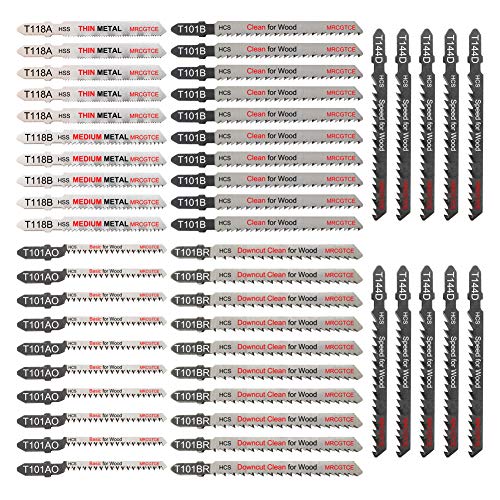
A mixed set is useful beside a jigsaw because wood projects rarely stay with one material. This 50-piece assortment includes T-shank profiles identified as T118A, T118B, T101AO, T101B, T101BR, and T144D. That range covers several wood-cutting approaches, along with options intended for plastic and metal, so a user can move from rough sizing to a finer panel cut without buying every blade separately.
The main advantage is variety rather than a single specialized fast-cut profile. T144D and other coarse wood blades are more relevant to speed, while T101BR and related profiles are aimed at cleaner wood work. A storage case keeps the assortment usable, which matters when an unlabeled pile of blades turns a quick Saturday repair into a rummaging session.
Pros
- Includes several documented T-shank blade profiles.
- Offers both speed-oriented and cleaner wood-cutting options.
- Includes blades for wood, plastic, and metal applications.
- Large 50-piece assortment suits varied workshop tasks.
- Storage case improves organization.
Cons
- Mixed assortments provide fewer specialized blades of one profile.
- Metal-rated blades still require material-specific selection and technique.
This is the practical pick for a household workshop, maintenance toolbox, or maker space where the next cut could involve plywood, plastic, or a thin metal component. It is less focused than a dedicated box of T744D or T344D blades, so professional users who repeatedly cut thick timber may prefer a specialized long-blade supply. Check the profile marking before each job rather than choosing by appearance alone.
To buy this product, click here.
7. 10-Piece Assorted T-Shank Jigsaw Blades – Best Compact Assortment

This compact set is built around recognizable blade codes rather than a single wood profile. It includes T111D, T101AO, T101BR, T101D, T101B, T118A, T118B, T144D, T244D, and T111C. The listing assigns several of those to clean wood, speed wood, basic wood, and basic metal applications, giving the buyer a small cross-section of common jigsaw tasks.
The T-shank interface and high-carbon steel construction suit users who want a backup assortment without storing 50 pieces. For fast wood cutting, the T144D and T111D entries are the most relevant, while the finer or specialty profiles can handle jobs where speed is secondary. Since the set mixes applications, the markings need to be read carefully before cutting.
Pros
- Includes multiple recognized T-shank blade profiles.
- Contains both speed-oriented and clean-cut wood options.
- Compact 10-piece assortment is easy to store.
- Includes blades identified for basic metal work.
- High-carbon steel construction is listed.
Cons
- Small quantity offers less redundancy for frequent cutting.
- Mixed profiles require careful selection for each material.
Choose this set for occasional repairs, new jigsaw owners, or a compact emergency kit. It gives more task coverage than a five-pack of one blade type, though it cannot replace a dedicated thick-wood supply for repeated framing cuts. The variety is useful only if the blade codes remain legible and the saw accepts T-shank blades.
To buy this product, click here.
8. 24-Piece U-Shank Assorted Jigsaw Blades – Best for U-Shank Saws

The key reason to choose this set is its U-shank interface. Buyers with a compatible older or U-shank jigsaw can use the assortment’s range of 6T, 8T, 10T, 14T, 18T, 24T, and 32T profiles for different wood thicknesses and cut priorities. The product information also describes use with plastic and metal, but the fast-wood buyer should first focus on selecting the appropriate coarse or fine tooth option.
High-carbon steel and polished teeth are listed, with the tooth range giving the set more flexibility than a single coarse blade. The tradeoff is compatibility. A U-shank blade should not be assumed to fit a T-shank clamp, and the product’s broad compatibility language does not remove the need to inspect the actual saw manual or blade holder.
Pros
- Designed around the U-shank interface.
- Includes seven listed tooth configurations from 6T to 32T.
- Offers fast and finer cutting choices for wood.
- High-carbon steel construction is specified.
- Also listed for plastic and metal applications.
Cons
- Not a direct choice for a T-shank-only jigsaw.
- Exact saw compatibility must be checked before purchase.
This set is useful when the blade system is the limiting factor and a compatible U-shank saw is already in the shop. It can cover rough wood sizing and more controlled cuts through its tooth range, but it ranks below the T-shank options for general availability and simpler compatibility. Confirm the holder style before opening the package.
To buy this product, click here.
9. T142HB T-Shank Flush-Cut Wood Blades – Best for Detailed Woodwork

The T142HB set brings a more controlled wood-cutting angle to this roundup. Its product information describes an optimized tooth design for fast and smooth cuts in plywood, softwood, and other wood materials, with applications including straight cuts, curved cuts, furniture work, and home renovation. That combination makes it more versatile for shaped pieces than a blade aimed solely at long, rough construction cuts.
High-carbon steel, a T-shank design, and a five-piece format make this a straightforward replacement pack for compatible standard jigsaws. The listing also refers to reduced vibration and cleaner edges, but those outcomes depend on the saw, workpiece support, feed pressure, and material. It is better viewed as a focused wood blade for controlled work than as the fastest option for thick beams.
Pros
- Designed for plywood, softwood, and general wood cutting.
- Suitable for straight and curved cuts according to the listing.
- T-shank design fits compatible standard jigsaws.
- High-carbon steel construction is documented.
- Useful for furniture, renovation, and replacement work.
Cons
- Five-piece pack offers less supply for heavy construction use.
- Available information does not specify TPI or working length.
Pick these blades for detailed DIY work where the path may change from a straight edge to a curve and the workpiece is ordinary plywood or softwood. They are not the most clearly documented choice for maximum-thickness timber because the product specifications do not give a TPI or cutting-length figure. That missing detail makes checking the product dimensions before a demanding cut especially sensible.
To buy this product, click here.
Buying Guide
Match the Tooth Profile to Cutting Speed
Coarse profiles such as the listed 6 TPI T744D, T344D, and T144D blades remove wood quickly and suit thick stock, framing, OSB, and rough sizing. Finer profiles such as the 10 TPI T101BR are more appropriate when the edge matters. Fast cutting still depends on feed rate and workpiece support, so a coarse blade should not be forced through a cut simply because it has fewer teeth.
Use the guidance on choosing an orbital setting to balance cutting speed and edge finish for the chosen blade.
Check Blade Length Against the Workpiece
A blade needs enough usable length to pass through the material while remaining engaged with the saw’s guide and clamp. The EZARC blade lists a 155 mm cutting length, while the BOSCH T144D lists 3 inches of usable length. Longer blades help with thick beams, but they can feel less controlled in thin panels. Match the blade to the actual stock instead of choosing the longest option automatically.
Confirm T-Shank or U-Shank Compatibility
T-shank products dominate this selection, but the 24-piece assortment is U-shank. The two systems should not be treated as interchangeable. Check the jigsaw’s blade clamp, especially with older tools or models that use a screw-secured blade. A physically similar blade can still be unusable if the shank does not lock correctly.
Separate Fast Rough Cuts From Finish Cuts
A blade intended for beams and construction timber is useful for getting a part close to size, but the resulting edge may need sanding or trimming. A finer T101BR profile or a more controlled wood blade can be a better follow-up for visible edges. Mixed sets are valuable because they let one saw handle both stages without relying on one tooth pattern for every job.
Evaluate Assortments by Useful Variety
A larger count does not automatically mean a better set. The 50-piece contractor assortment offers several named profiles, while the 10-piece set provides a smaller selection with speed, clean-cut, and basic metal options. Look at the actual blade codes and applications, not only the number printed on the package. Several near-identical coarse blades may be less useful than a smaller set with distinct cutting roles.
Use Material Claims Carefully
Several products mention plastic or metal alongside wood, but a wood-cutting roundup should still treat those as secondary applications. Metal requires the correct blade profile and suitable operating conditions. A mixed set can help with occasional material changes, yet it should not encourage using a fast wood blade on metal simply because the package lists multiple materials.
Best Jigsaw Blades for Fast Wood Cutting FAQ
Are T-shank blades compatible with every jigsaw?
No. T-shank blades fit many modern jigsaws, but the saw must have a compatible clamp. Older tools may use U-shank or another securing system. Check the tool’s documentation or inspect the blade holder before buying.
Are 6 TPI blades faster for every wood-cutting job?
They are generally intended for fast, coarse cutting, especially in thicker wood, but they are not automatically the best choice for every job. A finer profile can give better control and a more suitable edge in thinner plywood, laminated boards, or visible furniture parts.
Which blades are best for thick wood?
The EZARC T744D, Qjaiune T744D, and T344D selections have the strongest documented match for thick wood because they combine coarse 6 TPI teeth with longer blade formats. Check the actual workpiece thickness, usable blade length, and saw compatibility before cutting.
Can a long jigsaw blade cut curves?
It can, and the EZARC listing specifically describes smooth curve cutting, but blade length alone does not determine turning ability. A long coarse blade may be harder to guide through a tight curve than a shorter, narrower profile. Use the blade intended for the curve size and material.
Is a U-shank blade interchangeable with a T-shank blade?
No assumption should be made. U-shank and T-shank describe different blade interfaces. The U-shank assortment in this roundup is appropriate only for a jigsaw designed to secure that style.
Should I choose a mixed blade set or one dedicated wood blade?
Choose a mixed set if the workshop cuts several materials or needs both rough and cleaner wood profiles. A dedicated T744D, T344D, or T144D pack is more efficient for repeated fast wood cutting because every blade serves the same central task.
Do coarse jigsaw blades leave smooth edges?
Coarse blades prioritize chip removal and speed, so they may leave a rougher edge than finer teeth. Workpiece support, feed pressure, blade sharpness, and the material also affect the result. For visible edges, plan for a finer blade or light finishing work.
Final Verdict
The EZARC T744D is the strongest overall recommendation for fast wood cutting because its documented 6 TPI profile, 155 mm cutting length, and stated use with hardwood, softwood, beams, and planks line up closely with the search intent. The 20-pack T344D is a practical alternative for construction timber and plywood, while the BOSCH T144D is better suited to fast straight cuts in ordinary sheet goods within its listed capacity.
The 50-piece contractor set is the most flexible choice for a mixed workshop, and the T101BR pack is a better fit when cleaner straight cuts matter more than maximum blade reach. The U-shank assortment deserves attention only from buyers with a compatible saw. Before ordering, verify the shank style, compare the usable blade length with the workpiece, and choose tooth geometry based on whether the priority is rapid rough sizing or a more controlled finished edge.
