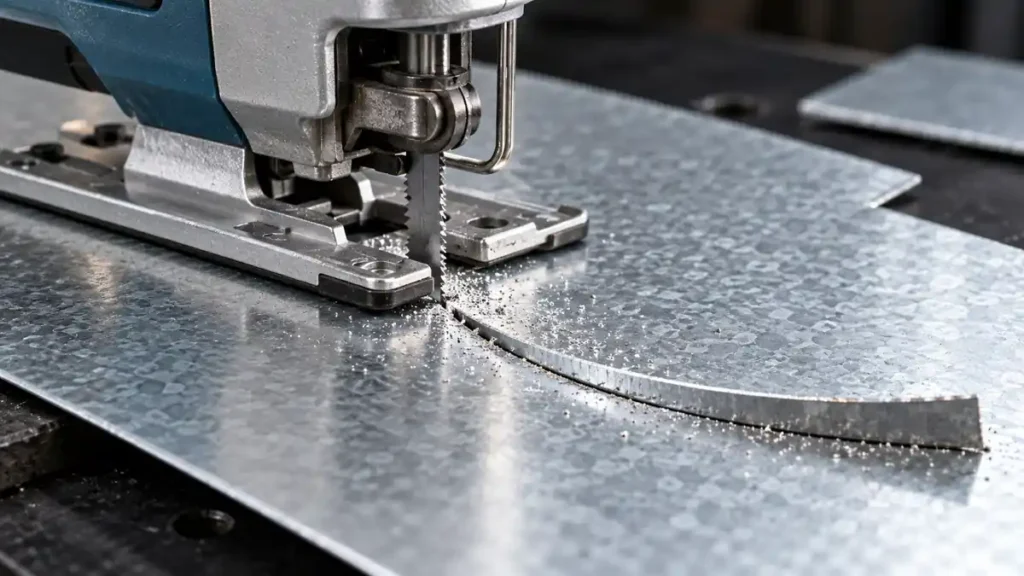
A sheet-metal jigsaw blade needs teeth fine enough to stay engaged in the stock without catching. Material rating and thickness range matter before pack quantity. Thin steel, thicker profiles, and nonferrous sheet can need different tooth designs.
These nine metal-cutting blades or assortments cover different thicknesses and workshop needs. The Bosch T121AF3 is a useful starting point for its named metal application. Choose the fine T118G or Diablo DJT121GF5 when the stock calls for a finer thin-sheet profile.
Quick Answer
Common sheet metal work: BOSCH T121AF3 Speed for Metal Blades. 21
Very thin sheet metal: BOSCH T118G Basic for Metal Blades. 36
Medium metal: Diablo DJT121AF5 Bi-Metal Metal Blades. 21
Best Jigsaw Blades for Sheet Metal Comparison Table
| Product | Best For | Specifications / Compatibility | Key Features |
|---|---|---|---|
| BOSCH T121AF3 Speed for Metal Blades | Common sheet metal work | 10 to 16 gauge, ferrous and non-ferrous | 21 |
| BOSCH T118G Basic for Metal Blades | Very thin sheet metal | 17 to 26 gauge, ferrous and non-ferrous | 36 |
| Diablo DJT121AF5 Bi-Metal Metal Blades | Medium metal | Metal applications listed | 21 |
| Bosch T321AF3 Speed for Metal Blades | Longer cuts and profiles | 10 to 16 gauge, pipes, tube stock | 21 |
| BOSCH T123X Progressor for Metal Blades | Mixed metal thicknesses | Sheet metal up to 8 gauge and other metals | 10 to 24 progressive |
| JMD T118A Metal Cutting Jigsaw Blades | Replacement blade supply | 1 to 3 mm thin sheet metal | 21 |
| 50-Piece Contractor Jigsaw Blade Set | Mixed workshop materials | Includes metal blade types | Varied |
| BOSCH T118A Metal Blades | Best Standard Thin-Metal Blade | T-shank blade | Bosch T118A, fine-tooth metal cutting |
| Diablo DJT121GF5 Thin-Metal Blades | Best Fine-Tooth Thin-Metal Pack | T-shank blade | Diablo DJT121GF5, 30 TPI bi-metal |
1. BOSCH T121AF3 Speed for Metal Blades — Common sheet metal work

A sheet-metal blade has to balance bite and restraint. The Bosch T121AF3 lands in a useful middle ground with 21 TPI teeth, a bi-metal construction, and a 3-5/8-inch overall length. Its published application covers 10 to 16 gauge sheet metal, or roughly 1/16 to 1/8 inch thin metal, in both ferrous and non-ferrous materials. That makes it a practical match for many panels, duct components, brackets, and similar stock.
The blade also uses a backward taper design and tooth geometry described for faster metal cutting. That does not guarantee a particular feed rate or edge finish, but it explains why this option makes more sense for general sheet-metal work than a very fine 36 TPI blade intended for thinner stock. A homeowner trimming a panel and a fabricator making repeated straight cuts may both appreciate the broader thickness range, provided the jigsaw accepts T-shank blades and the workpiece is firmly supported.
Pros
- Listed for 10 to 16 gauge sheet metal.
- Suitable for ferrous and non-ferrous thin metals.
- 21 TPI tooth configuration fits a broad sheet-metal range.
- Bi-metal construction is intended for durability and longer blade life.
- Backward taper design is intended to increase cutting speed.
Cons
- Its 2-5/8-inch working length is shorter than the extended Bosch T321AF3.
- The product information recommends lubricant, which adds preparation to the job.
This is the safest starting point for shoppers who have one sheet-metal project in mind but do not yet know whether a very thin or extra-long blade is more appropriate. It should be skipped for exceptionally thin 17 to 26 gauge stock if minimizing tooth snagging is the priority, where the T118G is more specifically matched. For ordinary thin steel or aluminum, however, the combination of documented material range, TPI, and bi-metal construction gives it the strongest overall fit in this group.
To buy this product, click here.
2. BOSCH T118G Basic for Metal Blades — Very thin sheet metal
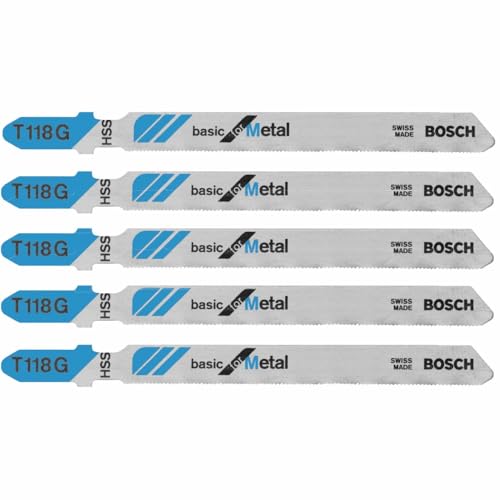
When a sheet is thin enough to flex beneath the shoe of a jigsaw, tooth count becomes especially meaningful. The Bosch T118G is listed for 17 to 26 gauge sheet metal and very thin ferrous or non-ferrous material from 1/64 to 3/64 inch thick. Its 36 TPI pattern is considerably finer than the 21 TPI blades elsewhere in this roundup, giving it a more specialized role for delicate stock.
The 3-5/8-inch blade has a 2-5/8-inch working length and uses high-speed steel with wavy, milled teeth. The listing identifies it for straight cuts, so it should not be treated as a tight-radius scrolling blade. Picture a small metal enclosure or thin flashing panel that needs a controlled opening. This is the type of job where a fine metal blade makes more sense than reaching for a coarse multipurpose option, although lubricant and steady support still matter.
Pros
- Specifically listed for 17 to 26 gauge sheet metal.
- Suitable for very thin ferrous and non-ferrous metals.
- 36 TPI teeth are matched to thin material.
- High-speed steel construction is intended for straight-cut life.
- Compatible with Bosch and other T-shank or combination T-U shank jigsaws, according to the listing.
Cons
- Its intended thickness range is too narrow for thicker sheet metal.
- Designed for straight cuts rather than tight curves.
Choose this five-piece pack when the workpiece is genuinely thin and prone to vibration. It is a poor substitute for a 21 TPI blade on 10 to 16 gauge material, where the finer teeth may make the cut feel unnecessarily slow. Buyers with mixed sheet thicknesses may prefer the Bosch T121AF3, but for thin panels this is the more precisely targeted choice.
To buy this product, click here.
3. Diablo DJT121AF5 Bi-Metal Metal Blades — Medium metal

Diablo positions the DJT121AF5 for medium metal, with 21 TPI teeth on 3-5/8-inch T-shank blades. The listing describes a bi-metal design, an ultra-hardened cutting edge, and a tooth configuration intended for metal applications. Those details place it alongside the Bosch T121AF3 as a general-purpose candidate for sheet-metal work, though the product specifications do not give the same specific 10 to 16 gauge range.
The compatibility description says the blades fit all combo and most U-shank cordless and corded jigsaws. That wording still deserves a check against the actual blade holder on your tool. A T-shank blade may fit many modern jigsaws, but a broad listing claim should not override the tool manufacturer’s requirements. For a metalworker who values a five-blade pack and wants a bi-metal option for medium stock, this is a reasonable alternative when the intended thickness falls within the product’s documented metal category.
Pros
- 21 TPI configuration is intended for medium metal applications.
- Bi-metal construction is specified.
- Ultra-hardened cutting edge is listed for demanding applications.
- Five blades provide replacements for repeated work.
- T-shank design supports many compatible cordless and corded jigsaws.
Cons
- Check a precise sheet-metal gauge range for the exact product configuration.
- Compatibility wording should be checked against the particular jigsaw holder.
This blade set suits shoppers who want a specialized metal blade without moving to the longer T321AF3. It is less compelling for extremely thin sheet metal because the product is described for medium metal rather than 17 to 26 gauge stock. It also lacks the explicit thickness detail that makes the Bosch T121AF3 easier to match, so confirm the workpiece range before ordering.
To buy this product, click here.
4. Bosch T321AF3 Speed for Metal Blades — Longer cuts and profiles
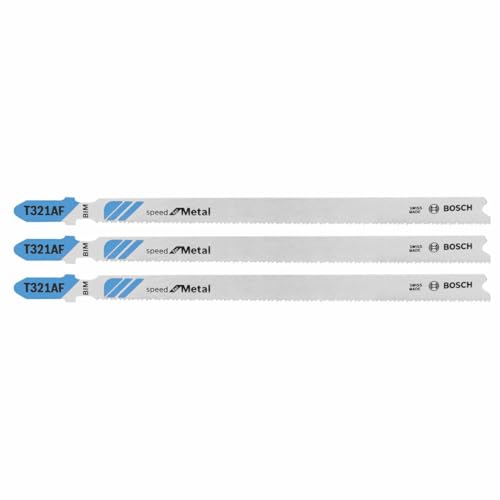
A longer blade can be useful when a project involves more than a flat panel. The Bosch T321AF3 has a 5-1/4-inch overall length and a 4-1/4-inch working length, substantially longer than the 3-5/8-inch blades in this group. Its listed applications include 10 to 16 gauge sheet metal, thin metal from 1/16 to 1/8 inch, pipes under 2-1/2 inches in diameter, tube stock, and angle iron.
The 21 TPI tooth design is aimed at smooth, fast cuts, while the bi-metal construction is specified for durability. Longer reach does not automatically mean better control, and a long blade can be unnecessary for a small sheet-metal opening. Still, if the job moves from flat stock to profiles or shallow pipe, having 4-1/4 inches of working length gives this blade a useful advantage. Lubricant is recommended for metal cutting, so the surrounding setup remains important.
Pros
- 4-1/4-inch working length provides extended reach.
- Listed for 10 to 16 gauge sheet metal.
- Suitable for pipes, profiles, tube stock, and angle iron.
- 21 TPI teeth are intended for smooth, fast metal cuts.
- Bi-metal construction is specified.
Cons
- Longer length may be unnecessary for small, thin sheet-metal openings.
- The pack contains three blades, fewer than several shorter-blade alternatives.
This is the sensible pick for a project that mixes sheet metal with profiles or tubing. It may be more blade than needed for delicate panels, where a shorter fine-tooth blade can be easier to control. Check the jigsaw’s clearance and T-shank requirements before buying, then support the workpiece carefully so the extra length does not introduce unwanted movement.
To buy this product, click here.
5. BOSCH T123X Progressor for Metal Blades — Mixed metal thicknesses

The Bosch T123X takes a broader approach than a fixed-pitch sheet-metal blade. Its progressive tooth design spans 10 to 24 TPI, and the listing describes use with thin metal, pipes, profiles, sheet metal up to 8 gauge, stainless steel from 1/16 to 1/8 inch, non-ferrous metal from 5/64 to 3/4 inch, plastics, and fiberglass. That range makes it the most versatile metal-oriented product in this selection, although broad capability also means the buyer has more material and thickness variables to manage.
The 4-inch overall length leaves 3 inches of working length, and the HSS construction is listed for long life. For a repair drawer that may see a thin panel one day and a small metal profile the next, the Progressor format is convenient. It should not be mistaken for a dedicated fine-tooth blade for the thinnest sheet, and the product’s wide application range does not establish identical cut quality across every listed material.
Pros
- Progressive 10 to 24 TPI design covers varied material thicknesses.
- Listed for sheet metal up to 8 gauge.
- Includes applications for stainless steel and non-ferrous metal.
- 3-inch working length suits a range of metal jobs.
- Five-piece pack provides replacement blades.
Cons
- Its broad application range is less specialized than a dedicated thin-sheet blade.
- Check one precise sheet-metal gauge range for every cut for the exact product configuration.
Choose this option when the workshop sees changing materials and thicknesses rather than one repeated sheet-metal task. A buyer cutting only very thin 17 to 26 gauge stock should look first at the T118G. Someone who needs one metal blade family for panels, profiles, and selected non-ferrous work may find the progressive design more useful.
To buy this product, click here.
6. JMD T118A Metal Cutting Jigsaw Blades — Replacement blade supply

Some sheet-metal jobs consume blades through repeated cuts, setup mistakes, or simple wear. The JMD T118A pack contains 30 T-shank blades, each described as a 75 mm, 21 TPI HSS blade for thin sheet metal from 1 to 3 mm. The blades use milled, wavy-set teeth and are intended for straight cuts, giving this pack a clear role as a supply-focused option.
The storage tube is a small but useful detail in a busy workshop. A handful of loose metal blades can disappear beneath sanding discs and offcuts, while a dedicated container keeps replacements together. The product listing says the blades fit most current jigsaws, but shoppers should still verify the tool’s T-shank requirement. The 1 to 3 mm range also needs attention because it overlaps some, but not all, common sheet-metal thicknesses.
Pros
- 30-piece pack supplies many replacement blades.
- 21 TPI design is intended for thin sheet metal.
- HSS construction is specified.
- Milled, wavy-set teeth are intended for straight metal cuts.
- Storage tube helps organize the blades.
Cons
- The intended application is limited to 1 to 3 mm sheet metal.
- Designed for straight cuts rather than detailed curved work.
This pack fits a workshop that values quantity and performs frequent straight cuts in thin, solid sheet. It is less suitable when you need a finely defined gauge range, a longer blade, or a specialty configuration for stainless steel. Confirm the actual material thickness and T-shank compatibility before committing to the larger pack.
To buy this product, click here.
7. 50-Piece Contractor Jigsaw Blade Set — Mixed workshop materials
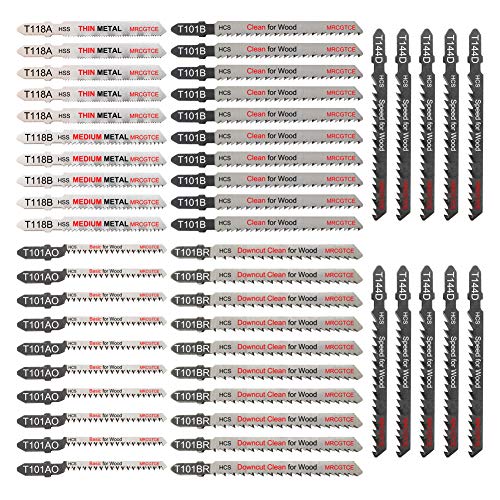
A mixed blade set can be handy when sheet metal is only one part of the job. This 50-piece contractor assortment includes T118A and T118B metal blade types alongside blades identified for wood and plastic. The included storage case gives the set a practical workshop role, especially for someone cutting a metal panel one afternoon and plywood or plastic on another day.
The tradeoff is specificity. The product specifications do not provide a complete gauge range, individual blade materials, exact tooth counts for every included type, or a precise breakdown of how many blades are intended for metal. That makes it harder to match the set to a demanding sheet-metal project than the dedicated Bosch and Diablo options. It is best viewed as a broad starter or backup assortment, not as a precision-selected metal blade collection.
Pros
- Includes T118A and T118B metal blade types.
- Contains blades for wood, plastic, and metal applications.
- 50-piece assortment provides many replacements.
- Storage case keeps different blade types together.
- T-shank format is suited to compatible jigsaws.
Cons
- Check full metal-blade quantity for the exact product configuration.
- It lacks the detailed sheet-metal thickness guidance provided by dedicated metal blades.
This set makes sense for a general-purpose workshop where a jigsaw handles several materials and the buyer accepts less precise metal guidance. For one important steel-cutting project, a dedicated blade with a documented gauge range is the more careful purchase. Keep the different blade types separated in the case so a wood blade does not accidentally end up in a metal job.
To buy this product, click here.
8. BOSCH T118A Metal Blades — Best Standard Thin-Metal Blade

The T118A is a fine-tooth metal-cutting blade for supported thin sheet. Its high-speed-steel construction and closely spaced teeth serve a different job from a coarse wood blade. The T-shank fits compatible clamps, making it a straightforward material-specific replacement when a general set has worn out its metal blade. Use it within the blade’s specified metal and thickness range, and keep the sheet clamped close to the line to limit chatter.
Choose this blade for the named material and cutting style. Match the usable length to the workpiece and fit it only to a compatible blade clamp. A supported workpiece and controlled feed help the blade follow the marked line.
Pros
- Fine-tooth metal profile
- High-speed-steel construction
- Fits compatible T-shank clamps
- Useful for thin-sheet straight cuts
Cons
- Not a wood or scrolling blade
- Blade rating must match the metal thickness
The BOSCH T118A Metal Blades is the best standard thin-metal blade in this comparison. Its bosch t118a, fine-tooth metal cutting make it worth considering when those features match your next project.
To buy this product, click here.
9. Diablo DJT121GF5 Thin-Metal Blades — Best Fine-Tooth Thin-Metal Pack

The DJT121GF5 uses a 30 TPI bi-metal design in a 3-5/8-inch blade. The fine tooth pattern is intended for thin-metal cutting, where a coarse blade can catch rather than maintain a smooth engagement. This five-pack gives you replacements for repeated sheet work. Choose it for the thin-metal application named on the pack, then match speed and support to the stock. Its material rating and tooth spacing matter more than simply choosing whichever blade is already fitted to the saw.
Choose this blade for the named material and cutting style. Match the usable length to the workpiece and fit it only to a compatible blade clamp. A supported workpiece and controlled feed help the blade follow the marked line.
Pros
- 30 TPI thin-metal profile
- Bi-metal construction
- Five-blade pack
- T-shank for compatible clamps
Cons
- Fine teeth are not for fast rough wood cutting
- Thin sheet still needs close support
The Diablo DJT121GF5 Thin-Metal Blades is the best fine-tooth thin-metal pack in this comparison. Its diablo djt121gf5, 30 tpi bi-metal make it worth considering when those features match your next project.
To buy this product, click here.
Buying Guide
Match the named material
Use a blade rated for the actual board, not just one that fits the clamp. Material-specific tooth construction matters in abrasive boards.
Use the guide to metal blade selection by alloy and thickness before choosing a tooth profile for the stock.
Check usable length
The blade must clear the full thickness throughout its stroke. Overall length and usable cutting length are different measurements.
Support the edge and waste
Clamp and support the material with clearance below the blade. A supported exit helps prevent the last section from breaking away.
Use the correct speed and feed
Follow the blade and saw recommendations. A suitable sharp blade and deliberate feed are more useful than forcing the teeth through the work.
Frequently Asked Questions
Does T-shank fit every jigsaw?
No. It fits compatible T-shank clamps. Check an older or unusual saw before ordering.
Will any carbide blade cut this material?
No. Carbide construction alone does not define the application. Match the named material and thickness rating.
Can I use a longer blade to increase saw capacity?
No. Stay within the tool’s rated capacity and choose sufficient usable blade length for the workpiece.
Final Verdict
BOSCH T121AF3 Speed for Metal Blades is the common sheet metal work pick. 21
For very thin sheet metal, consider BOSCH T118G Basic for Metal Blades. 36
