Explore the accessories and practical techniques that can help you get more from a jigsaw. This section covers cutting guides, splinter guards, blade changes, straight and curved cuts, bevel adjustments, and common cutting problems. Whether you’re learning the basics or working through a particular challenge, you’ll find explanations focused on tool setup, compatibility, and practical cutting considerations.
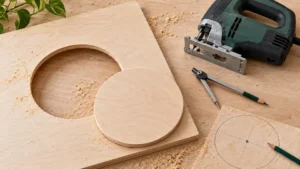
To cut a circle with a jigsaw, establish the required finished diameter, choose a blade that can turn within that radius and support both the retained piece and the waste. A compatible pivot guide can control the saw’s path, but […]
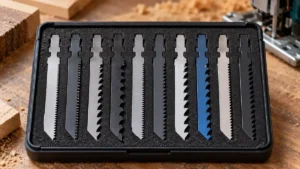
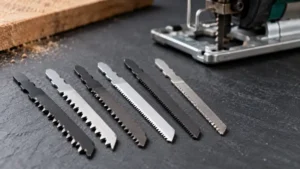
A U-shank jigsaw blade set can save an otherwise useful older jigsaw from sitting idle, but the shank is only the first checkpoint. Buyers also need a sensible mix of tooth counts, material guidance, blade quantity, and storage. A set […]
Orbital action on a jigsaw adds a forward-and-back movement to the blade’s normal up-and-down stroke. With orbital action engaged, the blade follows a slightly elliptical or pendulum-like path. It moves forward into the material during the cutting stroke and retreats […]
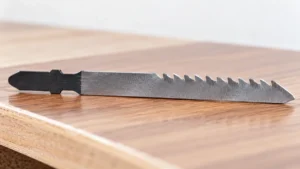
A good T-shank jigsaw blade set can turn a frustrating cut into a clean, controlled pass, but the right choice depends heavily on the material and cut shape. A blade for a quick plywood rip has a very different job […]
A reverse-cut jigsaw blade changes the cutting direction to help protect an upper decorative face. The blade still needs to match the saw clamp and material, and the shoe must remain firmly supported. Some finish blades use opposing tooth directions […]
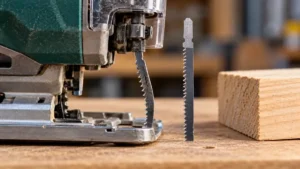
A jigsaw blade usually bends because it is being pushed forward or sideways faster than it can cut. Other common causes include a blade that is too narrow or flexible for the job, a tight turning radius, thick material, dull […]
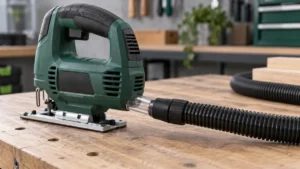
A jigsaw dust-extraction setup needs three compatible connections: the saw’s collection fitting, the hose interface and an extractor suitable for the material. A blower only moves debris away from the cutting line; it does not collect it. Before buying adapters, […]
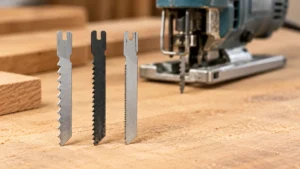
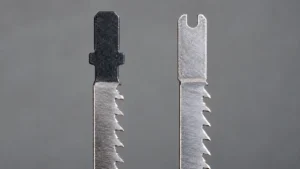
T-Shank and U-Shank jigsaw blades use different interfaces for attaching the blade to the saw. A T-Shank has lateral tabs near the top that engage with a compatible blade clamp. A U-Shank has a U-shaped cutout at its upper end […]
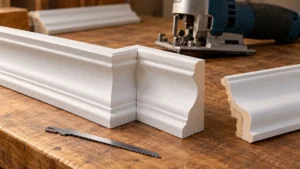
Coping molding with a jigsaw means following the profile of one piece while removing material behind the visible edge so it fits against the face of the adjoining piece. The clean front arris makes the joint; the back relief provides […]
A jigsaw can turn a sheet of plywood into a curved panel, trim a countertop opening, or slice through thin metal, but the blade decides whether that cut feels controlled or turns into a rough, wandering chore. Buyers searching for […]